Friday, 30 November 2012

Blessed Bernardo de Hoyos: "The Spouse of Christ"

In Catholic spiritual tradition, there is an important and honoured place for the idea of "The Bride of Christ". At one level, we are taught to think of the Church as a whole as such a bride of Christ, and the wedding at Cana as a metaphor for the marriage of Christ to his bride, the Church. At another level, religious women think of themselves as forgoing human marriage, to become brides of Christ. The image is a powerful and valuable one, in developing that personal relationship with the Lord that we seek - but where does it leave men, who may find it difficult to imagine themselves as brides?


Surprisingly perhaps, Catholic tradition provides an equivalent route for men - at least, for gay men, and others who are not threatened by thoughts of homoerotic attraction. Gerald Loughlin has described a medieval German tradition in which the wedding at Cana was seen as celebrating the wedding of Christ and his "beloved disciple" (assumed to be John the Evangelist). St John of the Cross used extensive homoerotic imagery in his mystical writing. Blessed Bernardo de Hoyos combined both of these ideas, taking them to their logical conclusion. As Kittredge Cherry noted at Jesus in Love blog, in a valuable post for his feast day (yesterday, November 29th), Blessed Bernardo saw himself, in a mystical vision, as marrying Christ - as a man, becoming not a bride, but a "Groom of Christ".
Always holding my right hand, the Lord had me occupy the empty throne; then He fitted on my finger a gold ring.... “May this ring be an earnest of our love. You are Mine, and I am yours. You may call yourself and sign Bernardo de Jesus, thus, as I said to my spouse, Santa Teresa, you are Bernardo de Jesus and I am Jesus de Bernardo. My honor is yours; your honor is Mine. Consider My glory that of your Spouse; I will consider yours, that of My spouse. All Mine is yours, and all yours is Mine. What I am by nature you share by grace. You and I are one!”
(quoted at Jesus in Love from “The Visions of Bernard Francis De Hoyos, S.J.[Image]” by Henri Bechard, S.J.)
Kittredge observes, quite correctly,
While the Catholic church refuses to bless same-sex marriages, the lives and visions of its own saints tell a far different story -- in which Christ the Bridegroom gladly joins himself in marriage with a man.
Michael Bayley at the Wild Reed, who drew my attention to Kittredge's post, thinks that we should declare Bernardo the patron saint of Catholic for Marriage Equality, MN. Why not the patron saint of marriage equality - period?

Tuesday, 27 November 2012

Harvey Milk

b. May 22, 1930
d. November 27, 1978

Harvey Milk became the first openly gay person to be elected to a significant public office when he was elected to the San Francisco Board of Supervisors in 1977. He served eleven months before he was assassinated.

"The important thing is not that we can live on hope alone, but that life is not worth living without it."
Harvey Milk was a New Yorker who migrated to San Francisco in the 1970's, when an influx of gay immigrants from across the country was changing the Castro neighborhood into the city's gay village. Milk opened a camera store and founded the Castro Valley Association of local merchants. His willingness to represent the interests of local merchants with city government earned him the unofficial title of "the Mayor of Castro Street." Milk discovered that he had a natural flair for politics.
Milk was a political outsider and a populist who made his own rules. From his shop in the Castro, he ran grassroots campaigns based on relentless meetings, door-to-door canvassing, and media interviews. His supporters formed "human billboards" by standing along major thoroughfares holding placards. Milk's first three tries for office were unsuccessful, but they gave him increasing credibility with the electorate.
When Milk was elected to the San Francisco Board of Supervisors in 1977, a lesbian wrote, "I thank God I have lived long enough to see my kind emerge from the shadows and join the human race."
Milk was shot to death in his City Hall office on Nov. 27, 1978, by Dan White, a conservative anti-gay former supervisor who also murdered Mayor George Moscone. White was convicted of manslaughter and sentenced to five years imprisonment. City-wide violence erupted in San Francisco when White's sentence was announced.
Harvey Milk had forebodings of his assassination. He left a tape-recorded "political will" naming his preferred successor on the Board of Supervisors. On that tape he said: "If a bullet should enter my brain, let that bullet destroy every closet door."
Bibliography:
DVD

Friday, 9 November 2012

Nov 9th: St. Matrona/Babylas of Perge

St Matrona /Babylas of Perge is one of a number of female saints in the early church who dressed as men to be admitted to all-male monasteries. The stories and motives of these women are remote from our time, and 'transvestite' is not to be confused with 'transgendered'. Still, whatever the full historic truth, it seems to me these are useful stories to hold on to as reminders of the important place of the transgendered, and differently gendered, in our midst. Many of us will remember how difficult and challenging was the process of recognising, and then confronting, our identities as lesbian or gay, particularly in the context of a hostile church. However difficult and challenging we may have found the process of honestly confronting our sexual identities, consider how much more challenging must be the process of confronting and negotiating honestly a full gender identity crisis. Their stories collectively also carry a sobering reminder of the differing regard given by society of the time to male and female lives - else why would women have sought out male monasteries, in spite of the risks and discomfort to themselves of their lives in disguise, if not expectation of some greater spiritual reward than in a female convent? 

Our Holy Mother Matrona (492 AD):
She was from Perga in Pamphylia, and married very young, to a youth named Domitian, to whom she bore a daughter. The couple settled in Constantinople. Matrona became so constant in attending all-night vigils in the city's many churches that her husband suspected her of infidelity and forbade her to go out. This was unbearable to Matrona, who fled the house with her daughter. Determined to embrace monastic life, she gave her daughter into the care of a nun named Susanna, disguised herself as a eunuch, and entered the monastery of St Bassian (October 10) under the name of Babylas. Though she amazed all with her zeal and ascetic labors, Bassian one day discerned that she was a woman. Though he reprimanded her severely because of her zeal, he was unwilling to drive her away from monastic life because of her zeal; so he directed her to go to Emesa in Syria to enter a certain women's monastery there.
  Matrona continued to advance in the virtues, and once healed a blind man by anointing his eyes with myrrh from the head of St John the Baptist (which had been miraculously discovered around that time). The miracle became widely-known, and because of it Matrona's husband learned of her whereabouts. When he came to her monastery she escaped to Jerusalem, but he pursued her there too. She fled from place to place, even living for several years in an abandoned pagan temple in Beirut, where she was constantly assaulted by the demons that inhabited the place. In time several pagan women, seeing her struggles, asked to be her disciples, and a small monastic community sprang up in the pagan temple. After a few years she and her disciples made their way back to to Constantinople, where St Bassian received her joyfully and helped her to establish a monastery. There she was visited by the Empress Verina, wife of Leo the Great, and many other noblewomen of the City, some of whom left all to join Matrona in monastic life. Saint Matrona lived to be almost one hundred years old and reposed in peace, having foretold the day of her death. 
Enhanced by Zemanta

Thursday, 1 November 2012

Nov Ist : All (Gay) Saints

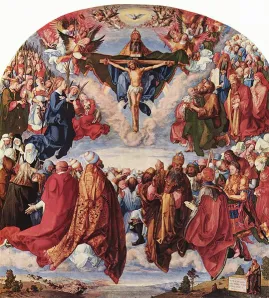
Are there gay saints? Some sources say clearly yes, listing numerous examples. Others dispute the idea, saying either that the examples quoted are not officially recognised, or denying that they were gay because we do not know that they were sexually active. Before discussing specifically LGBT or queer saints, consider a more general question. Who are the “Saints”, and why do we recognise them
?All Saints Albrecht  Dürer
Richard McBrien gives one response, at NCR on-line:
There are many more saints in heaven than the relatively few who have been officially recognized by the church. “For every St. Francis of Assisi or St. Rose of Lima there are thousands of unknown and long forgotten mothers and fathers, sisters and brothers, grandmothers and grandfathers, aunts and uncles, cousins, friends, neighbors, co-workers, nurses, teachers, manual laborers, and other individuals in various kinds of occupations who lived holy lives that were consistent with the values of the Gospel of Jesus Christ. “Although each is in eternal glory, none of their names is attached to a liturgical feast, a parish church, a pious society, or any other ecclesiastical institution. The catch-all feast that we celebrate next week is all the recognition they're ever going to receive from the church.” “The church makes saints in order to provide a steady, ever renewable stream of exemplars, or sacraments, of Christ, lest our following of Christ be reduced to some kind of abstract, intellectual exercise.
Two things are important here: the category of saints is far larger than just those who have been recognised by a formal process; and the reason for giving them honour is to provide role models. It is not inherent to the tradition of honouring the saints that they should be miracle workers, or that we should be praying to them for special favours – although three officially attested miracles will help the formal canonization process. This formal process did not even exist in the early church: it was only in the 11th or 12 the century that saint making became the exclusive preserve of the Pope. It now becomes easier to make sense of the gay, lesbian and transvestite saints in Church history, and their importance.
For some, their official recognition is not important – all that counts is their value as role models. If they are widely seen as such, we are entitled to call them so, even without clear canonized status.

Their sexual conduct (celibate or non-celibate) is equally irrelevant to the label “gay.” There are some notable monks and priests who had deep, emotionally intimate love affairs with men but were known to remain celibate. This does not change their orientation, making them gay, any more than a celibate heterosexual is somehow not straight. With that out of the way, it becomes possible to recognise (and welcome)a wide range of lesbigaytrans saints in Christian and Jewish history, from Biblical times to the 21st century. It is important that we do so, to remind ourselves that we have always been a part of the church, that we have not always been rejected by the religious bigots, and that we can live lives of honour and holiness within the truth of who we are.

Some examples to think about:
David and Jonathan: A well-known story of biblical same-sex love. The possible sexual nature of this love is disputed : but this story, and that of Ruth & Naomi, remain the longest love stories told in Scripture
Ruth & Naomi: See above SS Sergius & Bacchus Roman soldiers, lovers and martyrs. These are the best known of the gay saints , and are often regarded as patronal saints by gay Christians.
Felicity & Perpetua. Two Roman women martyred together, they are often named as counterparts to Sergius & Bacchus
St Paulinus of Nola, gay Bishop. Paulinus is well accepted as a recognised Catholic saint, with entries in all the standard Catholic reference books recording his ministry and hsi highly regarded poetry. What these don't tell you, is that some of this was erotic love poetry addressed to his boyfriend.


Some Modern Saints (discussed at "Jesus in Love " blog)

Fr Mychal Judge (NY fire service Catholic chaplain, died in twin towers.)
Matthew Shepard: Modern Gay Martyr (Murdered in hate crime. Now remembered in Mathew Shephard Crimes Bill)

Previous posts (at Queering the Church):

Other Sites:

Tuesday, 30 October 2012

David Morley, Twice Martyred Gay Barman?

Saint Sebastian is unique among the recognized saints of the church for having been martyred not once, but twice. In the modern context, perhaps we can say the same of David "Sinders" Morley. Working and well-known as a gay barman, there is no doubt at all that Morley was openly gay. Living openly, he was bearing witness to the possibility of living honestly and openly as a gay man in London. In 1999, it almost cost him his life - and may have done five years later, in 2004.


On 30th April, 1999, Morley was on duty at the Admiral Duncan pub in London's Old Compton Street when it was hit by a nail bomb attack, which killed three people and wounded about 70 others. Morley was injured, not killed, and ignoring his own burns, he set about helping others who were more seriously wounded as best he could.

Five years later, he was killed in a late night assault, which may have been prompted by homophobia, by a group of teenagers outside Waterloo station.

Religious leaders who rant about the supposed "evils" of same-sex love need to know that this is irresponsible. Such talk promotes hatred, hatred breeds violence.

Enhanced by Zemanta

Ramon Navarro ( 1899 – 1968), Victim of the Catholic Closet.

Ramon Navarro was once the leading Latin actor in movies after the death of Rudolph Valentino, starring in several major silent films and early talkies, in the late 1920's and early 1930's. He was killed on October 30th by two sex-workers he had hired from an agency,  in attempt to extort from him some of his perceived, but non-existent wealth. I see this tragic death as a sad symbol of the dangers of life in the closet, which had been forced on him by the twin pressures of his conflicts over sexuality and this Catholicism, and the constraints of the Hollywood publicists.


Those of us who are able to live out and proud in spite of the Vatican's disordered sexual teaching, are able to form sound, healthy and adult relationships. Those who live in the closet are forced to live alone in solitude, or in sham marriages - such as the system of lavender marriages imposed by Hollywood on its sex-symbol gay and lesbian stars.   

Some Catholics living alone will attempt to live a strictly celibate life in accordance with Catholic teaching - some may even succeed. Many others straddle an uneasy divide, between attempted celibacy, and sexual encounters in the closet. Especially for older men, sometimes the only feasible outlets are the seedier ones, in public toilets, or with commercial trade.  Both can be dangerous.

Ramon Navarro resisted the Hollywood pressure to enter a Hollywood marriage, and for a time was able to sustain a meaningful, but closeted relationship with his publicist, Herbert Howe, until the latter's death in 1959.

Some years later, in October 1969, he hired two brothers, Paul and Tom Ferguson (aged 22 and 17, respectively), to come to his home for sex.  Mistakenly believing that there was a large sum of money in the house, the two then assaulted and tortured Navarro for some hours, hoping to force him to reveal the whereabouts of the cash. They eventually left with just $20. Navarro died of asphyxiation, having choked on his own blood.

It is probable that what most offends opponents of the "gay lifestyle" is its association in their minds with the kind of anonymous, impersonal sexual activities that take place in public toilets, backroom bars and in commercial transactions. What they fail to observe, is that these are less typical of gay men in open and publicly affirmed partnerships, than of those who remain closeted. 

The best way to reduce the seedier, and more dangerous, elements in gay lives, is to support marriage equality.


Raymond Navarro. Wikipedia
Film Actors, Gay Male, glbtq encyclopedia
Enhanced by Zemanta

Saturday, 27 October 2012

Allen R Schindler Jr,. Naval Gay Martyr

Radioman Petty Officer Third Class in the United States Navy. On October 27, 1992, he was killed in a public toilet in Sasebo, Nagasaki, Japan by shipmate Terry M. Helvey, who acted with the aid of an accomplice, Charles Vins, in what Esquire called a "brutal murder". Schindler was gay, and had previously complained to naval authorities of harassment, including death threats in comments such as "There's a faggot on this ship and he should die". Conscious of the dangers to his personal safety, he had begun separation process to leave the Navy, but his superiors insisted he remain on his ship until the process was finished.  The good military man that he was, he obeyed orders, and remained in the Navy, waiting to be discharged. Instead, he was murdered for being gay - a modern gay martyr, killed for not hiding his sexuality.


Prior to the attack, President Bill Clinton had promised to sign an executive order to permit gay service members to serve openly in the military - but did not keep his promise. Perhaps it was encouragement from this suggestion of a change in the military climate that encouraged him to complaint to his chain of command, but if so his action backfired badly. Instead of protection from dismissal, his commanding officer simply threatened him with a dishonourable discharge - and within days, news of the complaint, and with it confirmation that he was indeed gay, was public knowledge all over the ship.

On the day of the attack, Helvey and Vins had purchased (between just two people) two large bottles of whiskey, a bottle of schnapps, a bottle of vodka, orange juice and a six-pack of beer and went drinking in a park, where they saw Schindler, and followed him into a public restroom. In a completely unprovoked attack, Helvey assaulted Schindler with fists and feet, leaving him so badly mutilated that medical evidence described the body as similar in its wounds to those that might be sustained by being stomped on by a horse, or from a high speed car crash, or even in a low speed aircraft accident. The body was so badly mutilated, that Schindler's family were unable to recognize him, except by tattoo marks on his arms.

During the trial Helvey denied that he killed Schindler because he was gay, stating, "I did not attack him because he was homosexual" but evidence presented by Navy investigator, Kennon F. Privette, from the interrogation of Helvey the day after the murder showed otherwise. "He said he hated homosexuals. He was disgusted by them," Privette said. On killing Schindler, Privette quoted Helvey as saying: "I don't regret it. I'd do it again. ... He deserved it."


After his death, the naval authorities that had failed to protect him, continued to behave shamefully, initially denying that they had received any complaints of harassment. They refused to speak publicly about the case or to release the Japanese murder report, and were "less than forthcoming" even to Schindler's mother.

Truth however, will out. Helvey and Vins eventually faced a trial in open court. Helvey received a life sentence for murder, and Vins served a 78-day sentence before receiving a general discharge from the Navy in plea bargain to lesser offences, including failure to report a serious crime and to testify truthfully against Terry Helvey. The captain who kept the incident quiet was demoted and transferred to Florida.

The case was one of the impulses to the passing of "Don't Ask, Don't Tell", which for all its manifest faults, was initially an attempt to provide some form of protection to gays and lesbians in the military (provided they "didn't tell".


(Also see Kittredge Cherry's reflection at Jesus in Love, and a wonderful painting of The Murder of Allen Schindler by Matthew Wettlaufer)

 Sources:

Allen J Schnidler, Wikipedia,
Allen Schindler, in memoriam, at Auschwitz.dk
Allen R. Schindler, Jr.,Petty Officer Third Class, United States Navy at Matt and Andrej Koymasky's Memorial Hall


Enhanced by Zemanta