Showing posts with label lesbian saints. Show all posts

Thursday, 1 November 2012

Nov Ist : All (Gay) Saints

Are there gay saints? Some sources say clearly yes, listing numerous examples. Others dispute the idea, saying either that the examples quoted are not officially recognised, or denying that they were gay because we do not know that they were sexually active. Before discussing specifically LGBT or queer saints, consider a more general question. Who are the “Saints”, and why do we recognise them
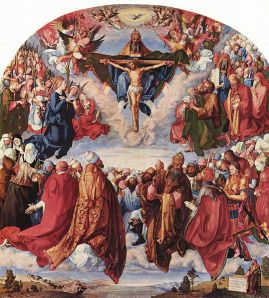
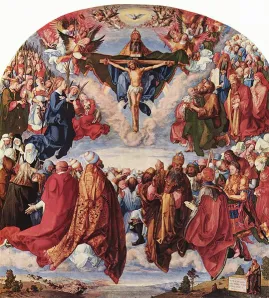
?All Saints Albrecht  Dürer
Richard McBrien gives one response, at NCR on-line:
There are many more saints in heaven than the relatively few who have been officially recognized by the church. “For every St. Francis of Assisi or St. Rose of Lima there are thousands of unknown and long forgotten mothers and fathers, sisters and brothers, grandmothers and grandfathers, aunts and uncles, cousins, friends, neighbors, co-workers, nurses, teachers, manual laborers, and other individuals in various kinds of occupations who lived holy lives that were consistent with the values of the Gospel of Jesus Christ. “Although each is in eternal glory, none of their names is attached to a liturgical feast, a parish church, a pious society, or any other ecclesiastical institution. The catch-all feast that we celebrate next week is all the recognition they're ever going to receive from the church.” “The church makes saints in order to provide a steady, ever renewable stream of exemplars, or sacraments, of Christ, lest our following of Christ be reduced to some kind of abstract, intellectual exercise.
Two things are important here: the category of saints is far larger than just those who have been recognised by a formal process; and the reason for giving them honour is to provide role models. It is not inherent to the tradition of honouring the saints that they should be miracle workers, or that we should be praying to them for special favours – although three officially attested miracles will help the formal canonization process. This formal process did not even exist in the early church: it was only in the 11th or 12 the century that saint making became the exclusive preserve of the Pope. It now becomes easier to make sense of the gay, lesbian and transvestite saints in Church history, and their importance.
For some, their official recognition is not important – all that counts is their value as role models. If they are widely seen as such, we are entitled to call them so, even without clear canonized status.

Their sexual conduct (celibate or non-celibate) is equally irrelevant to the label “gay.” There are some notable monks and priests who had deep, emotionally intimate love affairs with men but were known to remain celibate. This does not change their orientation, making them gay, any more than a celibate heterosexual is somehow not straight. With that out of the way, it becomes possible to recognise (and welcome)a wide range of lesbigaytrans saints in Christian and Jewish history, from Biblical times to the 21st century. It is important that we do so, to remind ourselves that we have always been a part of the church, that we have not always been rejected by the religious bigots, and that we can live lives of honour and holiness within the truth of who we are.

Some examples to think about:
David and Jonathan: A well-known story of biblical same-sex love. The possible sexual nature of this love is disputed : but this story, and that of Ruth & Naomi, remain the longest love stories told in Scripture
Ruth & Naomi: See above SS Sergius & Bacchus Roman soldiers, lovers and martyrs. These are the best known of the gay saints , and are often regarded as patronal saints by gay Christians.
Felicity & Perpetua. Two Roman women martyred together, they are often named as counterparts to Sergius & Bacchus
St Paulinus of Nola, gay Bishop. Paulinus is well accepted as a recognised Catholic saint, with entries in all the standard Catholic reference books recording his ministry and hsi highly regarded poetry. What these don't tell you, is that some of this was erotic love poetry addressed to his boyfriend.


Some Modern Saints (discussed at "Jesus in Love " blog)

Fr Mychal Judge (NY fire service Catholic chaplain, died in twin towers.)
Matthew Shepard: Modern Gay Martyr (Murdered in hate crime. Now remembered in Mathew Shephard Crimes Bill)

Previous posts (at Queering the Church):

Other Sites:

Wednesday, 7 March 2012

SS. Perpetua and *Felicity, martyrs, 07/03

"Felicitas Perpetua" = eternal bliss - and also the names of the two saints the Catholic Church remembers and celebrates every year on March 7, SS Felicity and Perpetua, who were martyred together in Carthage in 203. Their story is not well known, but their names are familiar to older Catholics as one of a few same sex couples that were once listed in the Eucharistic Prayer of the Mass. These paired names are an echo of their place in the ancient rite of adelphopoeisis (literally, "making of brothers"), the liturgical rite once used to bless same sex unions in Church.
As two women martyred together, and from the kiss of peace which they exchanged at the end, they are frequently described as a lesbian counterpart to Sergius and Bacchus. This is inaccurate. Their relationship was not primarily one of lovers in the modern sense, but of mistress and slave. But that description is also inaccurate to modern ears, as it overlooks the very different status of women,and the very different nature of marriage relationships, in Roman times. In the journal kept by Perpetua (from which we know the story), she never once even mentions her husband. It is entirely possible (even probable?) that whatever the nature of her sexual life, Perpetua's emotional involvement with Felicity may have been more important than her relationship with her husband.

Monday, 1 November 2010

Nov 1st: All (Gay) Saints

Today is the feast of All Saints.  For us as gay men, lesbians in the church, this begs the obvious questions: are there gay saints?  Does it matter?
Some sources say clearly yes, listing numerous examples. Others dispute the idea, saying either that the examples quoted are not officially recognised, or denying that they wer gay because we do not know that they were sexually active.  Before discussing specifically LGBT or queer saints, consider a more general question.
Who are the “Saints”, and why do we recognise them?
All Saints Albrecht  Dürer
All Saints : Albrecht Dürer
Richard McBrien gives one response, at NCR on-line:
There are many more saints in heaven than the relatively few who have been officially recognized by the church.
“For every St. Francis of Assisi or St. Rose of Lima there are thousands of unknown and long forgotten mothers and fathers, sisters and brothers, grandmothers and grandfathers, aunts and uncles, cousins, friends, neighbors, co-workers, nurses, teachers, manual laborers, and other individuals in various kinds of occupations who lived holy lives that were consistent with the values of the Gospel of Jesus Christ.
“Although each is in eternal glory, none of their names is attached to a liturgical feast, a parish church, a pious society, or any other ecclesiastical institution. The catch-all feast that we celebrate next week is all the recognition they're ever going to receive from the church.”
“The church makes saints in order to provide a steady, ever renewable stream of exemplars, or sacraments, of Christ, lest our following of Christ be reduced to some kind of abstract, intellectual exercise.
Two things are important here, especially at this feast of "all" saints: the category of saints is far larger than just those who have been recognised by a formal process; and the reason for giving them honour is to provide role models. It is not inherent to the tradition of honouring the saints that they should be miracle workers, or that we should be praying to them for special favours – although officially attested miracles are part of the canonization process. This formal process did not even exist in the early church:  it was only in the 11th or 12 the century that saint making became the exclusive preserve of the Pope.
It now becomes easier to make sense of the gay, lesbian and transvestite saints in Church history, and their importance for the feast of All Saints.