Showing posts with label LGBT. Show all posts

Saturday, 8 December 2012

James Stoll, Unitarian Pioneer of LGBT Inclusion in Church

Rev. James Lewis Stoll, who died on December 8th 1994, was a Unitarian Universalist minister who became the first ordained minister of any religion in the United States or Canada to come out as gay. He did so at the annual Continental Conference of Student Religious Liberals on September 5, 1969 in La Foret, Colorado. Later, he led the effort that convinced the Unitarian Universalist Association to pass the first-ever gay rights resolution in 1970. 


After training at Starr King School for the Ministry, in Berkeley, followed by ordination, he served as pastor at a church in Kennewick, Wash., from 1962 until 1969. For reasons that have not been disclosed, he was asked to resign, and then moved to San Francisco, where he shared an apartment with three others.

In September of 1969, he attended a convention of college-age Unitarians in Colorado Springs. One evening after dinner, he stood up and came out publicly as a gay man. He declared his orientation, stated that it was not a choice, that he was no longer ashamed of it, and that from then on, he would refuse to live a lie.
“On the second or third night of the conference,” according to Mr. Bond-Upson, “after dinner, Jim got up to speak. He told us that he’d been doing a lot of hard thinking that summer. Jim told us he could no longer live a lie. He’d been hiding his nature — his true self — from everyone except his closest friends. ‘If the revolution we’re in means anything,’ he said, ‘it means we have the right to be ourselves, without shame or fear.'
“Then he told us he was gay, and had always been gay, and it wasn’t a choice, and he wasn’t ashamed anymore and that he wasn’t going to hide it anymore, and from now on he was going to be himself in public. After he concluded, there was a dead silence, then a couple of the young women went up and hugged him, followed by general congratulations. The few who did not approve kept their peace.” ’
After the convention, Stoll wrote articles on gay rights, and preached sermons on the subject at several churches. The following year, the full annual meeting of the Unitarian Universalist Association passed a resolution condemning discrimination against homosexual persons, beginning a gradual but irresistible move towards full LGBT inclusion.  

No action was ever taken by the church against Stoll, and so he remained a minister in good standing, but he was never again called to serve a congregation. It is not clear whether this had anything to do with lingering prejudice against his orientation. It could also be on the grounds of some suspicions of drug abuse, or of inappropriate sexual behaviour.

Later, he founded the first counseling center for gays and lesbians in San Francisco. In the 1970s he established the first hospice on Maui. He was president of the San Francisco chapter of the American Civil Liberties Union in 1990s. He died at the age of 58 from complications of heart and lung disease, exacerbated by obesity and a life-long smoking habit

Stoll's name is not well known today, but for this brave and honest public witness, he deserves to be better remembered.In declaring himself, he was not the first ordained clergyman to come out, but he was the first to do so voluntarily, and the first in an established denomination. His action undoubtedly made it easier for the others who followed him, and to the formal acceptance by the Unitarians of openly gay men and lesbians in the church, and to the now well-established process to full LGBT inclusion in so many denominations.

He was not a Catholic, but in Catholic tradition today would be considered his "die natalis", or day of new birth in Christ. Remember him.

Source:
Haunted Man of the Cloth, Pioneer of Gay Rights (NY Times)
Enhanced by Zemanta

Friday, 9 November 2012

Nov 9th: St. Matrona/Babylas of Perge

St Matrona /Babylas of Perge is one of a number of female saints in the early church who dressed as men to be admitted to all-male monasteries. The stories and motives of these women are remote from our time, and 'transvestite' is not to be confused with 'transgendered'. Still, whatever the full historic truth, it seems to me these are useful stories to hold on to as reminders of the important place of the transgendered, and differently gendered, in our midst. Many of us will remember how difficult and challenging was the process of recognising, and then confronting, our identities as lesbian or gay, particularly in the context of a hostile church. However difficult and challenging we may have found the process of honestly confronting our sexual identities, consider how much more challenging must be the process of confronting and negotiating honestly a full gender identity crisis. Their stories collectively also carry a sobering reminder of the differing regard given by society of the time to male and female lives - else why would women have sought out male monasteries, in spite of the risks and discomfort to themselves of their lives in disguise, if not expectation of some greater spiritual reward than in a female convent? 

Our Holy Mother Matrona (492 AD):
She was from Perga in Pamphylia, and married very young, to a youth named Domitian, to whom she bore a daughter. The couple settled in Constantinople. Matrona became so constant in attending all-night vigils in the city's many churches that her husband suspected her of infidelity and forbade her to go out. This was unbearable to Matrona, who fled the house with her daughter. Determined to embrace monastic life, she gave her daughter into the care of a nun named Susanna, disguised herself as a eunuch, and entered the monastery of St Bassian (October 10) under the name of Babylas. Though she amazed all with her zeal and ascetic labors, Bassian one day discerned that she was a woman. Though he reprimanded her severely because of her zeal, he was unwilling to drive her away from monastic life because of her zeal; so he directed her to go to Emesa in Syria to enter a certain women's monastery there.
  Matrona continued to advance in the virtues, and once healed a blind man by anointing his eyes with myrrh from the head of St John the Baptist (which had been miraculously discovered around that time). The miracle became widely-known, and because of it Matrona's husband learned of her whereabouts. When he came to her monastery she escaped to Jerusalem, but he pursued her there too. She fled from place to place, even living for several years in an abandoned pagan temple in Beirut, where she was constantly assaulted by the demons that inhabited the place. In time several pagan women, seeing her struggles, asked to be her disciples, and a small monastic community sprang up in the pagan temple. After a few years she and her disciples made their way back to to Constantinople, where St Bassian received her joyfully and helped her to establish a monastery. There she was visited by the Empress Verina, wife of Leo the Great, and many other noblewomen of the City, some of whom left all to join Matrona in monastic life. Saint Matrona lived to be almost one hundred years old and reposed in peace, having foretold the day of her death. 
Enhanced by Zemanta

Saturday, 27 October 2012

Desiderius Erasmus of Rotterdam

Erasmus, born on the 27th October 1466, was a Dutch humanist and theologian,  who merits serious consideration by queer people of faith.

Born Gerrit Gerritszoon, he became far better known as Desiderius Erasmus of Rotterdam: Erasmus was his saint's name, after St. Erasmus of Formiae; Rotterdam, for the place of his birth (although he never lived there after the first few years of early childhood; and "Desiderius" a name he gave himself - "the one who is desired".

Erasmus, the "gay icon"?

Some LGBT activists have hailed Erasmus as a gay icon from history. Circa Club for instance has no doubt, using that precise term and including Erasmus in it's collection of historical gay icons. The primary basis of the claim is a series of passionate love letters he wrote to  a young monk Servatius Roger, and  allegations of improper advances made to the young Thomas Grey, later Marquis of Dorset, while employed as his tutor.
Others are unconvinced, pointing out that the nature of friendship between men, and the form of expressions of affection between them, were very different in Erasmus' day to ours. They also point out that there were never any direct allegations of physical relations with Grey, or with anyone else. This argument largely rests on the assumption that in a time of marked public opposition (and official persecution) of  "sodomy", any suggestion of homosexual intercourse would have provoked strong denunciation and even prosecution. I am not convinced by either side.

Erasmus was certainly not "gay" in any modern sense. The use of the term "gay icon" for any man of the Renaissance period, and particularly for a priest, is clearly anachronistic, and inappropriate. It is also true that expressions of "love" in the letters to Servatius may be no more than expressions of Platonic affection, expressed a little more effusively (but not much more so) than was customary at the time. We cannot say for certain that he was sexually active with men.

But the absence of proof also does not disprove the hypothesis. As a priest, Erasmus was expected to be celibate. There is also no evidence of sexual relations with women, but that does not disprove that he was heterosexual. The claims that the strong climate of opposition to sodomy "would have" resulted in public exposure are also invalid. Over several centuries, thousands of "sodomites" were tried and executed - but the meaning of the term was vague and variable, including everything from "unnatural" (i,e, anal or oral) intercourse between husband and wife, to witchcraft and heresy, to treason. In post-Reformation England, it was even sometimes used interchangeably with "popery", as Catholicism was also viewed as treason against the English monarchy. In fact, many of those convicted may have been the victims simply of malice and grossly unfair criminal procedures, and completely innocent of sexual non-conformity - and very many more who were indeed engaging in homosexual activities were left entirely unhindered.

The matter of Erasmus' sexual activities is at best undecided - and also irrelevant. To focus on "did he or didn't he" is to make the mistake of the homophobes, who are convinced that homoerotic relationships are all about genital sex. It is enough for me to note that whatever the physical relationship may or may not have been, there was a definite, powerful and emotionally intimate relationship between Erasmus and Serviatus.
I also like this quotation, from his "In praise of marriage":
I have no patience with those who say that sexual excitement is shameful and that venereal stimuli have their origin not in nature, but in sin. Nothing is so far from the truth. As if marriage, whose function cannot be fulfilled without these incitements, did not rise above blame. In other living creatures, where do these incitements come from? From nature or from sin? From nature, of course. It must be borne in mind that in the appetites of the body there is very little difference between man and other living creatures. Finally, we defile by our imagination what of its own nature is fair and holy. If we were willing to evaluate things not according to the opinion of the crowd, but according to nature itself, how is it less repulsive to eat, chew, digest, evacuate, and sleep after the fashion of dumb animals, than to enjoy lawful and permitted carnal relations?
-In Praise of Marriage (1519), in Erasmus on Women (1996) Erika Rummel

Erasmus, the scholarly reformer.

It is not his sexuality that most impresses me, but his legacy as a scholar and church reformer. His career spanned the years leading up to, and after, Luther's break with the Catholic Church that became the Protestant Reformation. Prior to the split, Erasmus had himself been fiercely critical of the Church, arguing forcefully for reform of the many and manifold abuses. He had close relationships with Luther and many other leading members of the Reformation movement, which his ideas strongly influenced. However, when the break came, he chose to remain formally inside the church structures, and not outside of it.

LGBT Christians are often attacked by others for remaining inside a religion which is seen as inimical to gay interests, and so to be siding with the enemy of gay liberation, but this is simplistic. Erasmus' response to the reformers was that it was the abuses that needed to be destroyed, not the church itself - an argument that applies equally strongly to the situation today, in respect of sexuality. The restricted, misguided view of sexuality promoted by some claiming the authority of religion, is not inherent in the Christian religion, but has been imposed on it to promote a particular heterosexual agenda. It is this abuse that we must oppose, not Christianity.

In doing so, we should also learn from Erasmus' methods. Among his criticisms of the Church was its heavy dependence on medieval scholastic theology, with its elaborate structure of speculative philosophy. Instead, he went back to the sources, to build his theology on a sounder structure of evidence. Recognizing the inadequacies of the Latin Vulgate bible, he devoted himself to the study of Greek, and eventually published a more reliable Latin translation (which came to replace the Vulgate, with a parallel Greek text), He also wrote a series of treatises on several of the church fathers.

Queer theologians today are doing something similar. Instead of sitting back meekly and accepting the received ideas on the Bible's supposed condemnation of homosexuality, they have gone back to the roots of Biblical scholarship, closely studying the texts in the original Hebrew and Greek, and paying close attention to the full literary analysis and contextual considerations. They have demonstrated the weaknesses of the traditional interpretations, and have earned the concurrence of many heterosexual colleagues. This reassessment of the Biblical evidence has been one of the important factors in the present moves to greater LGBT inclusion in church, as pastors or in rites for recognizing same-sex unions. Other theologians have resisted the received opposition by ignoring scholastic monolith, and going back to the source of the Christian religion - Christ himself, as revealed in the Scriptures. Others again, emphasise the importance of a personal relationship with God, through prayer, in place of unthinking deference to the human authority of clerical oligarchs.

Erasmus, the man in the middle.

In the build-up to the Reformation, Erasmus aimed to avoid taking sides in the split. His thinking was a definite influence on the reformist cause,  and was later accused of having "laid the egg that hatched the Reformation". His response was that he had hoped it would lay a different bird. He worked hard to retain good relationships with both sides and to keep the peace between them, but in the end, his reward was to be viewed with some suspicion and resentment by both sides. By Catholics, for having fostered the reformist thinking in the first place, and by Reformists for having deserted them at the end.

Queer people of faith will sympathise. We too aim to straddle two camps- and are frequently attacked from both sides: by some traditionalists Christians for our supposed sexual sin, and by secular gay activists for siding with the enemy,

May the example of Desiderius Erasmus sustain us in our endeavour.


Books:
Bray, AlanThe Friend

Related articles at Queering the Church, and at Queer Saints and Martyrs:

Sunday, 7 October 2012

Sergius & Bacchus, October 7th: Patron Saints of Gay Marriage?

Sergius and Bacchus are by a long way the best known of the so-called gay or lesbian saints - unless we include as "saints" the biblical pairs David and Jonathan, and Ruth and Naomi.  We need to be careful with terminology though: the word "gay" can be misleading, as it certainly cannot be applied with the same connotations as in modern usage, and technically, they are no longer recognised as saints by Western church, as decreed by the Vatican - but they are still honoured by the Orthodox churches, and by many others who choose to ignore the rulings of Vatican bureaucrats. The origins of saint-making lay in recognition by popular acclaim, not on decision by religious officials.

Whatever the quibbles we may have, they remain of great importance to modern queer Christians, both for their story of religious faith and personal devotion, and as potent symbols of how sexual minorities were accepted and welcomed in the earliest days of the Christian community.

They are particularly important in the movement to marriage equality, for their significance in early rites of blessing same-sex unions in church, which may point a way to making a modern provision for something similar without necessarily changing the traditional understanding of church marriage to that between a man and a woman - with its link to child-bearing.

(And, as I have written before, I have a very special personal connection with this pair of early saints and martyrs for the faith. Like so many queer Catholics, it never occurred to me that there could even exist gay or lesbian Catholics until I heard of SS Sergius and Bacchus. Some months after first hearing of them, I read their story in John Boswell, and wondered when was their feast day. I investigated - and found by wonderful serendipity that it was that very day. That began for me a continuing exploration of the other LGBT saints, of the rest of gay history in the churches, of more general gay and lesbian theology - and  this blog. By further serendipity, I discovered this week that today, the feast day of Sergius and Bacchus, is also the birthday of  - Dan Savage, well known for his work to combat homophobic teen bullying.  If Serge and Bacchus may be regarded as patrons saints of gay adults, is Dan Savage a modern patron saint of gay teens?).
A modern icon of Saints Sergius and Bacchus by...
A modern icon of Saints Sergius and Bacchus by the gay, Franciscan iconographer Robert Lentz (Photo credit: Wikipedia)

The Lovers' Story

Sergius and Bacchus were third /fourth century Roman soldiers, and lovers. This alone is worth noting in any discussion of homoerotic relationships and the early Christians: in the Roman world, as in most of the Mediterranean region, such relationships were commonplace. What mattered in questions of sexual ethics and social approval (or otherwise) had little to do with the gender of the partners, but with their respective social status.

They were of high social standing, good enough to have a close personal relationship with the emperor, Tertullian. This provoked jealousy. They were also Christians, which gave their enemies a useful pretext to denounce them to the Emperor. He ordered them to offer sacrifice to the Roman gods, which they refused to do. Their refusal provoked the wrath of the emperor, who began to exact a series of penalties, culminating in the sentence of death. The first to be killed was Bacchus, who was flogged to death. Serge was subjected to further torture, before being killed himself. The fifth century "Passion of Sergius and Bacchus" describes many details, and also some supposed miraculous interventions, such as the dead Bacchus appearing to Sergius in a vision, where he admonished his partner for grieving, and promised that they would soon be together again:
Why do you grieve and mourn, brother? If I have been taken away from you in body, I am still with you in the bond of union, chanting and reciting, "I will run the way of thy commandments, when thou shall enlarge my heart".  
Boswell makes two points about the trial and passion of Sergius and Bacchus that are especially relevant to their significance for queer Christians: in all the legal and theological arguments over the charges against them, the matter of their relationship was simply not an issue. The complaint was that they had refused to honour pagan gods. Their sexuality was of no consequence at all. Later, when the Greek hagiographer has the dead Bacchus appear to Sergius to comfort him with the prospect of paradise, the greatest joy of the promised afterlife is to be reunited with his male lover. Neither the Roman jurists, nor the fifth century Christian writer who recorded the passion, have anything at all to say against the relationship - and the Christian celebrates the quality and value of their love.

Sergius and Bacchus & Gay Marriage

It is simply historically untrue that marriage has always been between one man and one woman, or that same-sex marriage is a modern invention. Among many counter-examples that easily disprove that belief, is the tradition of liturgical blessings, in church, of same-sex unions as described by the ground-breaking historical work of John Boswell. While these were not in any way an exact counterpart to modern marriage (nor were heterosexual unions from the same period), they do no need to be considered carefully in modern responses in faith to the questions around marriage and family equality. Sergius and Bacchus are significant here, for being mentioned by name in many of the liturgies for these rites that have survived, along with numerous other, less familiar examples of same-sex couples from church history.

There are also surviving texts of ancient and medieval hymns to the couple. Boswell quotes one from the sixth century, which has the opening verse ,
Of Serge and Bacchus,
the pair
filled with grace
,

let us sing, O ye faithful!
Glory to Him who worketh
through his saints
amazing and wonderful deeds! 
The full hymn is too long to quote here in full, but one verse in particular emphasises the importance of their mutual devotion:
It was not desire for this world
that captivated Serge for Christ,
nor the empty life of worldly affairs
[that captivated] Bacchus;
rather, made one
as brethren
in the bond of love
they called out valiantly to the tyrant,
"See in two bodies
one soul and and heart,
one will and virtue.
Take those that yearn to please God.
Glory to Him who worketh
through his saints
amazing and wonderful deeds!
The words "made brethren" in this verse are a reference to the literal translation of the greek name for the rite, that of "making brothers".  This has been taken by some commentators as disproving Boswell's claim that these rites have any connection to marriage, and are instead simply a joining in spiritual brotherhood. (A claim that Boswell himself anticipated and countered in the text himself).

Whatever the original connotation of the words though, that there was some concept of marriage involved is clearly shown by another hymn from the ninth century, quoted and discussed at "Obscure Classics of Latin Literature", on a page for Carolingian poetry.

Hymn of SS. Sergius and Bacchus

– spuriously attributed to Walahfrid Strabo (c. 808 – 849 CE)
I. O ye heavens, draw up the marriage contract as our voices resound with odes
And let us make manifest the gracious rewards of the Lord.
We who are below shall celebrate the saints with an illustrious hymn
From our very hearts.

II. Holy martyrs shining by virtue of your merits, Sergius and Bacchus,
As partners you wear God's crown, you have transcended
Together the enclosure of the flesh; and now you are
Above the stars.
"O ye heavens, draw up the marriage contract" seems pretty explicit, to me.

Glory to Him who worketh
through his saints
amazing and wonderful deeds!


Indeed.

(At Jesus in Love, Kittredge Cherry has a fascinating post on depictions of Sergius and Bacchus in art, featuring in particular a wonderful stained glass window of the pair, at St. Martha’s Church in Morton Grove, Illinois. This was donated to the church by its LGBT parishioners, and is believed to be the only representation of them in any United States Church).

Books

Boisvert, Donald: Sanctity And Male Desire: A Gay Reading Of SaintsCatholic Saints Books)

Boswell, John: Same-Sex Unions in Premodern Europe

Jordan, Mark: Authorizing Marriage?: Canon, Tradition, and Critique in the Blessing of Same-Sex Unions

O'Neill, Dennis: Passionate Holiness: Marginalized Christian Devotions for Distinctive People

O'Sullivan, Andrew: Same-Sex Marriage: Pro and Con: A Reader

Related articles

Enhanced by Zemanta

Monday, 17 September 2012

Hildegard of Bingen

Hildegard's name is one to be reckoned with. Although today we usually use the term "Renaissance Man" to indicate one with a wide range of learning to his credit, perhaps we should also recognize in a similar way some extraordinary medieval women -such as Hildegard, and others who entered convents and applied themselves with distinction to learning over many fields.

Even in some distinguished company, Hildegard stands out. Her music is highly regarded, as are her literary output and her mystical writings - which of course is what makes her particularly honoured inside the church. To round out her skills, she was also recognized as a notable poet, artist, healer and scientist.  What makes her of particular interest at this site, is that she also had an intense attachment to a fellow nun, Richardis, who may have inspired some of her finest writing.


I have known a little (very little) about Hildegard for some time, and have come across suggestions of her possible lesbianism, but have not had enough knowledge to write about her myself. I was delighted then to find that my colleague Kittredge Cherry has done some digging, and produced a wonderful extended post on this great woman. As one of Kitt's readers put it in a comment,

Monday, 27 August 2012

Modern Heroes: Del Martin & Phyllis Lyon

Del Martin 
 
b. May 5, 1921
d. August 27, 2008
 
Phyllis Lyon 
 
b. November 10, 1924

"Two extraordinary people ... that have spent the greater part of a half century ... fighting for their right to live the way so many of us, frankly, take for granted."
 San Francisco Mayor Gavin Newsom
Wedding of Del Martin and Phyllis Lyons, 2008


Del Martin and Phyllis Lyon founded the first lesbian organization in the United States and have fought for more than 50 years for the rights of lesbians and gays. On June 16, 2008, Martin and Lyon became the first gay couple to be legally married in California.

Martin and Lyon both earned degrees in journalism. While working as journalists in Seattle, the two became romantically involved. The couple relocated to San Francisco and moved in together on Valentine’s Day 1953.

In 1955, finding it hard to develop a social network in San Francisco, Martin, Lyon and a small group of women founded the first lesbian organization, called the Daughters of Bilitis. The name was inspired by Pierre Louys’s “Songs of Bilitis,” a collection of poems celebrating lesbian sexuality.

Though it was intended to be a secret society, Martin and Lyon wanted to make the Daughters of Bilitis more visible. The group began publishing a monthly magazine, called The Ladder, which was the first-ever lesbian publication. As editors of the magazine, they capitalized the word “lesbian” every time it appeared.

In 1964, while fighting to change California sex laws criminalizing homosexuals, the couple joined religious and gay community leaders to form the Council on Religion and the Homosexual (CRH). This organization was at the forefront of the movement to gain religious support on gay rights issues. Both women served on the founding CRH board of directors.

In 2004, when gay marriage was offered in San Francisco, Martin and Lyon were the first to wed. A California appellate court ruling subsequently invalidated their marriage. Then in May 2008, a California Supreme Court decision provided same-sex couples the right to marry. On June 16, 2008, they were the first same-sex couple married in California. The wedding was officiated by San Francisco Mayor Gavin Newsom.

Martin and Lyon have published two books together, “Lesbian/Woman” (1972) and “Lesbian Love and Liberation” (1973). On their 50th anniversary, the documentary “No Secret Anymore: The Times of Del Martin and Phyllis Lyon” premiered. In 2005, the National Gay and Lesbian Journalists Association inducted Martin and Lyon into the LGBT Journalists Hall of Fame for their pioneering work on The Ladder. In 2007, they received the 2007 Gay and Lesbian Alliance Against Defamation (GLAAD) Pioneer Award.

Bibliography
Del Martin & Phyllis Lyon.” (The Lesbian, Gay, Bisexual and Transgender Religious Archives Network).

Kornblum, Janet. “Gay Activists Blaze Trail for half century.”  USA Today. March 4, 2004


Streitmatter, Rodger.  “Phyllis Lyon & Del Martin.”  National Lesbian & Gay Journalists Association: LGBT Journalists Hall of Fame.  June 5, 2008

Articles
Gordon, Rachel. “Lesbian Pioneer Activists See Wish Fulfilled.” San Francisco Chronicle. June 16, 2008

Marshall, Carolyn. “Dozens of Gay Couples Marry in San Francisco Ceremonies.” The New York Times. February 13, 2004

McKinley, Jesse. “Same-Sex Marriages Begin in California.” The New York Times. June 17, 2008

Books
Lesbian/Woman (1972)
Lesbian love and liberation (The Yes book of sex) (1973)
Battered Wives (1976)

Other Resources


Enhanced by Zemanta

Saturday, 21 July 2012

SS Symeon of Emessa and John: Hermits, Saints and Lovers


The information for this pair of same sex lovers is sparse, but the story important.  I quote directly from the LGBT Catholic Handbook Calendar of gay & lesbian saints :
"The story itself is about a same-sex relationship. Symeon..and John.... meet on a pilgrimage to Jerusalem. They become friends and "would no longer part from each other". In fact they abandon their families and go together to dedicate their lives to God. In the monastery they first join, they are tonsured by the abbot who blesses them together (Krueger 139-141, 142). This seems to refer to some early monastic version of the adelphopoiia ceremony."
Twenty nine years later, they part and their stories diverge. Simeon wants to leave John, as he had earlier left his wife, and becomes know as a "fool for Christ".  But:
The extent of the relationship is revealed at this point. John is not keen for Symeon to leave. He says to Symeon "…...Please, for the Lord's sake, do not leave wretched me….Rather for the sake of Him who joined us, do not wish to be parted from your brother. You know that, after God, I have no one except you, my brother, but I renounced all and was bound to you, and now you wish to leave me in the desert, as in an open sea. Remember that day when we drew lost and went down to the Lord Nikon, that we agreed not to be separated from one another. Remember that fearful day when we were clothed in the holy habit, and we two were as one soul, so that all were astonished at our love. Don't forget the words of the great monk…Please don't lest I die and God demands an account of my soul from You."
Halsall states clearly that this was not a sexual relationship, but it is clearly an emotionally intimate, same sex relationship.  At a time when "marriage" did not carry the same meaning that it has today;  when many religious married couples, even outside holy orders, were encouraged to remain celibate;  and given that they had entered a monastery before living together as  hermits, this is unremarkable.

But as an intimate relationship over nearly thirty years, consecrated by the abbot in a rite of  adelphopoiia, their story, vague and indistinct as it is, must surely be taken as yet another dimly remembered tale of  gay lovers, buried in the history of the Christian Church, that modern scholarship is beginning to uncover.
Their feast days are celebrated together on 21 st July (Orthodox calendar).
Enhanced by Zemanta

Friday, 22 June 2012

St. Paulinus of Nola, bishop 22/06

Although some would dispute the description of Paulinus as 'gay', the description seems to me entirely appropriate to his sensibility. Although history records no evidence of physical expression of his same sex attraction, nor is there any evidence against it.  Given the historical context he was living in (4th/5th century Roman empire) , when sex with either gender was commonplace for men at at all levels of society, inside and outside the Christian church, the absence of written records of private activities after 15 centuries is completely unremarkable.  Nor is the fact that he was married particularly significant - for Romans, marriage and sex with men were entirely compatible.  

Tuesday, 8 May 2012

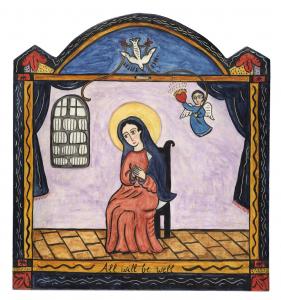
All Will be Well, and All Shall Be Well: Julian of Norwich, 8th May

There is no way that we should be thinking of Julian as gay or lesbian, but we should certainly think of her as queer (and as, she was undoubtedly female, in spite of her name). There are two reasons for including her here. The first is her pioneering unequivocal feminism. These are shown by her gender bending references in her book to God as mother - and even to Jesus as "mother Jesus", which are habits for us too to acquire in our prayer. In her own career, she was remarkable for producing the first book to be written in English by a woman. Can we think of her as the first feminist theologian?
"The Mother can lay her child tenderly to her breast, but our tender Mother Jesus can lead us easily into his blessed breast through his sweet open side, and show us there a part of the godhead and of the joys of heaven with inner certainty of endless bliss.

The second is the fundamental nature of her spirituality, which was centuries ahead of her time, and can be especially valuable to those who, like the LGBT community, feel threatened by an accusatory and hostile  institutional Church.  Here, it is important to note that her optimistic spirituality, as indicated in the well-known quotation in my headline, is not simply a Panglossian, mindless "always look on the bright side". There is a very sound theological basis for it, made clear in an expanded formulation of the idea:
"And so our good Lord answered to all questions and doubts which I could raise, saying most comfortably: I may make all things well, and I can make all things well, and I shall make all things well, and I will make all things well, and you will see yourself that every kind of thing will be well".
All will be well - because God has promised to make them well. Hope is a virtue - and optimisim a theological obligation.

Julian (not her birth name) was born in 1342. At the age of 30, she fell dangerously ill, coming close to death. At this time, she experienced a series of mystical visions on the Passion of Christ and on the love of God. After her recovery, she became an anchoress, and recorded her experiences which she described as "showings", in her book. She is renowned for her insistence in these on God's unbending love and care for Her people, which was unusual for a time when religion was seen in much stricter, more judgemental terms of avoiding eternal damnation.

Read "The Showing Of Love" on-line
The "Umilta" website has an astonishing collection of links to scholarly work on Juliana and her times ( including this useful one : Equally in God's Image  Women in the Middle Ages
Friends of Julian describes itself as the  "official" Julian website. I don't know on what authority they make the claim, but the site is at least attractive and informative.

Tuesday, 28 February 2012

Remembering Peter Gomes: Black, Gay, Baptist Pastor

Peter Gomes, who died a year ago today, was an anomaly in the growing ranks of out and open gay or lesbian clergy: he was raised Catholic, but became a Baptist pastor. He was also African American, and a Republican. Not, in short, an obvious fit with the popular image of an American gay man. But (and this is important) he was able to recognize and publicly acknowledge his sexuality, and to reconcile it with his faith. This is an important reminder for us that there is no conflict at all between a gay or lesbian orientation and religious faith, or with conservative political philosophy. The only conflict is with those influential people in some churches and in some political circles who seek to impose their own interpretations of Scripture, or their own political prejudices, on everybody else - in disregard of the fundamental Gospel message of inclusion and justice, and the conservative principle of non-interference in private lives. He is also a potent reminder that advocates for equality and sexual justice are no longer found only among liberals, but also include many important conservatives: Republicans in the US, and (some of) David Cameron's  Tories in the UK. Nor are the advocates for full inclusion in church all liberal or mainline Protestants: they also include Baptists, Mormons - and Catholics.


Gomes was renowned for the power of his preaching: Time magazine named him in 1979 as one of the outstanding preachers in America and he was widely sought after as a speaker and preacher in both the U.S. and Europe. He was equally renowned for his scholarship:  he was a member of both the Divinity School faculty and the Faculty of Arts and Sciences, at Harvard, and an Honorary Fellow of Emmanuel College, University of Cambridge.
This scholarship is important, to appreciate his full significance as an advocate for LGBT inclusion and equality (Read more at Queering the Church)
Enhanced by Zemanta

Monday, 20 February 2012

Remembering Marcella Althaus - Reid, "Indecent Theologian"

Theologian Marcella Althaus - Reid died February 20th 2009, after a theological journey that began with the study and practice of liberation theology in the slums of Argentina under the military junta, and ended as Professor of Contextual Theology at Edinburgh University, where her interests included Liberation Theology, Feminist theology and Queer Theology. I have an instinctive personal response to this trajectory - my own journey in faith was strongly coloured by my experience of the Catholic Church under apartheid South Africa as an important force campaigning for justice and peace.  As in Argentian, liberation theology was an important influence in the South African Catholic Church, where it transformed into Black theology - and later contextual theology. Like Althaus- Reid, my conviction that Christianity must stand on the side of justice and inclusion for the marginalized has led me to a conviction that this must also include justice in the church, and justice also for the sexually marginalized of all shades: gay, lesbian, trans, bi- or simply queer (in either meaning - sexually non-conformist, or just "strange"). And like her, I too have migrated from a land of southern sun to British damp and cold. So - I could be biased.


As a theologian, her work was undoubtedly influential - but also highly controversial. Just the titles of her two major books illustrate this: "Indecent Theology", and "The Queer God". I love the title and concept "Indecent Theology" (which I have not read), which suggests for me two distinct concepts: that theology should not shrink from tackling concepts that are too often avoided as "indecent", and simultaneously that in tackling conventional themes, it need not automatically adopt a reverential, deferential submission to received, supposedly authoritative opinion.  Her thorough grounding in liberation theology left Althaus - Reid with a firm commitment to the value of base communities, in which ordinary people in small groups can do theology by talking about the influence and impact of God in their lives, in their unique circumstances. The formal, accredited theologians have greater training and academic understanding of the theory of God - but the base communities have real - world experience of their own lives. Both methods of doing theology deserve attention and respect.

For her admirers, she was a pioneer in the transformation of gay liberation theology into queer theology. See for instance, Jay Emerson Johnson of the Pacific School of Religion, in a commemorative reflection after her death:
Hardly anyone has a neutral reaction to the word “queer.” People either love it or hate it. I used to belong to that latter camp until a wiry, effervescent, brilliant Latin American liberation theologian converted me. That theologian’s name was Marcella Althaus-Reid, who passed away on February 20 – far too young and with many more theological and spiritual insights left to offer to a world that desperately needs them.
“Queer theology” has been bubbling up in some quarters for a while now, but not quite as long as “queer theory.” Both spark considerable controversy, and sometimes for similar reasons. Usually the word “queer” is enough to send an otherwise congenial dinner party of LGBT people rocking with impassioned disclaimers, hurled history lessons, and proffered pleas for tolerance. In religious circles, gay and lesbian people have been working for decades to carve out a “place at the table” in faith communities that they so rightly deserve. The work can be slow and arduous, which the word “queer” – some strenuously insist – can derail. A few years ago I attended a national gathering of LGBT-affirming ministries where a well-known gay Christian author practically begged his audience of several hundred to refrain from using “that word” in their advocacy work. It simply perpetuates the assumption that we’re different, he explained.
That’s exactly the point, as Marcella Althaus-Reid would have chimed in had she been there. We are different. And the only way to do Christian theology is from that place of difference. The “we” for Althaus-Reid didn’t mean only lesbian and gay people, nor the ones so quickly added on later, like bisexuals and transgender folks. “We” are all those who don’t fit the regulatory regimes of both state and church marked by gender, sexuality, race, ethnicity, class, and economics. For her, “queer” maps out a space of resistance to those regimes, not just to oppose but creatively to construct, re-imagine, and envision a different kind of world.
Johnson doesn't spell it out, but her understanding of "queer" was emphatically not restricted to lesbian, gay and trans - it very much included bisexual (which she was herself), and all the varieties of sexual non-conformity - she was one of the few queer theologians to include discussion of S/M  sexuality.
For her detractors, there are many counterarguments. A good friend, who knows far more about the Catholic Church and theology than I do, once described her to me quite simply as a "nutter". Her writing has far more the character of post-modern philosophy or literary criticism than of conventional theology. Her sources are secular writing more often than they are scriptural, or based on earlier theologians. (When I read "The Queer God", I was baffled at times by the style and the dense, sometime impenetrable writing - but equally stimulated and excited by other passages of brilliance and insight). Some would even argue that her theology is post-Christian, not Christian. For example, Rollan McCleary:

In reality, Marcella Althaus-Reid constitutes one of the strangest phenomena in the long and diverse history of Christian thought. To judge from her published works this lecturer in “Christian ethics” who dismissed the Ten Commandments as “a consensus” reflecting “elite perspectives” (2003:163) was less a spokesperson for the “indecent” or disruptive she is supposed to represent and that might have had it uses, than an unusual kind of atheist and blasphemer whose written wit and reportedly frequent laughter in person barely disguised the extent of the game she must have known she was playing. Within the increasingly effete, too often irrelevant world of theological and Queer studies she found opportunity. Her admirers, and in her last years she had them on an international scale, have been deceived or perhaps never really understood what she wrote - whole chunks of it admitted to be dense, difficult, interdisciplinary and multidisciplinary based. Those who truly understood might have to be considered infidels towards the religion they profess.
But even her detractors agree on some undeniable lasting value in her work. McCleary concedes in his post,

.... even if Marcella hadn’t returned right answers she had raised pertinent questions based on experiences not to be ignored.

Enhanced by Zemanta

Tuesday, 14 February 2012

Valentine’s Day: Same Sex Lovers in Church History

For St Valentine's day,we should remember the same sex lovers (a surprising number of them) who feature in Scripture and in the history of the Catholic Church.  In the list below, I do not not claim that the relationships were necessarily sexual (although some of them most definitely were, but all are deserve attention by modern queer Christians. (For fuller assessments, follow the links).

SS Sergius & Bacchus, Gay lovers, Roman soldires, martyrs and saints.

Monday, 13 February 2012

SS, Polyeuct and Nearchos, Roman Soldiers, Lovers and Martyrs

The Roman soldiers, lovers and martyrs Sergius and Bacchus are well known examples of early queer saints. Polyeuct and Nearchos are not as familiar- but should be.  John Boswell ("Same Sex Unions in Pre-Modern Europe") names the two as one of the three primary pairs of same sex lovers in the early church, their martyrdom coming about half a century after Felicity and Perpetua, and about another half century before  Sergius & Bacchus .
Like the later pair, Polyeuct and Nearchos were friends in the Roman army in Armenia. Nearchos was a Christian, Polyeuct was not. Polyeuct was married, to a woman whose father was a Roman official. When the father-in-law undertook as part of his duties to enforce a general persecution of the local Christians, he realized that this would endanger Polyeuct, whose close friendship with Nearchos could tempt him to side with the Christians.  The concern was fully justified: although Polyeuct was not himself a Christian, he refused to prove his loyalty to Rome by sacrificing to pagan gods. In terms of the regulations being enforced, this meant that he would sacrifice his chances of promotion, but (as a non-Christian) not his life. Christians who refused to sacrifice faced beheading. When Nearchos learned of this, he was distraught, not at the prospect of death in itself, but because in dying, he would enter Paradise without the company of his beloved Polyeuct. When Polyeuct learned the reasons for his friends anguish, he decided to become a Christian himself, so that he too could be killed, and enter eternity together with Nearchos.