Although some would dispute the description of Paulinus as 'gay', the description seems to me entirely appropriate to his sensibility. Although history records no evidence of physical expression of his same sex attraction, nor is there any evidence against it. Given the historical context he was living in (4th/5th century Roman empire) , when sex with either gender was commonplace for men at at all levels of society, inside and outside the Christian church, the absence of written records of private activities after 15 centuries is completely unremarkable. Nor is the fact that he was married particularly significant - for Romans, marriage and sex with men were entirely compatible.
Showing posts with label Homosexuality. Show all posts
Showing posts with label Homosexuality. Show all posts
Friday, 22 June 2012


Wednesday, 25 January 2012
The Conversion of St Paul
Today, the Church celebrates the feast of the conversion of St Paul. Just in that title, there is encouragement for LGBT Christians: just as Saul of Tarsus, scourge of the early Christians found God and became instead a great champion of their cause, it is possible that the institutional churches, which are so widely seen by the queer community as their persecutors, could likewise meet God and undergo a similar change of heart, to become our champions - turning to what Jenni at Queering the Church described a few days ago as a "preferential option for the queer". This is not as far-fetched as it may seem: there has already been a most extraordinary transformation of religious responses to homoerotic relationships over the last half century, and an increasing number of influential churchmen and women are becoming enthusiastic straight allies, champions of our cause.
I am working towards an extended post on this theme (which will be the basis of an address I will be giving to the Quest annual conference in September), so will not go over the evidence here. Meanwhile, in honour of Paul, I reproduce below a post I wrote in 2010.
*********
There is much that is paradoxical in the figure of Paul. In his dual persona as Saul / Paul, he is renowned as both a one-time feared persecutor of Christians, and as the greatest of all the early missionaries, who spread the word far beyond it s original geographic compounds, and author of by far the most influential Christian texts outside the Gospels themselves. In the same way, as the author of the most infamous New Testament clobber texts, he is widely regarded as strongly condemning homoerotic relationships - and yet Paul Halsall lists him in his Calendar of LGBT Saints:
There is considerable debate over those anti-gay "proof -texts", but whatever the conclusions, there is much, as Anglican Bishop of Newark John Spong has pointed out, which leads one to suspect Paul might have been "queer" in some way. The fact he was never married, unusual for a Jew of his time, his companionship with a series of younger men, especially St. Timothy, his mention of an unnamed "thorn in the flesh". and, possibly, his disdain for some types of exploitative homosexual relationship in his period, all raise questions, questions which cannot be answered it must be admitted, about his sexuality.
What are we to make of this?
 |
| Conversion of St Paul (Andrea Meldolla, more often known in English as Andrea Schiavone or Lo Schiavone c. 1510/1515) |
First, let us dismiss the idea that Paul's writing is anti-gay: it isn't, and further, much of his message is precisely the opposite, arguing for full inclusion of all. For a counter to the standard view of Paul as anti-gay, anti-sex, see Reidulf Molvaer, Sex & St. Paul the Realist
St. Paul was, in many ways, an ascetic and happy to be so, but he refused to make asceticism a general model or ideal for Christians - most people cannot live by such principles, especially in the area of sex. In the seventh chapter of his first letter to Corinth, he rejects any appeal for his support of sexual abstinence as ethically superior to active sexual relations. He sets limits, but does not limit legitimate sexual relations to marriage. In his day, it was commonly believed that homosexual practice, more easily than heterosexual relations, could bring people into harmony with the unchangeable nature of God. This Paul strongly rejects in the first chapter of his letter to Rome. Otherwise he does not write about "natural" homosexuality. In fact, it is a logical inference from the principles he sets forth in his letter to Corinth that loving, lasting homosexual relations are ethically as valid as heterosexual relations. Dr. Molvaer maintains that insight into contemporary ideologies can be a help to understanding what the New Testament says about these matters. Today, as in the early Church, extraneous influences in these areas can easily distort genuine Christian moral concerns as they are stated by Christ and St. Paul.
Then, consider his person. Astonishingly little is known for certain of Paul the man, but Bishop Spong is not the only one to have suggested that Paul may have had same close same -sex relationships of his own. Gay Catholic blogger Jeremiah Bartram, who recently spent time on a pilgrimage "in the footsteps of St Paul" has reflected deeply on the life and writign of Paul, and concluded that on balance, the suggestion is sound.
In the absence of hard evidence, personally I am happy to leave this discussion to others with greater scholarship and expertise behind them. My interest in the queer saints is in the lessons they hold for us today, and here I think there is one clear message, which lies in the best known story of al about Paul, his conversion on the road to Damascus. This has entered language as a "Damascene Conversion", and therein lies hope. For if Saul, the renowned persecutor of Christians, could undergo such a complete change of heart and become instead active as the most famous proselytizer, so too is there hope for the religion -based persecutors of sexual minorities today. Not only is there hope, but there is already abundant evidence from the very many Christians in the modern world who have experienced just such Damascene conversions, going from direct, outright condemnation of same sex relationships, to actively advocating full inclusion in church. These changes of heart, usually coming after intensive study of Scripture and extensive discussions with gay and lesbian church members, have already been responsible for changes of policy in several denominations, and a more welcoming atmosphere in many local congregations. This process will continue.
For those Catholics who like to pray to the saints, you can freely include St Paul in you prayers. This is not because he was queer (although he may have been), but because his own conversion experience provides a useful model for all those modern day conversions that we need among the bigots who use religion as a cloak for prejudice and discrimination.
Saturday, 24 December 2011
John Boswell
b. March 20, 1947
d. December 24, 1994


John Boswell was a gifted medieval philologist who read more than fifteen ancient and modern languages. After receiving his PhD from Harvard in 1975, he joined the history faculty at Yale University. Boswell was an authority on the history of Jews, Muslims, and Christians in medieval Spain. He helped to found the Lesbian and Gay Studies Center at Yale in 1987. In 1990 he was named the A. Whitney Griswold Professor of History.
Boswell's second book on homosexuality in history was The Marriage of Likeness: Same-Sex Unions in Premodern Europe, published in 1994. In it he argues that the Christian ritual of adelphopoiia ("brother-making") is evidence that prior to the Middle Ages, the Church recognized same-sex relationships. Boswell's thesis has been embraced by proponents of same-sex unions, although it remains controversial among scholars.
John Boswell converted to Roman Catholicism as an undergraduate at the College of William and Mary, and remained a devout Catholic for the rest of his life. He was an effective teacher and popular lecturer on several topics, including his life journey as an openly gay Christian man.
Boswell died of AIDS-related illness on Christmas Eve in 1994 at age 47.
Bibliography:

d. December 24, 1994
John Boswell was an esteemed historian who argued that homosexuality has always existed, that it has at times enjoyed wide social acceptance, and that the Church historically allowed same-sex unions.
"It is possible to change ecclesiastical attitudes toward gay people and their sexuality because the objections to homosexuality are not biblical, they are not consistent, they are not part of Jesus' teaching; and they are not even fundamentally Christian."

John Boswell was a gifted medieval philologist who read more than fifteen ancient and modern languages. After receiving his PhD from Harvard in 1975, he joined the history faculty at Yale University. Boswell was an authority on the history of Jews, Muslims, and Christians in medieval Spain. He helped to found the Lesbian and Gay Studies Center at Yale in 1987. In 1990 he was named the A. Whitney Griswold Professor of History.
In 1980 Boswell published the book for which he is best known: Christianity, Social Tolerance, and Homosexuality: Gay People in Western Europe from the Beginning of the Christian Era to the Fourteenth Century. In this groundbreaking study, Boswell argued against "the common idea that religious belief-Christian or other-has been the cause of intolerance in regard to gay people." The book was named one of the New York Times ten best books of 1980 and received both the American Book Award and the Stonewall Book Award in 1981.
Boswell's second book on homosexuality in history was The Marriage of Likeness: Same-Sex Unions in Premodern Europe, published in 1994. In it he argues that the Christian ritual of adelphopoiia ("brother-making") is evidence that prior to the Middle Ages, the Church recognized same-sex relationships. Boswell's thesis has been embraced by proponents of same-sex unions, although it remains controversial among scholars.
John Boswell converted to Roman Catholicism as an undergraduate at the College of William and Mary, and remained a devout Catholic for the rest of his life. He was an effective teacher and popular lecturer on several topics, including his life journey as an openly gay Christian man.
Boswell died of AIDS-related illness on Christmas Eve in 1994 at age 47.
- Schlager, Bernard, Profile of John Boswell, Religious Archives Network
- Kuefler, Matthew: The Boswell Thesis: Essays on Christianity, Social Tolerance, and Homosexuality

- "The Church and the Homosexual: An Historical Perspective," Keynote to Dignity Convention, 1979
- Christianity, Social Tolerance, and Homosexuality: Gay People in Western Europe from the Beginning of the Christian Era to the Fourteenth Century
- Same-Sex Unions in Premodern Europe
.

Thursday, 3 June 2010
Uganda Martyrs: Charles Lwangwa and companions
There have been many reports recently about the strong anti-gay sentiment and legislative measures emerging in Uganda, such as this report today from Box Turtle Bulletin: Ugandan Parliament Takes Up Anti-Gay Bill, or Homosexuals Face Death Penalty in New Vision (Uganda), forwarded by email from Other Sheep. What I have not seen in any reports, is any reference to the story of the Ugandan Martyrs, which makes an ironic contrast to the current persecution.
Some years ago, I did a great deal of reading on African history, including one book on the colonial exploration and development of East Africa. From this book (The title of which I no longer recall) I remember very clearly, although you will not find the full story in the mainly sanitised abbreviated stories at the top of a Google search. The Ugandan martyrs are commemorated in the Church calendar on June 3rd each year, as the feast of Charles Lwangwa and companions.
This is the story as I read and remember it.
Wednesday, 18 February 2009
Same-Sex Lovers in Church History
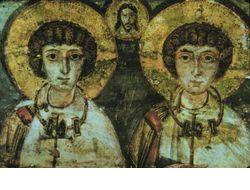
SS Sergius & Bacchus: Gay lovers, Roman soldiers, martyrs and saints.
Subscribe to:
Posts (Atom)