Although some would dispute the description of Paulinus as 'gay', the description seems to me entirely appropriate to his sensibility. Although history records no evidence of physical expression of his same sex attraction, nor is there any evidence against it. Given the historical context he was living in (4th/5th century Roman empire) , when sex with either gender was commonplace for men at at all levels of society, inside and outside the Christian church, the absence of written records of private activities after 15 centuries is completely unremarkable. Nor is the fact that he was married particularly significant - for Romans, marriage and sex with men were entirely compatible.
Showing posts with label gay bishops. Show all posts
Showing posts with label gay bishops. Show all posts
Friday, 22 June 2012


Wednesday, 19 May 2010
Gay Bishops: How Many?

Bishop Mary Glasspool
Bishop Mary Glasspool has now been consecrated as a bishop in the diocese of Los Angeles, making her the second openly gay bishop in the Episcopal church. (There could soon be another Episcopal gay bishop. Rev Michael Barlowe is one of four candidates for a vacancy in Utah). Some sources are describing her as the second gay bishop in history" - but that would be pushing it, and is breathtaking in its cultural myopia. So, for context and a refresher once again of how deeply homoerotic relationships have been embedded in the Christian church, I offer some reminders.

Mary Glasspool is the first openly lesbian bishop in the Episcopal church, but not the first globally: that would be Bishop Eva Brunne, consecrated by the Swedish Lutherans last year.

Bishop Gene Robinson was the first modern bishop in the Anglican communion to be consecrated while openly gay, but there have been others before him who came out openly after being named bishop - for example, Otis Charles, also of Utah, Derek Rawcliffe of Glasgow and Galloway in the Scottish Episcopalian church, and Mervyn Castle of False Bay (part of the Archdiocese of Cape Town in the Anglican, "Church of the Province of South Africa").
Wednesday, 21 April 2010
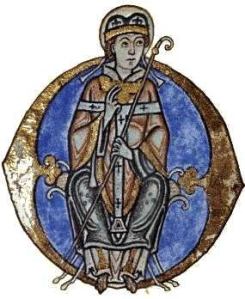
Anselm of Canterbury: Gay Bishop, Gay Protector. 21/04
Anselm, Archbishop of Canterbury from 1093 - 1109, is important for the evidence he represents that the hostility of some Christians to homoerotic relationships has not always been typical of the institutional church. He has two claims in particular to attention from modern gay and lesbian Catholics. First, he is one of a band of notable medieval clerics who although personally celibate, exhibited a clear homoerotic sensibility, whose affectionate letters to his band of intimate male friends contribute to what John Boswell has described as a "medieval flowering" of a gay subculture, which was not again equalled until the latter part of the twentieth century. He reminds us also, that just as there was then a homoerotic culture deeply embedded in the catholic clergy, exactly the same applies today, as Mark Jordan has clearly shown ("The Silence of Sodom: Homosexuality in Modern Catholicism ").
"). 
 .
However, he is also important as an early protector of gay men from the rising tide of intolerance that came to dominate the later medieval and renaissance periods, intolerance that persevered today, and is widely mistaken for something which is somehow inherent to the Christian faith.
From the Calendar of LGBT Saints: (April 21):
The Council of London in 1102 wanted to enact ecclesiastical legislation which declared – for the first time in English history – that homosexual behaviour was a sin, and they recommended that offending laymen be imprisoned and clergymen be anathematized.But Anselm as Archbishop of Canterbury prohibited the publication of their decree, advising the Council that homosexuality was widespread and few men were embarrassed by it or had even been aware it was a serious matter; he felt that although sodomites should not be admitted to the priesthood, confessors should take into account mitigating factors such as age and marital status before prescribing penance, and he advised counselling rather than punishment.
See Also:
The Medieval Flowering of Homoerotic Christianity
The Homoerotic Catholic Church
Books:
Boswell, John: Christianity, Social Tolerance, and Homosexuality: Gay People in Western Europe from the Beginning of the Christian Era to the Fourteenth Century

Jordan,Mark D: The Silence of Sodom: Homosexuality in Modern Catholicism
Norton, Rictor: My Dear Boy: Gay Love Letters Through the Centuries
.
Monday, 15 March 2010
St Paulinus of Nola, Gay Bishop, Poet
Although some would dispute the description of Paulinus as 'gay', the description seems to me entirely appropriate to his sensibility. Although history records no evidence of physical expression of his same sex attraction, nor is there any evidence against it. Given the historical context he was living in (4th/5th century Roman empire) , when sex with either gender was commonplace for men at at all levels of society, inside and outside the Christian church, the absence of written records of private activities after 15 centuries is completely unremarkable. Nor is the fact that he was married particularly significant - for Romans, marriage and sex with men were entirely compatible. 
What is known is that he was passionately in love with a man, Ausonius, to whom he addressed exquisitely tender love poetry. This is of sufficient quality and gay sensibility to be included in the Penguin book of homosexual verse:
"To Ausonius"
I, through all chances that are given to mortals,
And through all fates that be,
So long as this close prison shall contain me,
Yea, though a world shall sunder me and thee,Thee shall I hold, in every fibre woven,
Not with dumb lips, nor with averted face
Shall I behold thee, in my mind embrace thee,
Instant and present, thou, in every place.Yea, when the prison of this flesh is broken,
And from the earth I shall have gone my way,
Wheresoe'er in the wide universe I stay me,
There shall I bear thee, as I do today.Think not the end, that from my body frees me,
Breaks and unshackles from my love to thee;
Triumphs the soul above its house in ruin,
Deathless, begot of immortality.Still must she keep her senses and affections,
Hold them as dear as life itself to be,
Could she choose death, then might she choose forgetting:Living, remembering, to eternity.
[trans. Helen Waddell, in Penguin Book of Homosexual Verse]
It is surely clear from the above that whatever his physical erotic activities, his sensibility was entirely what we would today call "Gay". Paulinus' feast day is on June 22nd. It is fitting that we remember him, and the multitude of other LGBT saints in the long history of the church.
Further reading:
For more online, see Paul Hansall's invaluable LGBT Catholic handbook, or the Catholic Encyclopedia. (Note though that the latter's entry on Paulinus is an excellent case study on how official Church history scrupulously edits out our LGBT history. In a reasonably lengthy entry, Ausonius and the verses addressed to him are noted - but the essential facts that the relationship was passionate, or that the verses were clearly love poetry, are carefully filtered out.)
In print, see John Boswell's "Christianity, Social Tolerance and Homosexuality", pp133 - 134.
Subscribe to:
Posts (Atom)