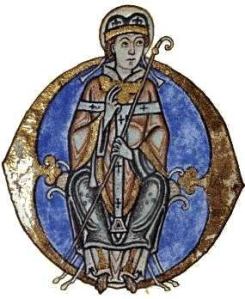
Ever since I started here at QTC, I have tried to share with you some information about our gay, lesbian and trans saints and martyrs, which I think is one of the great unknown stories of Church a and LGBT history. Ever since Stonewall, there has been a recognition that so much of the queer past has been hidden from history, with a great deal of work done to uncover this history and bring it into the light of day. In exactly the same way, and more dangerously, our history in the church has also been hidden. The pioneering work of scholars like John Boswell (and before him, Vern Bullough) has done a great deal to open this history up for exposure, but too often it remains buried in academic treatises which are valuable, but possibly inaccessible or intimidating to a general reader.
Showing posts with label queer church history. Show all posts
Thursday, 5 August 2010
Friday, 25 June 2010
St Paulinus of Nola: Bishop, Poet, Saint - and Gay.
Although some would dispute the description of Paulinus as 'gay', the description seems to me entirely appropriate to his sensibility. Although history records no evidence of physical expression of his same sex attraction, nor is there any evidence against it. Given the historical context he was living in (4th/5th century Roman empire), when sex with either gender was commonplace for men at at all levels of society, inside and outside the Christian church, the absence of written records of private activities after 15 centuries is completely unremarkable. Nor is the fact that he was married particularly significant - for Romans, marriage and sex with men were entirely compatible.
Wednesday, 21 April 2010
The Medieval Flowering of Homoerotic Christiantity
In the modern popular imagination, the middle ages have generally had a bad press, compared unfavourably with the classical civilizations which preceded it, the Renaissance flowering which followed it - or even the Islamic and Byzantine centres of scholarship and learning alongside medieval Europe. However, the thousand or so years between the fall of Rome and the high Renaissance cover a wide range of conditions. In the midst of this period, at the start of the second millenium, lies a period which deserves greater attention from anyone interested in the history of the church, or of homosexuality, or (most particularly) of the intersection of the two. This was a period of the most visible, most public "gay" sub-culture in Europe before the late twentieth century. It was also a great age of church reform - and despite strong pressure from vocal opponents, the church reformers generally ignored it.
Anselm of Canterbury: Gay Bishop, Gay Protector. 21/04
Anselm, Archbishop of Canterbury from 1093 - 1109, is important for the evidence he represents that the hostility of some Christians to homoerotic relationships has not always been typical of the institutional church. He has two claims in particular to attention from modern gay and lesbian Catholics. First, he is one of a band of notable medieval clerics who although personally celibate, exhibited a clear homoerotic sensibility, whose affectionate letters to his band of intimate male friends contribute to what John Boswell has described as a "medieval flowering" of a gay subculture, which was not again equalled until the latter part of the twentieth century. He reminds us also, that just as there was then a homoerotic culture deeply embedded in the catholic clergy, exactly the same applies today, as Mark Jordan has clearly shown ("The Silence of Sodom: Homosexuality in Modern Catholicism
").

However, he is also important as an early protector of gay men from the rising tide of intolerance that came to dominate the later medieval and renaissance periods, intolerance that persevered today, and is widely mistaken for something which is somehow inherent to the Christian faith.
From the Calendar of LGBT Saints: (April 21):
The Council of London in 1102 wanted to enact ecclesiastical legislation which declared – for the first time in English history – that homosexual behaviour was a sin, and they recommended that offending laymen be imprisoned and clergymen be anathematized.But Anselm as Archbishop of Canterbury prohibited the publication of their decree, advising the Council that homosexuality was widespread and few men were embarrassed by it or had even been aware it was a serious matter; he felt that although sodomites should not be admitted to the priesthood, confessors should take into account mitigating factors such as age and marital status before prescribing penance, and he advised counselling rather than punishment.
See Also:
The Medieval Flowering of Homoerotic Christianity
The Homoerotic Catholic Church
Books:
Boswell, John: Christianity, Social Tolerance, and Homosexuality: Gay People in Western Europe from the Beginning of the Christian Era to the Fourteenth Century
Jordan,Mark D: The Silence of Sodom: Homosexuality in Modern Catholicism
Norton, Rictor: My Dear Boy: Gay Love Letters Through the Centuries
Subscribe to:
Posts (Atom)