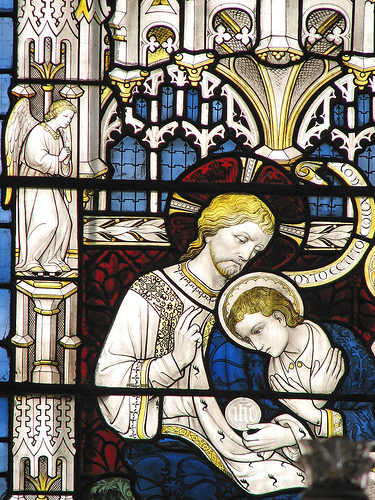
In Catholic spiritual tradition, there is an important and honoured place for the idea of "The Bride of Christ". At one level, we are taught to think of the Church as a whole as such a bride of Christ, and the wedding at Cana as a metaphor for the marriage of Christ to his bride, the Church. At another level, religious women think of themselves as forgoing human marriage, to become brides of Christ. The image is a powerful and valuable one, in developing that personal relationship with the Lord that we seek - but where does it leave men, who may find it difficult to imagine themselves as brides?

Surprisingly perhaps, Catholic tradition provides an equivalent route for men - at least, for gay men, and others who are not threatened by thoughts of homoerotic attraction. Gerald Loughlin has described a medieval German tradition in which the wedding at Cana was seen as celebrating the wedding of Christ and his "beloved disciple" (assumed to be John the Evangelist). St John of the Cross used extensive homoerotic imagery in his mystical writing. Blessed Bernardo de Hoyos combined both of these ideas, taking them to their logical conclusion. As Kittredge Cherry noted at Jesus in Love blog, in a valuable post for his feast day (yesterday, November 29th), Blessed Bernardo saw himself, in a mystical vision, as marrying Christ - as a man, becoming not a bride, but a "Groom of Christ".
Kittredge observes, quite correctly,Always holding my right hand, the Lord had me occupy the empty throne; then He fitted on my finger a gold ring.... “May this ring be an earnest of our love. You are Mine, and I am yours. You may call yourself and sign Bernardo de Jesus, thus, as I said to my spouse, Santa Teresa, you are Bernardo de Jesus and I am Jesus de Bernardo. My honor is yours; your honor is Mine. Consider My glory that of your Spouse; I will consider yours, that of My spouse. All Mine is yours, and all yours is Mine. What I am by nature you share by grace. You and I are one!”(quoted at Jesus in Love from “The Visions of Bernard Francis De Hoyos, S.J.[Image]” by Henri Bechard, S.J.)
While the Catholic church refuses to bless same-sex marriages, the lives and visions of its own saints tell a far different story -- in which Christ the Bridegroom gladly joins himself in marriage with a man.
Michael Bayley at the Wild Reed, who drew my attention to Kittredge's post, thinks that we should declare Bernardo the patron saint of Catholic for Marriage Equality, MN. Why not the patron saint of marriage equality - period?


 , the reputable biblical scholar Theodore Jennings mounts an extended argument that Jesus himself was actually gay and that the beloved disciple of John's Gospel was Jesus' lover. To support this provocative conclusion, Jennings examines not only the texts that relate to the beloved disciple but also the story of the centurion's servant boy and the texts that show Jesus' rather negative attitude toward the traditional family: not mother and brothers, but those who do the will of God, are family to Jesus. Jennings suggests that Jesus relatives and disciples knew he was gay, and that, despite the efforts of the early Church to downplay this "dangerous memory" about Jesus, a lot of clues remains in the Gospels. Piecing the clues together, Jennings suggests not only that Jesus was very open to homosexuality, but that he himself was probably in an intimate, and probably sexual, relationship with the beloved disciple.