Showing posts with label saints. Show all posts

Friday, 9 November 2012

Nov 9th: St. Matrona/Babylas of Perge

St Matrona /Babylas of Perge is one of a number of female saints in the early church who dressed as men to be admitted to all-male monasteries. The stories and motives of these women are remote from our time, and 'transvestite' is not to be confused with 'transgendered'. Still, whatever the full historic truth, it seems to me these are useful stories to hold on to as reminders of the important place of the transgendered, and differently gendered, in our midst. Many of us will remember how difficult and challenging was the process of recognising, and then confronting, our identities as lesbian or gay, particularly in the context of a hostile church. However difficult and challenging we may have found the process of honestly confronting our sexual identities, consider how much more challenging must be the process of confronting and negotiating honestly a full gender identity crisis. Their stories collectively also carry a sobering reminder of the differing regard given by society of the time to male and female lives - else why would women have sought out male monasteries, in spite of the risks and discomfort to themselves of their lives in disguise, if not expectation of some greater spiritual reward than in a female convent? 

Our Holy Mother Matrona (492 AD):
She was from Perga in Pamphylia, and married very young, to a youth named Domitian, to whom she bore a daughter. The couple settled in Constantinople. Matrona became so constant in attending all-night vigils in the city's many churches that her husband suspected her of infidelity and forbade her to go out. This was unbearable to Matrona, who fled the house with her daughter. Determined to embrace monastic life, she gave her daughter into the care of a nun named Susanna, disguised herself as a eunuch, and entered the monastery of St Bassian (October 10) under the name of Babylas. Though she amazed all with her zeal and ascetic labors, Bassian one day discerned that she was a woman. Though he reprimanded her severely because of her zeal, he was unwilling to drive her away from monastic life because of her zeal; so he directed her to go to Emesa in Syria to enter a certain women's monastery there.
  Matrona continued to advance in the virtues, and once healed a blind man by anointing his eyes with myrrh from the head of St John the Baptist (which had been miraculously discovered around that time). The miracle became widely-known, and because of it Matrona's husband learned of her whereabouts. When he came to her monastery she escaped to Jerusalem, but he pursued her there too. She fled from place to place, even living for several years in an abandoned pagan temple in Beirut, where she was constantly assaulted by the demons that inhabited the place. In time several pagan women, seeing her struggles, asked to be her disciples, and a small monastic community sprang up in the pagan temple. After a few years she and her disciples made their way back to to Constantinople, where St Bassian received her joyfully and helped her to establish a monastery. There she was visited by the Empress Verina, wife of Leo the Great, and many other noblewomen of the City, some of whom left all to join Matrona in monastic life. Saint Matrona lived to be almost one hundred years old and reposed in peace, having foretold the day of her death. 
Enhanced by Zemanta

Sunday, 7 October 2012

Sergius & Bacchus, October 7th: Patron Saints of Gay Marriage?

Sergius and Bacchus are by a long way the best known of the so-called gay or lesbian saints - unless we include as "saints" the biblical pairs David and Jonathan, and Ruth and Naomi.  We need to be careful with terminology though: the word "gay" can be misleading, as it certainly cannot be applied with the same connotations as in modern usage, and technically, they are no longer recognised as saints by Western church, as decreed by the Vatican - but they are still honoured by the Orthodox churches, and by many others who choose to ignore the rulings of Vatican bureaucrats. The origins of saint-making lay in recognition by popular acclaim, not on decision by religious officials.

Whatever the quibbles we may have, they remain of great importance to modern queer Christians, both for their story of religious faith and personal devotion, and as potent symbols of how sexual minorities were accepted and welcomed in the earliest days of the Christian community.

They are particularly important in the movement to marriage equality, for their significance in early rites of blessing same-sex unions in church, which may point a way to making a modern provision for something similar without necessarily changing the traditional understanding of church marriage to that between a man and a woman - with its link to child-bearing.

(And, as I have written before, I have a very special personal connection with this pair of early saints and martyrs for the faith. Like so many queer Catholics, it never occurred to me that there could even exist gay or lesbian Catholics until I heard of SS Sergius and Bacchus. Some months after first hearing of them, I read their story in John Boswell, and wondered when was their feast day. I investigated - and found by wonderful serendipity that it was that very day. That began for me a continuing exploration of the other LGBT saints, of the rest of gay history in the churches, of more general gay and lesbian theology - and  this blog. By further serendipity, I discovered this week that today, the feast day of Sergius and Bacchus, is also the birthday of  - Dan Savage, well known for his work to combat homophobic teen bullying.  If Serge and Bacchus may be regarded as patrons saints of gay adults, is Dan Savage a modern patron saint of gay teens?).
A modern icon of Saints Sergius and Bacchus by...
A modern icon of Saints Sergius and Bacchus by the gay, Franciscan iconographer Robert Lentz (Photo credit: Wikipedia)

The Lovers' Story

Sergius and Bacchus were third /fourth century Roman soldiers, and lovers. This alone is worth noting in any discussion of homoerotic relationships and the early Christians: in the Roman world, as in most of the Mediterranean region, such relationships were commonplace. What mattered in questions of sexual ethics and social approval (or otherwise) had little to do with the gender of the partners, but with their respective social status.

They were of high social standing, good enough to have a close personal relationship with the emperor, Tertullian. This provoked jealousy. They were also Christians, which gave their enemies a useful pretext to denounce them to the Emperor. He ordered them to offer sacrifice to the Roman gods, which they refused to do. Their refusal provoked the wrath of the emperor, who began to exact a series of penalties, culminating in the sentence of death. The first to be killed was Bacchus, who was flogged to death. Serge was subjected to further torture, before being killed himself. The fifth century "Passion of Sergius and Bacchus" describes many details, and also some supposed miraculous interventions, such as the dead Bacchus appearing to Sergius in a vision, where he admonished his partner for grieving, and promised that they would soon be together again:
Why do you grieve and mourn, brother? If I have been taken away from you in body, I am still with you in the bond of union, chanting and reciting, "I will run the way of thy commandments, when thou shall enlarge my heart".  
Boswell makes two points about the trial and passion of Sergius and Bacchus that are especially relevant to their significance for queer Christians: in all the legal and theological arguments over the charges against them, the matter of their relationship was simply not an issue. The complaint was that they had refused to honour pagan gods. Their sexuality was of no consequence at all. Later, when the Greek hagiographer has the dead Bacchus appear to Sergius to comfort him with the prospect of paradise, the greatest joy of the promised afterlife is to be reunited with his male lover. Neither the Roman jurists, nor the fifth century Christian writer who recorded the passion, have anything at all to say against the relationship - and the Christian celebrates the quality and value of their love.

Sergius and Bacchus & Gay Marriage

It is simply historically untrue that marriage has always been between one man and one woman, or that same-sex marriage is a modern invention. Among many counter-examples that easily disprove that belief, is the tradition of liturgical blessings, in church, of same-sex unions as described by the ground-breaking historical work of John Boswell. While these were not in any way an exact counterpart to modern marriage (nor were heterosexual unions from the same period), they do no need to be considered carefully in modern responses in faith to the questions around marriage and family equality. Sergius and Bacchus are significant here, for being mentioned by name in many of the liturgies for these rites that have survived, along with numerous other, less familiar examples of same-sex couples from church history.

There are also surviving texts of ancient and medieval hymns to the couple. Boswell quotes one from the sixth century, which has the opening verse ,
Of Serge and Bacchus,
the pair
filled with grace
,

let us sing, O ye faithful!
Glory to Him who worketh
through his saints
amazing and wonderful deeds! 
The full hymn is too long to quote here in full, but one verse in particular emphasises the importance of their mutual devotion:
It was not desire for this world
that captivated Serge for Christ,
nor the empty life of worldly affairs
[that captivated] Bacchus;
rather, made one
as brethren
in the bond of love
they called out valiantly to the tyrant,
"See in two bodies
one soul and and heart,
one will and virtue.
Take those that yearn to please God.
Glory to Him who worketh
through his saints
amazing and wonderful deeds!
The words "made brethren" in this verse are a reference to the literal translation of the greek name for the rite, that of "making brothers".  This has been taken by some commentators as disproving Boswell's claim that these rites have any connection to marriage, and are instead simply a joining in spiritual brotherhood. (A claim that Boswell himself anticipated and countered in the text himself).

Whatever the original connotation of the words though, that there was some concept of marriage involved is clearly shown by another hymn from the ninth century, quoted and discussed at "Obscure Classics of Latin Literature", on a page for Carolingian poetry.

Hymn of SS. Sergius and Bacchus

– spuriously attributed to Walahfrid Strabo (c. 808 – 849 CE)
I. O ye heavens, draw up the marriage contract as our voices resound with odes
And let us make manifest the gracious rewards of the Lord.
We who are below shall celebrate the saints with an illustrious hymn
From our very hearts.

II. Holy martyrs shining by virtue of your merits, Sergius and Bacchus,
As partners you wear God's crown, you have transcended
Together the enclosure of the flesh; and now you are
Above the stars.
"O ye heavens, draw up the marriage contract" seems pretty explicit, to me.

Glory to Him who worketh
through his saints
amazing and wonderful deeds!


Indeed.

(At Jesus in Love, Kittredge Cherry has a fascinating post on depictions of Sergius and Bacchus in art, featuring in particular a wonderful stained glass window of the pair, at St. Martha’s Church in Morton Grove, Illinois. This was donated to the church by its LGBT parishioners, and is believed to be the only representation of them in any United States Church).

Books

Boisvert, Donald: Sanctity And Male Desire: A Gay Reading Of SaintsCatholic Saints Books)

Boswell, John: Same-Sex Unions in Premodern Europe

Jordan, Mark: Authorizing Marriage?: Canon, Tradition, and Critique in the Blessing of Same-Sex Unions

O'Neill, Dennis: Passionate Holiness: Marginalized Christian Devotions for Distinctive People

O'Sullivan, Andrew: Same-Sex Marriage: Pro and Con: A Reader

Related articles

Enhanced by Zemanta

Monday, 17 September 2012

Hildegard of Bingen

Hildegard's name is one to be reckoned with. Although today we usually use the term "Renaissance Man" to indicate one with a wide range of learning to his credit, perhaps we should also recognize in a similar way some extraordinary medieval women -such as Hildegard, and others who entered convents and applied themselves with distinction to learning over many fields.

Even in some distinguished company, Hildegard stands out. Her music is highly regarded, as are her literary output and her mystical writings - which of course is what makes her particularly honoured inside the church. To round out her skills, she was also recognized as a notable poet, artist, healer and scientist.  What makes her of particular interest at this site, is that she also had an intense attachment to a fellow nun, Richardis, who may have inspired some of her finest writing.


I have known a little (very little) about Hildegard for some time, and have come across suggestions of her possible lesbianism, but have not had enough knowledge to write about her myself. I was delighted then to find that my colleague Kittredge Cherry has done some digging, and produced a wonderful extended post on this great woman. As one of Kitt's readers put it in a comment,

Monday, 13 February 2012

SS, Polyeuct and Nearchos, Roman Soldiers, Lovers and Martyrs

The Roman soldiers, lovers and martyrs Sergius and Bacchus are well known examples of early queer saints. Polyeuct and Nearchos are not as familiar- but should be.  John Boswell ("Same Sex Unions in Pre-Modern Europe") names the two as one of the three primary pairs of same sex lovers in the early church, their martyrdom coming about half a century after Felicity and Perpetua, and about another half century before  Sergius & Bacchus .
Like the later pair, Polyeuct and Nearchos were friends in the Roman army in Armenia. Nearchos was a Christian, Polyeuct was not. Polyeuct was married, to a woman whose father was a Roman official. When the father-in-law undertook as part of his duties to enforce a general persecution of the local Christians, he realized that this would endanger Polyeuct, whose close friendship with Nearchos could tempt him to side with the Christians.  The concern was fully justified: although Polyeuct was not himself a Christian, he refused to prove his loyalty to Rome by sacrificing to pagan gods. In terms of the regulations being enforced, this meant that he would sacrifice his chances of promotion, but (as a non-Christian) not his life. Christians who refused to sacrifice faced beheading. When Nearchos learned of this, he was distraught, not at the prospect of death in itself, but because in dying, he would enter Paradise without the company of his beloved Polyeuct. When Polyeuct learned the reasons for his friends anguish, he decided to become a Christian himself, so that he too could be killed, and enter eternity together with Nearchos.

Thursday, 12 January 2012

12th January: St Aelred of Rievaulx, Patron of Same Sex Intimacy

St Aelred,  whose feast we celebrate today, is recognised in all sources as an important English saint, who lived in the north of England in the 12 C. As a young man, he joined the Cistercian abbey of Rievaulx, later returning there as Abbott.  He is remembered especially for his writings on friendship, some of which have led gay writers such as John Boswell to claim him as 'homosexual'. For instances, Integrity USA, an Anglican LGBT organisation, have designated him as their patron. From the website of Integrity, this Collect for the feast of Aelred:


Collect

Pour into our hearts, 0 God, the Holy Spirit's gift of love, that we, clasping each the other's hand, may share the joy of friendship, human and divine, and with your servant Aelred draw many into your community of love; through Jesus Christ the Righteous, who lives and reigns with you in the unity of the Holy Spirit, one God, now and for ever. Amen.

Monday, 9 January 2012

Saints Polyeuct and Nearchos, 3rd Century Lovers and Martyrs.

The Roman soldiers, lovers and martyrs Sergius and Bacchus are well known examples of early queer saints. Polyeuct and Nearchos are not as familiar - but should be.  John Boswell ("Same Sex Unions in Pre-Modern Europe") names the two as one of the three primary pairs of same-sex lovers in the early church, their martyrdom coming about half a century after Felicity and Perpetua, and about another half century before  Sergius & Bacchus .

Like the later pair, Polyeuct and Nearchos were friends in the Roman army in Armenia. Nearchos was a Christian, Polyeuct was not. Polyeuct was married, to a woman whose father was a Roman official. When the father-in-law undertook as part of his duties to enforce a general persecution of the local Christians, he realized that this would endanger Polyeuct, whose close friendship with Nearchos could tempt him to side with the Christians.  The concern was fully justified: although Polyeuct was not himself a Christian, he refused to prove his loyalty to Rome by sacrificing to pagan gods. In terms of the regulations being enforced, this meant that he would sacrifice his chances of promotion, but (as a non-Christian) not his life. Christians who refused to sacrifice faced beheading. When Nearchos learned of this, he was distraught, not at the prospect of death in itself, but because in dying, he would enter Paradise without the company of his beloved Polyeuct. When Polyeuct learned the reasons for his friends anguish, he decided to become a Christian himself, so that he too could be killed, and enter eternity together with Nearchos.

Thursday, 5 January 2012

Apollinaria/Dorotheos 5/01


According to the LGBT Catholic Handbook, this week sees the feast day of St.  Apollinaria /Dorotheos of Egypt (5th, 6th January). She is said to have been one of a group of transvestite saints - women who took on men's clothing  in order to live as monks.

For the specific story of Apollinaria, we turn to the Orthodox church, who take these female monks rather more serioulsy than the western church.


This is from the Orthodox website, "God is Wonderful in His Saints"
She was a maiden of high rank, the daughter of a magistrate named Anthimus in the city of Rome. Filled with love for Christ, she prevailed on her parents to allow her to travel on pilgrimage to the Holy Land. In Jerusalem she dismissed most of her attendants, gave her jewels, fine clothes and money to the poor, and went on to Egypt accompanied only by two trusted servants. Near Alexandria she slipped away from them and fled to a forest, where she lived in ascesis for many years. She then made her way to Sketis, the famous desert monastic colony, and presented herself as a eunuch named Dorotheos. In this guise she was accepted as a monk.
Anthimus, having lost his elder daughter, was visited with another grief: his younger daughter was afflicted by a demon. He sent this daughter to Sketis, asking the holy fathers there to aid her by their prayers. They put her under the care of "Dorotheos", who after days of constant prayer effected the complete cure of her (unknowing) sister. When the girl got back home it was discovered that she was pregnant, and Anthimus angrily ordered that the monk who had cared for her be sent to him. He was astonished to find that "Dorotheos" was his own daughter Apollinaria, whom he had abandoned hope of seeing again. After some days the holy woman returned to Sketis, still keeping her identity secret from her fellow-monks. Only at her death was her true story discovered.
The Handbook lists some scholarly references in support, while a look at some orthodox websites corroborates the story and confirms her feast on 5th January.  The Advent Catholic Encyclopedia. however,  dismisses the tale as 'hagiographic fiction.'

Apollinaria's story and motives are remote from our time, and 'transvestite' is not to be confused with 'transgendered'. (UPDATE: After I first described this group of women as "transvestite", I was taken to task by a reader, who pointed out that these days, "cross-dressing" is more appropriate terminology). Still, whatever the full historic truth of Apollinaria/ Dorotheos specifically, it seems to me this is a useful story to hold on to as a reminder of the important place of the transgendered, and differently gendered,  in our midst.

Many of us will remember how difficult and challenging was the process of recognising, and then confronting, our identities as lesbian or gay, particularly in the context of a hostile church. However difficult and challenging we may have found the process of honestly confronting  our sexual identities,  consider how much more challenging must  be the process of confronting and negotiating honestly a full gender identity crisis.

Let us acknowledge the courage of those who have done it, and pray for those who are preparing to do so.

Related articles


References:


Talbot, Alice-Mary: "Holy Women of Byzantium: Ten Saints' Lives in English Translation"

Anson, J., "", Viator 5 (1974), 1-32

Bennasser, Khalifa Abubakr, Gender and Sanctity in Early Byzantine Monasticism: A Study of the Phenomenon of Female Ascetics in Male Monastic Habit with a Translation of the Life of St. Matrona, [Rutgers Ph.D Dissertation 1984; UMI 8424085]
Enhanced by Zemanta

Tuesday, 27 December 2011

St John the Evangelist, the "Beloved Disciple": December 27th

In the catalogue of "gay saints", or pairs of supposedly "gay lovers" in Scripture, the coupling of John the Evangelist (the "beloved disciple")  and Jesus himself is surely the most controversial. Many people, including some of my friends from the LGBT Soho Masses, find the whole idea that this may have been a "gay", sexually active relationship, highly offensive. Others argue the opposite case.

In an explosive book, "the man jesus loved,  the reputable biblical scholar Theodore Jennings mounts an extended argument that Jesus himself was actually gay and that the beloved disciple of John's Gospel was Jesus' lover.  To support this provocative conclusion, Jennings examines not only the texts that relate to the beloved disciple but also the story of the centurion's servant boy and the texts that show Jesus' rather negative attitude toward the traditional family: not mother and brothers, but those who do the will of God, are family to Jesus.  Jennings suggests that Jesus relatives and disciples knew he was gay, and that, despite the efforts of the early Church to downplay this "dangerous memory" about Jesus, a lot of clues remains in the Gospels.  Piecing the clues together, Jennings suggests not only that Jesus was very open to homosexuality, but that he himself was probably in an intimate, and probably sexual, relationship with the beloved disciple.
-Daniel Helminiak, Sex and the Sacred

Tuesday, 20 December 2011

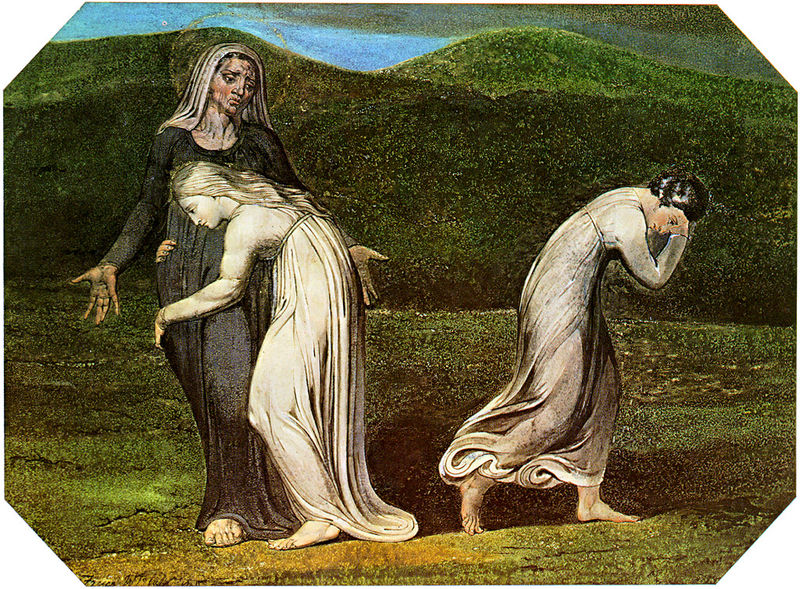
Ruth & Naomi, 20th December

The story of Ruth and Naomi is widely quoted by queer writers as an example from Scripture of possible lesbian love: but how relevant is it? Superficially at least, it is just a simple story of exceptionally strong family affection and loyalty, between mother- and daughter- in-law. Whether in any way “lesbian” or not, the story is relevant, but not perhaps in the way usually told. To unravel the lessons it may hold for us, let’s begin with the simple story.
Naomi was an Israelite widow, living for a while (on account of famine) in Moab, where she married her two sons to Moabite women, Orpah and Ruth. The sons later died, leaving Naomi “all alone, without husband or sons” ,
She did have two daughters-in-law, and when she heard that conditions back in Israel had improved, she returned, initially taking her two daughters-in-law with her. She then had a change of heart, and encourages the two women to return to their own home in Moab. After some persuasion, Orpah did so, but Ruth refused. 

Do not press me to leave you
Or turn back from following you!
Where you go I will go,
Where you lodge, I will lodge;
Your people will be my people, and your God my God.
Where you die, I will die –
There will I be buried.
May the Lord do thus and so to me,
and more as well,
if even death parts me from you
.
(Ruth 1: 16-17)
After their arrival in Bethlehem, Naomi arranged a second husband for Ruth, to Boaz. She then bore a grandson for Naomi, a grandson who would support them both in old age, and who would in time be part of the lineage linking Naomi to David, and hence to Jesus. (Ruth becomes King David’s great-grandmother: Ruth is the mother of Obed, who is father of Jesse and grandfather of David.)

It is obvious from the above that Naomi was mother-in-law to Ruth –twice over. It is equally obviously a story of great affection and loyalty between two women. Is it more?


John Boswell doesn’t think so:
“There is little in the Book of Ruth to suggest that anything other than loyalty bound Ruth to Naomi (who had, in fact, suggested that Ruth depart, along with her other daughters-in-law; but Ruth refused to do so.)”
He also points out that the obvious devotion of Ruth to Naomi is instrumental in securing the attention of Boaz. What would be the point of remembering a lesbian relationship that serves to attract a husband for one of the women?


Paul Halsall asks, but does not answer, the question,
Is this a story about Lesbianism, which was not forbidden at all in the Law? Whatever the answer, it is a story of love and loyalty between two women.
However, he does point to another aspect of the story which is less commonly remarked on, that it is a story of the outsider, and how outsiders can become insiders. As a Moabite woman, Ruth is very much an outsider in Israeli society. Yet she accepts this in her loyalty to Naomi, and is ultimately rewarded by becoming the mother of Obed, the grandmother of King David, and ultimately an ancestor of Jesus himself.
This is a book of the inclusivity of God's call, and another Biblical illustration of the limits of the Law
Paul Glaser also sees this as a story of devotion, but reads it as a “coming out” story:
All of us who grow to accept and affirm our sexuality have in some sense heard this call to come out. In grief and regret, some of us may feel forced to leave a family, a congregation, or a community (much as Ruth did) to make our commitments. Following Ruth and Naomi’s strategy, we may use whatever is available to us in the church and society to survive. Yet, alongside Ruth and Naomi, we use our commitment to lovers, our fresh understandings of God, and our new communities of faith – maybe a support group, a network, an organization, a congregation - to survive.
A comment placed on this site by a Baptist pastor ( “ hinbww ”) responding to an earlier article on the Bible (Is the Bible Anti-gay?"), stated unequivocally:
Ruth & Naomi were married.
He later elaborated:

Ruth 1:14, referring to the relationship between Ruth and Naomi, mentions that “Ruth clave onto her.” (KJV) The Hebrew word translated here as “clave” is identical to that used in the description of a heterosexual marriage in Genesis 2:24: ” Therefore shall a man leave his father and his mother, and shall cleave unto his wife: and they shall be one flesh.” (KJV)

This book was probably included in the Hebrew Scriptures because King David was one of the descendents of Ruth. Although this same-sex friendship appears to have been very close, there is no proof that it was a sexually active relationship.
How valid this interpretation is, I have no idea. I have no knowledge of Hebrew, but if the word used in Ruth 1:14 is the same as that in Genesis 2:24, as stated, then the suggestion is an important one which needs to be taken seriously. It is also worth pointing out though, that Naomi’s arrangement of a marriage to Boaz does not eliminate the possibility of a lesbian relationship between the two women; and that a lesbian relationship does not necessarily imply a sexual relationship. (We recognise a number of gay clergy as saints who clearly demonstrate a homosexual orientation, and who had deeply intimate emotional relationships with men, who are nevertheless accepted as having remained celibate).

What do I think?
I don’t see the need for just a single, "correct" interpretation. I think the reading of “cleave” suggested above is worth taking seriously and one which I will try to explore further. I also think it is worthwhile to use the passage as a reflection on female loyalty, or on inclusion and outsiders, or on coming out. But I also see this passage in another light, which is instructive but not inspirational.

When I read Ruth as a gay man, I am struck by another theme entirely how totally dependent women of that time were on men, for their very survival. When Naomi’s sons died, she is described as being left all alone. She was not – she had two daughters in law, but they didn’t count. Much later, during the negations leading up to the marriage of Ruth to Boaz, there is a complicated bit about the sale of a piece of land. The critical point is that the purchaser of the property is obliged to take the woman with it – women are sold as property along with the land, The joyful climax of the story is the birth of a son, who can take care of both women in their old age,

This reminder of the total dependence of women on men goes to the heart of the problems of the church on matters of gender and sexuality. Women continue to be seen as inferior to men, and are treated accordingly. The inferior status is also why the Leviticus prohibition is on men who lie with men “as with women”, and why so many societies, then and now, see it as shameful for a man to take the “female” part in male intercourse, but to take the “masculine”, active, role, is not regarded as gay at all. These attitudes , coupled with some bizarre ides about animal behaviour, were behind the condemnation of same sex relationships by some (not all) early church fathers.

The social attitudes of Jewish society revealed by the story of Ruth and Naomi are at the heart of the modern oppression by the church of women and gay men. Ruth and Naomi found a way to survive and flourish working within the system. For us today, in a world where the attitudes outside the church (informed by science and reason) are very different, should not have to work within an unjust system to flourish ourselves. Instead, we should work to subvert and destroy those elements that are unloving and unjust.
Kittredge Cherry has also written on these two: see Jesus in Love blog


references:
John Boswell, Same Sex Unions in Pre-Modern Europe, (Harper-Collins)
Chris Glaser, Coming out as Sacrament (Westminster John Knox Press)
Paul Halsall, Calendar of LGBT Saints (on-line)

Saturday, 17 December 2011

Three Young Men in the Burning Fiery Furnace: Dec 17th

Today, the church celebrates the feast of three young men, Shadrack, Mesach and Abednego, the companions of Daniel the prophet. I missed the opportunity to comment on the due date, which was unfortunate: they are important for highlighting a much neglected group in the church - the transgendered.


We are probably all familiar with the stories of Daniel in the lion's den, and of his three companions in the burning fiery furnace. What they don't tell us in Sunday School, is that as slaves captured and taken to service in the king's court in Babylon they were almost certainly eunuchs - castrated males. This was the standard fate of slaves in the royal court, as Kathryn Ringrose has shown, and as anticipated by Isaiah:
And some of your descendants, your own flesh and blood who will be born to you, will be taken away, and they will become eunuchs in the palace of the king of Babylon.
-Isaiah 39:7

Thursday, 15 December 2011

Vida Dutton Scudder, American Lesbian Saint for Our Times

Vida Dutton Scudder is a rare example of a modern lesbian who is a recognized Christian saint (recognized by the US Episcopal Church, not the Roman Catholics). Her work and message are particularly relevant to the twentieth century, as we grapple with an economic crisis triggered in effect by corporate and consumer greed.

Born in 1861, over a long life Scudder was an educator, writer, and welfare activist in the social gospel movement. Much of her thinking has particular relevance to us today, as we grapple with a financial and economic crisis precipitated in effect by a corporate and consumer culture marked by unrestrained greed. Throughout her life Scudder’s primary relationships and support network were women. From 1919 until her death, Scudder was in a relationship with Florence Converse, with whom she lived.


After earning a BA degree from Smith College in 1894, in 1895 she became one of the first two American women admitted to graduate study at Oxford university. After returning to Boston, Scudder taught English literature at Wellesley College, where she becoming an associate professor in 1892 and full professor from 1910.

While studying in England, she had come under the influence of people like John Ruskin,Leo Tolstoi, George Bernard Shaw, and Fabian Socialism. Back in Boston, she became actively involved in promoting her socialist ideas, especially Christian socialism. In 1988, two years after her return from Oxford, she joined both the Companions of the Holy Cross, a women's group dedicated to intercessionary prayer and social reconciliation, and the Society of Christian Socialists . In 1890 she was a co-founder of the Boston "settlement house" Dennison House, part of a movement which had the goal of getting the rich and poor in society to live more closely together in an interdependent community, in which volunteer middle-class "settlement workers" would live, hoping to share knowledge and culture with, and alleviate the poverty of their low-income neighbors. From 1893 she was active in the trade union movement, and in 1911 she co-founded the Episcopal Church Socialist League and joined the Socialist Party, attempting to reconcile the conflicting doctrines of Marxism and Christianity. After the First World War, she also embraced capitalism, and in 1923 she joined the Fellowship of Reconciliation, giving a series of lectures before the Women's International League for Peace and Freedom in Prague.


After her retirement from Wellesley in 1928 until her death in 1954 at the age of 92, as Theresa Corcoran notes:
She continued to be in the storm center of advanced thought in the church and in society, supporting by her name and by her writing such groups as Reinhold Niebuhr's Fellowship of Socialist Christians and Rufus Jones's Wider Quaker Fellowship. She worked closely with the Christendom group in England, encouraged Mother Pattie Ellis in her desire to establish the Community of the Way of the Cross, a women's religious order combining active social work with monastic life, and followed closely the Reverend Frederick Hastings Smyth's Society of the Catholic Commonwealth.
Her socialism was not simply a political impulse, but sprang from her deep religious conviction and Gospel values, seeking to implement God's kingdom on earth. She valued her red Socialist membership card, but placed it in her personal oratory at home beside her crucifix. In the early years after the Russian Revolution she wrote that she "took delight in the Russian experiment", but later recognized that it too, could not guarantee justice, writing in her autobiography,
  "I'm afraid that Lenin would have scoffed at my treatment of the red flag given me at this time, which I placed beside the crucifix -- where it still hangs -- in my private oratory . . . I was doing my best to align a catastrophic and dialectical conception of history with my Christian thinking; and in communist revolution I discerned a Divine Judgment which was the sign of approaching redemption . . . But as coercion and cruelty were continuously impounded as means to reach justice and brotherhood, uncritical enthusiasm waned. Helped . . . by Franciscan studies, I became increasingly convinced that no revolution could bring ultimate salvation unless it proceeded from a Christian conception of man."
As we now recognize the failings of the unrelenting pursuit of profit that have brought us to our present crisis, we would do well to reflect deeply on these words. It is not neither the capitalist "system" that has created the problem, but the failure of our values. As Scudder writes, we need to return to a Christian conception of what it is to be human, remembering all the many warnings of Jesus Christ on the dangers of riches and the pursuit of wealth.

She is recognized as a saint by the Episcopal Church (USA), with a feast day on October 10.

PRAYER to VIDA SCUDDER

Most gracious God, you sent your beloved Son to preach peace to those who are far off and to those who are near: Raise up in your church witnesses who, after the example of your servant Vida Dutton Scudder, stand firm in proclaiming the power of the Gospel of Jesus Christ, who lives and reigns with you and the Holy Spirit, one God, now and for ever. Amen. 
(from a collection of lectionary resources for the Episcopal Church)


Enhanced by Zemanta

Wednesday, 9 February 2011

Pope Benedict, on the Queer Lessons in the Church's Martyrdom of St Joan.

At Enhanced Masculinity, I came across a post which reported on an address by Pope Benedict about the martyrdom and later canonization of St Joan of Arc. I was pleased to see this, as I have written before of the importance of Joan as a queer saint who was first martyred by the church, and later rehabilitated and honoured. Much the same will surely occur in time to those modern queer heroes who have been professionally martyred, by the Church which has deliberately destroyed their careers, for the great sin of attempting to speak the truth on sexual ethics or LGBT inclusion.


So, in addition to the significance of this address to my own arguments about the relevance of the queer saints and martyrs, it also relates to the current theological ferment on sexual ethics and widespread criticism of the institutional church. When I then crossed to the Vatican website and read the address in full, I found even more in Pope Benedict's words that can guide and inspire gay in lesbian Catholics in our struggles to withstand the hostility of the traditional, disordered teaching on homoerotic relationships.

Friday, 31 December 2010

The Story of the "Queer Saints and Martyrs": Taking Shape

Ever since I began writing for the Queer Church, one of the key themes I have been exploring has been that of the place of LGBT men and women in Christian history - recognized and unrecognised saints, martyrs for the church, some who have  been martyred by the church directly or indirectly, and those who have achieved remarkable high office in the church, as popes, bishops or abbots in spite of clear homoerotic interests and activities.

As I have explored individuals and notable groups, I have been seeing the outline of a narrative thread underlying them, which I have been using to draw them together into what I hope will become a book for publication. The outline for the book I have previously published, as a synopsis, and as a reflection of the feast of All (Gay) Saints. I have now expanded this synopsis one level, which I will be posting in instalments over the coming week, under six main divisions. For a preview of these posts and the work in progress, follow the links to my  "Queer Saints and Martyrs" pages here at Queering the Church, and from them to the detailed posts on individuals and groups at my satellite site, "Queer Saints and Martyrs - and others".

Prologue: Before Christianity

Same sex relationships in other religions, in the stories of the Hebrew Bible/Old Testament, and in the Gospels (before the disciples of Christ came to be known as "Christians")

The Early Christians: Saints and Martyrs for the Church

From both the Western and Eastern Roman Empire, a wide range of men (and fewer women). These include pairs of lovers, martyrs for the church, bishops who wrote homoerotic verse, and cross-dressing women.

Christian Homoeroticism in the Middle Ages: Saints and Others

Boswell has been criticized by more recent academics for his assertion that the Middle Ages represented a great flowering of a gay sub-culture. However, even if he overstated his case and the term "gay" for this period is subject to misinterpretation, there is no doubt that there were numerous recognized saints and other senior clergy who freely used homoerotic imagery in their spiritual writing, and  others who are notable for achieving high office as popes or bishops, in spite of well-known erotic relationships with men.

The prevalence of such relationships among the clergy prompted the most important of the calls for strong penalties against "sodomy", by Alain de Lille and St Peter Damian in particular. For a long time though, these calls were rejected by the leaders of the Church.

The Great Persecution: Martyred by the Church

The figure of Saint Joan is of central importance to queer Christians, as a cross-dressing queer saint who was first martyred by the church, and later canonized.  As the Middle  Ages passed into the Early Renaissance, many thousands more alleged sodomites were tried and condemned to death by the church, either directly by the Inquisition or by secular authorities at its instigation.

Ecclesiastical involvement in these trials later gave way to purely secular proceedings, but the initial pseudo-religious motivation for declaring same-sex love a capital offence remained an important factor in the retention of the death penalty in many European countries right up to the nineteenth and twentieth centuries, and for the export of state-sanctioned persecution by the colonial powers to societies which had previously tolerated or even celebrated sexual minorities.

As secular authorities relaxed or withdrew criminal sanctions though, religious authorities applied a form of figurative martyrdom to gay or lesbian identified people in the church, attempting to censor the writing of theologians who dissented from the orthodox prohibitions, or excluding from ministry those who were seen to be gay or lesbian.

Modern Saints, Modern Martyrs.

In the early church, it was said that the growth of the faith was fed by the blood of the martyrs. Much the same thing appeared to be happening at the close of the twentieth century and start of the twenty first. "Martyr" means one who gives witness, and the witness of the LGBT identified men and women who refused to be silenced by the Church authorities has inspired many more. Over the last few decades there has been a great flowering of writing on faith and spirituality from a queer perspective, and of explicitly queer ministry.

Epilogue: All Saints, and the Call to Witness

"Sainthood" in Christian theology is not simply a matter of those few who have been formally recognised and canonized by the Catholic Church, but is a state to which we are all called.

Friday, 3 December 2010

Saints Polyeuct and Nearchus, Jan 9th

The story of the Roman soldiers Sergius and Bacchus is well known. Polyeuct and Nearchos were similar. They too were also Roman soldiers, martyred because of their Christian faith, and in love with each other. Metaphrastes described them as one soul in two bodies, joined by boundless love. Polyeuct converted to Christianity because Nearchos was going to be executed for being Christian. Polyeuct wanted to be executed with him so that their souls would be united forever in the kingdom of heaven.


There names were paired together by early Christians as a same-sex couple, and invoked as such in the "adelphopoiia" ceremonies, recently discussed by historian John Boswell as indicating a Christian tradition of exclusive and publicly recognized same-sex unions. St. Polyeuctus had a huge church, modeled after the Temple of Solomon, built in his name in 6th century Constantinople.


Select bibliography
Boswell, John, Same-Sex Unions in Premodern Europe
O.Neill, Denis, Passionate Holiness: Marginalized Christian Devotions for Distinctive People


Enhanced by Zemanta

Saturday, 31 July 2010

"Not-a lesbian", "Not a Saint", Benedetta Carlini,Visionary Nun (1590 - 1661 )

Earlier this week, the Catholic Church marked the feast day of SS Martha and  Mary. In my post here, and in the comments thread for Kittredge Cherry's corresponding post at Jesus in Love Blog, there was some attention given to the nature of their relationship. Were they literally "just" sisters? Was the word a euphemism for a different kind of relationship? Is it fair to call them "lesbians"?  Does it matter?

I believe that the very attempt to force people into sexual categories is a trap. This is what has created the myth in the first place of a normative heterosexual identity within an opposite sex, monogamous marriage. The truth is that in nature and in human societies the world over and in all periods of history, relationships and forms of sexual expression are bewildering in their diversity. Trying to apply modern words to historic patters is particularly dangerous, as the attempt risks burying the past in the baggage carried by those words. This was clearly illustrated for me when I read this morning about Bernadetta Carlini, an Italian visionary whose description as a "lesbian nun" clouds more than it illustrates - even though the one thing that is not contested in her story is that it featured regular sex with a woman (sometimes described as the earliest recorded instance of lesbianism in modern history).