Showing posts with label martyrs. Show all posts

Sunday, 7 October 2012

Sergius & Bacchus, October 7th: Patron Saints of Gay Marriage?

Sergius and Bacchus are by a long way the best known of the so-called gay or lesbian saints - unless we include as "saints" the biblical pairs David and Jonathan, and Ruth and Naomi.  We need to be careful with terminology though: the word "gay" can be misleading, as it certainly cannot be applied with the same connotations as in modern usage, and technically, they are no longer recognised as saints by Western church, as decreed by the Vatican - but they are still honoured by the Orthodox churches, and by many others who choose to ignore the rulings of Vatican bureaucrats. The origins of saint-making lay in recognition by popular acclaim, not on decision by religious officials.

Whatever the quibbles we may have, they remain of great importance to modern queer Christians, both for their story of religious faith and personal devotion, and as potent symbols of how sexual minorities were accepted and welcomed in the earliest days of the Christian community.

They are particularly important in the movement to marriage equality, for their significance in early rites of blessing same-sex unions in church, which may point a way to making a modern provision for something similar without necessarily changing the traditional understanding of church marriage to that between a man and a woman - with its link to child-bearing.

(And, as I have written before, I have a very special personal connection with this pair of early saints and martyrs for the faith. Like so many queer Catholics, it never occurred to me that there could even exist gay or lesbian Catholics until I heard of SS Sergius and Bacchus. Some months after first hearing of them, I read their story in John Boswell, and wondered when was their feast day. I investigated - and found by wonderful serendipity that it was that very day. That began for me a continuing exploration of the other LGBT saints, of the rest of gay history in the churches, of more general gay and lesbian theology - and  this blog. By further serendipity, I discovered this week that today, the feast day of Sergius and Bacchus, is also the birthday of  - Dan Savage, well known for his work to combat homophobic teen bullying.  If Serge and Bacchus may be regarded as patrons saints of gay adults, is Dan Savage a modern patron saint of gay teens?).
A modern icon of Saints Sergius and Bacchus by...
A modern icon of Saints Sergius and Bacchus by the gay, Franciscan iconographer Robert Lentz (Photo credit: Wikipedia)

The Lovers' Story

Sergius and Bacchus were third /fourth century Roman soldiers, and lovers. This alone is worth noting in any discussion of homoerotic relationships and the early Christians: in the Roman world, as in most of the Mediterranean region, such relationships were commonplace. What mattered in questions of sexual ethics and social approval (or otherwise) had little to do with the gender of the partners, but with their respective social status.

They were of high social standing, good enough to have a close personal relationship with the emperor, Tertullian. This provoked jealousy. They were also Christians, which gave their enemies a useful pretext to denounce them to the Emperor. He ordered them to offer sacrifice to the Roman gods, which they refused to do. Their refusal provoked the wrath of the emperor, who began to exact a series of penalties, culminating in the sentence of death. The first to be killed was Bacchus, who was flogged to death. Serge was subjected to further torture, before being killed himself. The fifth century "Passion of Sergius and Bacchus" describes many details, and also some supposed miraculous interventions, such as the dead Bacchus appearing to Sergius in a vision, where he admonished his partner for grieving, and promised that they would soon be together again:
Why do you grieve and mourn, brother? If I have been taken away from you in body, I am still with you in the bond of union, chanting and reciting, "I will run the way of thy commandments, when thou shall enlarge my heart".  
Boswell makes two points about the trial and passion of Sergius and Bacchus that are especially relevant to their significance for queer Christians: in all the legal and theological arguments over the charges against them, the matter of their relationship was simply not an issue. The complaint was that they had refused to honour pagan gods. Their sexuality was of no consequence at all. Later, when the Greek hagiographer has the dead Bacchus appear to Sergius to comfort him with the prospect of paradise, the greatest joy of the promised afterlife is to be reunited with his male lover. Neither the Roman jurists, nor the fifth century Christian writer who recorded the passion, have anything at all to say against the relationship - and the Christian celebrates the quality and value of their love.

Sergius and Bacchus & Gay Marriage

It is simply historically untrue that marriage has always been between one man and one woman, or that same-sex marriage is a modern invention. Among many counter-examples that easily disprove that belief, is the tradition of liturgical blessings, in church, of same-sex unions as described by the ground-breaking historical work of John Boswell. While these were not in any way an exact counterpart to modern marriage (nor were heterosexual unions from the same period), they do no need to be considered carefully in modern responses in faith to the questions around marriage and family equality. Sergius and Bacchus are significant here, for being mentioned by name in many of the liturgies for these rites that have survived, along with numerous other, less familiar examples of same-sex couples from church history.

There are also surviving texts of ancient and medieval hymns to the couple. Boswell quotes one from the sixth century, which has the opening verse ,
Of Serge and Bacchus,
the pair
filled with grace
,

let us sing, O ye faithful!
Glory to Him who worketh
through his saints
amazing and wonderful deeds! 
The full hymn is too long to quote here in full, but one verse in particular emphasises the importance of their mutual devotion:
It was not desire for this world
that captivated Serge for Christ,
nor the empty life of worldly affairs
[that captivated] Bacchus;
rather, made one
as brethren
in the bond of love
they called out valiantly to the tyrant,
"See in two bodies
one soul and and heart,
one will and virtue.
Take those that yearn to please God.
Glory to Him who worketh
through his saints
amazing and wonderful deeds!
The words "made brethren" in this verse are a reference to the literal translation of the greek name for the rite, that of "making brothers".  This has been taken by some commentators as disproving Boswell's claim that these rites have any connection to marriage, and are instead simply a joining in spiritual brotherhood. (A claim that Boswell himself anticipated and countered in the text himself).

Whatever the original connotation of the words though, that there was some concept of marriage involved is clearly shown by another hymn from the ninth century, quoted and discussed at "Obscure Classics of Latin Literature", on a page for Carolingian poetry.

Hymn of SS. Sergius and Bacchus

– spuriously attributed to Walahfrid Strabo (c. 808 – 849 CE)
I. O ye heavens, draw up the marriage contract as our voices resound with odes
And let us make manifest the gracious rewards of the Lord.
We who are below shall celebrate the saints with an illustrious hymn
From our very hearts.

II. Holy martyrs shining by virtue of your merits, Sergius and Bacchus,
As partners you wear God's crown, you have transcended
Together the enclosure of the flesh; and now you are
Above the stars.
"O ye heavens, draw up the marriage contract" seems pretty explicit, to me.

Glory to Him who worketh
through his saints
amazing and wonderful deeds!


Indeed.

(At Jesus in Love, Kittredge Cherry has a fascinating post on depictions of Sergius and Bacchus in art, featuring in particular a wonderful stained glass window of the pair, at St. Martha’s Church in Morton Grove, Illinois. This was donated to the church by its LGBT parishioners, and is believed to be the only representation of them in any United States Church).

Books

Boisvert, Donald: Sanctity And Male Desire: A Gay Reading Of SaintsCatholic Saints Books)

Boswell, John: Same-Sex Unions in Premodern Europe

Jordan, Mark: Authorizing Marriage?: Canon, Tradition, and Critique in the Blessing of Same-Sex Unions

O'Neill, Dennis: Passionate Holiness: Marginalized Christian Devotions for Distinctive People

O'Sullivan, Andrew: Same-Sex Marriage: Pro and Con: A Reader

Related articles

Enhanced by Zemanta

Thursday, 9 August 2012

Edith Stein, "St Theresa Benedicta of the Cross"

Today, Aug 9th, the Catholic Church celebrates the feast day of "St Theresa Benedicta of the Cross" - better known to most people as Edith Stein, Jewish convert to Catholicism, and nun who died in the Nazi gas chambers on August 9th 1942, and was later canonized by Pope John Paul II in 1998.


There is nothing that directly links her to gay or lesbian Catholics, but indirectly I was struck, when reading her story this morning, of how many parallels and points of similarity there are between her situation and ours, that offer abundant material for reflection. This is a new idea for me, which I still need to think through and investigate - but as her day is still fresh, I offer them raw, as they are, while still topical. Perhaps some readers would like to help me to think this through further.

Wednesday, 18 January 2012

The Priest With the Pink Triangle

For the first post in my "queer modern heroes" series, I begin with someone most people have never heard of. (I'm not sure anyone even knows his name.) I begin with him because he represents a double martyrdom, martyred for his orientation, and also martyred for his faith. I choose him also precisely because he is anonymous, reminding us that in our own way, we are all called to our own heroism in the face of persecution, all called to be "martyrs" in the true, original sense - as witnesses to truth. I read this story in John McNeill's "Taking a chance on God": McNeill got the story from Heinz Heger. These are McNeill's words:

"I would like to end this reflection on the mature life of faith with the eyewitness account of a gay priest who was beaten to death in a German concentration camp during World War II because he refused to stop praying or to express contempt for himself. The story is recounted by Heinz Heger in his book "The Men With the Pink Triangle", in which he he recalls what took place in the special concentration camp for gay men in Sachsenhausen (Sachsenhausen was a "level 3" camp where prisoners were deliberately worked to death):


"Homosexual" prisoners in Sachsenhausen


Toward the end of February, 1940, a priest arrived in our block, a man some 60 years of age, tall and with distinguished features. We alter discovered that he came from Sudetenland, from an aristocratic German family.

He found the torment of the arrival procedure especially trying, particularly the long wait naked and barefoot outside the block. When his tonsure was discovered after the shower, the SS corporal in charge took up a razor and said "I'll go to work on this one myself, and extend his tonsure a bit." And he saved the priest's head with the razor, taking little trouble to avoid cutting the scalp. quite the contrary.

The priest returned to the day-room of our lock with his head cut open and blood streaming down. His face was ashen and his eyes stared uncomprehendingly into the distance. He sat down on a bench, folded his hands in his lap and said softly, more to himself than to anyone else: "And yet man is good, he is a creature of God!"
I was sitting beside him, and said softly but firmly: "Not all men; there are also beasts in human form, whom the devil must have made."

The priest paid no attention to my words, he just prayed silently, merely moving his lips. I was deeply moved, even though I was by then already numbed by all the suffering I had see, and indeed experienced myself. But I had always had a great respect for priests, so that his silent prayer, this mute appeal to God, whom he called upon for help and strength in his bodily pain and mental torment, went straight to my heart.

Monday, 9 January 2012

Saints Polyeuct and Nearchos, 3rd Century Lovers and Martyrs.

The Roman soldiers, lovers and martyrs Sergius and Bacchus are well known examples of early queer saints. Polyeuct and Nearchos are not as familiar - but should be.  John Boswell ("Same Sex Unions in Pre-Modern Europe") names the two as one of the three primary pairs of same-sex lovers in the early church, their martyrdom coming about half a century after Felicity and Perpetua, and about another half century before  Sergius & Bacchus .

Like the later pair, Polyeuct and Nearchos were friends in the Roman army in Armenia. Nearchos was a Christian, Polyeuct was not. Polyeuct was married, to a woman whose father was a Roman official. When the father-in-law undertook as part of his duties to enforce a general persecution of the local Christians, he realized that this would endanger Polyeuct, whose close friendship with Nearchos could tempt him to side with the Christians.  The concern was fully justified: although Polyeuct was not himself a Christian, he refused to prove his loyalty to Rome by sacrificing to pagan gods. In terms of the regulations being enforced, this meant that he would sacrifice his chances of promotion, but (as a non-Christian) not his life. Christians who refused to sacrifice faced beheading. When Nearchos learned of this, he was distraught, not at the prospect of death in itself, but because in dying, he would enter Paradise without the company of his beloved Polyeuct. When Polyeuct learned the reasons for his friends anguish, he decided to become a Christian himself, so that he too could be killed, and enter eternity together with Nearchos.

Wednesday, 9 February 2011

Pope Benedict, on the Queer Lessons in the Church's Martyrdom of St Joan.

At Enhanced Masculinity, I came across a post which reported on an address by Pope Benedict about the martyrdom and later canonization of St Joan of Arc. I was pleased to see this, as I have written before of the importance of Joan as a queer saint who was first martyred by the church, and later rehabilitated and honoured. Much the same will surely occur in time to those modern queer heroes who have been professionally martyred, by the Church which has deliberately destroyed their careers, for the great sin of attempting to speak the truth on sexual ethics or LGBT inclusion.


So, in addition to the significance of this address to my own arguments about the relevance of the queer saints and martyrs, it also relates to the current theological ferment on sexual ethics and widespread criticism of the institutional church. When I then crossed to the Vatican website and read the address in full, I found even more in Pope Benedict's words that can guide and inspire gay in lesbian Catholics in our struggles to withstand the hostility of the traditional, disordered teaching on homoerotic relationships.

Saturday, 29 January 2011

David Kato: A New Ugandan Martyr

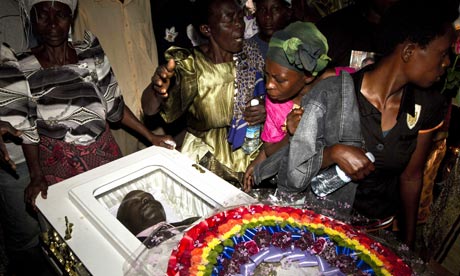
In June each year, the Church remembers a group of Ugandan martyrs, in the feast of Charles Lwangwa and companions. This week, we as queer Christians have new Ugandan martyr to remember, in David Kanto, an openly gay church worker who was brutally murdered in a clearly homophobic attack. While we mourn his death, we should at the same time pause to reflect on both sets of deaths, and on the role of the Christian churches in fomenting African homophobia, in colonial times and in the modern world.
Charles Lwangwa and companions were a group of young pages to the king of Buganda who converted to Christianity. Encouraged by the local missionaries, they resisted the sexual advances of their royal master. For this act of treason (in the eyes of the king and the Buganda court), they were executed. For this courageous martyrdom (as the missionaries saw it), they were later canonized as saints.
This week, David Kanto was murdered.


David Kato, Martyr
David was brutally beaten to death in his home today, 26 January 2011, around 2pm.  Across the entire country, straight, lesbian, gay, bisexual, transgender, and intersex Ugandans mourn the loss of David, a dear friend, colleague, teacher, family member, and human rights defender.
David has been receiving death threats since his face was put on the front page of Rolling Stone Magazine, which called for his death and the death of all homosexuals.  David's death comes directly after the Supreme Court of Uganda ruled that people must stop inciting violence against homosexuals and must respect the right to privacy and human dignity.
-extract from public statement by Sexual Minorities Uganda


Friday, 31 December 2010

The Story of the "Queer Saints and Martyrs": Taking Shape

Ever since I began writing for the Queer Church, one of the key themes I have been exploring has been that of the place of LGBT men and women in Christian history - recognized and unrecognised saints, martyrs for the church, some who have  been martyred by the church directly or indirectly, and those who have achieved remarkable high office in the church, as popes, bishops or abbots in spite of clear homoerotic interests and activities.

As I have explored individuals and notable groups, I have been seeing the outline of a narrative thread underlying them, which I have been using to draw them together into what I hope will become a book for publication. The outline for the book I have previously published, as a synopsis, and as a reflection of the feast of All (Gay) Saints. I have now expanded this synopsis one level, which I will be posting in instalments over the coming week, under six main divisions. For a preview of these posts and the work in progress, follow the links to my  "Queer Saints and Martyrs" pages here at Queering the Church, and from them to the detailed posts on individuals and groups at my satellite site, "Queer Saints and Martyrs - and others".

Prologue: Before Christianity

Same sex relationships in other religions, in the stories of the Hebrew Bible/Old Testament, and in the Gospels (before the disciples of Christ came to be known as "Christians")

The Early Christians: Saints and Martyrs for the Church

From both the Western and Eastern Roman Empire, a wide range of men (and fewer women). These include pairs of lovers, martyrs for the church, bishops who wrote homoerotic verse, and cross-dressing women.

Christian Homoeroticism in the Middle Ages: Saints and Others

Boswell has been criticized by more recent academics for his assertion that the Middle Ages represented a great flowering of a gay sub-culture. However, even if he overstated his case and the term "gay" for this period is subject to misinterpretation, there is no doubt that there were numerous recognized saints and other senior clergy who freely used homoerotic imagery in their spiritual writing, and  others who are notable for achieving high office as popes or bishops, in spite of well-known erotic relationships with men.

The prevalence of such relationships among the clergy prompted the most important of the calls for strong penalties against "sodomy", by Alain de Lille and St Peter Damian in particular. For a long time though, these calls were rejected by the leaders of the Church.

The Great Persecution: Martyred by the Church

The figure of Saint Joan is of central importance to queer Christians, as a cross-dressing queer saint who was first martyred by the church, and later canonized.  As the Middle  Ages passed into the Early Renaissance, many thousands more alleged sodomites were tried and condemned to death by the church, either directly by the Inquisition or by secular authorities at its instigation.

Ecclesiastical involvement in these trials later gave way to purely secular proceedings, but the initial pseudo-religious motivation for declaring same-sex love a capital offence remained an important factor in the retention of the death penalty in many European countries right up to the nineteenth and twentieth centuries, and for the export of state-sanctioned persecution by the colonial powers to societies which had previously tolerated or even celebrated sexual minorities.

As secular authorities relaxed or withdrew criminal sanctions though, religious authorities applied a form of figurative martyrdom to gay or lesbian identified people in the church, attempting to censor the writing of theologians who dissented from the orthodox prohibitions, or excluding from ministry those who were seen to be gay or lesbian.

Modern Saints, Modern Martyrs.

In the early church, it was said that the growth of the faith was fed by the blood of the martyrs. Much the same thing appeared to be happening at the close of the twentieth century and start of the twenty first. "Martyr" means one who gives witness, and the witness of the LGBT identified men and women who refused to be silenced by the Church authorities has inspired many more. Over the last few decades there has been a great flowering of writing on faith and spirituality from a queer perspective, and of explicitly queer ministry.

Epilogue: All Saints, and the Call to Witness

"Sainthood" in Christian theology is not simply a matter of those few who have been formally recognised and canonized by the Catholic Church, but is a state to which we are all called.

Thursday, 3 June 2010

Uganda Martyrs: Charles Lwangwa and companions

There have been many reports recently about the strong anti-gay sentiment and legislative measures emerging in Uganda, such as this report today from  Box Turtle Bulletin: Ugandan Parliament Takes Up Anti-Gay Bill, or Homosexuals Face Death Penalty in New Vision (Uganda), forwarded by email from Other Sheep.  What I have not seen in any reports, is any reference to the story of the Ugandan Martyrs, which makes an ironic contrast to the current persecution.

Some years ago, I did a great deal of reading on African history, including one book on the colonial exploration and development of East Africa. From this book (The title of which I no longer recall) I remember very clearly, although you will not find the full story in the mainly sanitised abbreviated stories at the top of a Google search.  The Ugandan martyrs are commemorated in the Church calendar on June 3rd each year, as the feast of Charles Lwangwa and companions.

This is the story as I read and remember it.

Uganda_Martyrs