Rev. James Lewis Stoll, who died on December 8th 1994, was a Unitarian Universalist minister who became the first ordained minister of any religion in the United States or Canada to come out as gay. He did so at the annual Continental Conference of Student Religious Liberals on September 5, 1969 in La Foret, Colorado. Later, he led the effort that convinced the Unitarian Universalist Association to pass the first-ever gay rights resolution in 1970.
After training at Starr King School for the Ministry, in Berkeley, followed by ordination, he served as pastor at a church in Kennewick, Wash., from 1962 until 1969. For reasons that have not been disclosed, he was asked to resign, and then moved to San Francisco, where he shared an apartment with three others.
In September of 1969, he attended a convention of college-age Unitarians in Colorado Springs. One evening after dinner, he stood up and came out publicly as a gay man. He declared his orientation, stated that it was not a choice, that he was no longer ashamed of it, and that from then on, he would refuse to live a lie.
“On the second or third night of the conference,” according to Mr. Bond-Upson, “after dinner, Jim got up to speak. He told us that he’d been doing a lot of hard thinking that summer. Jim told us he could no longer live a lie. He’d been hiding his nature — his true self — from everyone except his closest friends. ‘If the revolution we’re in means anything,’ he said, ‘it means we have the right to be ourselves, without shame or fear.'
“Then he told us he was gay, and had always been gay, and it wasn’t a choice, and he wasn’t ashamed anymore and that he wasn’t going to hide it anymore, and from now on he was going to be himself in public. After he concluded, there was a dead silence, then a couple of the young women went up and hugged him, followed by general congratulations. The few who did not approve kept their peace.” ’
After the convention, Stoll wrote articles on gay rights, and preached sermons on the subject at several churches. The following year, the full annual meeting of the Unitarian Universalist Association passed a resolution condemning discrimination against homosexual persons, beginning a gradual but irresistible move towards full LGBT inclusion.
No action was ever taken by the church against Stoll, and so he remained a minister in good standing, but he was never again called to serve a congregation. It is not clear whether this had anything to do with lingering prejudice against his orientation. It could also be on the grounds of some suspicions of drug abuse, or of inappropriate sexual behaviour.
Later, he founded the first counseling center for gays and lesbians in San Francisco. In the 1970s he established the first hospice on Maui. He was president of the San Francisco chapter of the American Civil Liberties Union in 1990s. He died at the age of 58 from complications of heart and lung disease, exacerbated by obesity and a life-long smoking habit
Stoll's name is not well known today, but for this brave and honest public witness, he deserves to be better remembered.In declaring himself, he was not the first ordained clergyman to come out, but he was the first to do so voluntarily, and the first in an established denomination. His action undoubtedly made it easier for the others who followed him, and to the formal acceptance by the Unitarians of openly gay men and lesbians in the church, and to the now well-established process to full LGBT inclusion in so many denominations.
He was not a Catholic, but in Catholic tradition today would be considered his "die natalis", or day of new birth in Christ. Remember him.
St Matrona /Babylas of Perge is one of a number of female saints in the early church who dressed as men to be admitted to all-male monasteries. The stories and motives of these women are remote from our time, and 'transvestite' is not to be confused with 'transgendered'. Still, whatever the full historic truth, it seems to me these are useful stories to hold on to as reminders of the important place of the transgendered, and differently gendered, in our midst. Many of us will remember how difficult and challenging was the process of recognising, and then confronting, our identities as lesbian or gay, particularly in the context of a hostile church. However difficult and challenging we may have found the process of honestly confronting our sexual identities, consider how much more challenging must be the process of confronting and negotiating honestly a full gender identity crisis. Their stories collectively also carry a sobering reminder of the differing regard given by society of the time to male and female lives - else why would women have sought out male monasteries, in spite of the risks and discomfort to themselves of their lives in disguise, if not expectation of some greater spiritual reward than in a female convent?
Our Holy Mother Matrona (492 AD):
She was from Perga in Pamphylia, and married very young, to a youth named Domitian, to whom she bore a daughter. The couple settled in Constantinople. Matrona became so constant in attending all-night vigils in the city's many churches that her husband suspected her of infidelity and forbade her to go out. This was unbearable to Matrona, who fled the house with her daughter. Determined to embrace monastic life, she gave her daughter into the care of a nun named Susanna, disguised herself as a eunuch, and entered the monastery of St Bassian (October 10) under the name of Babylas. Though she amazed all with her zeal and ascetic labors, Bassian one day discerned that she was a woman. Though he reprimanded her severely because of her zeal, he was unwilling to drive her away from monastic life because of her zeal; so he directed her to go to Emesa in Syria to enter a certain women's monastery there.
Matrona continued to advance in the virtues, and once healed a blind man by anointing his eyes with myrrh from the head of St John the Baptist (which had been miraculously discovered around that time). The miracle became widely-known, and because of it Matrona's husband learned of her whereabouts. When he came to her monastery she escaped to Jerusalem, but he pursued her there too. She fled from place to place, even living for several years in an abandoned pagan temple in Beirut, where she was constantly assaulted by the demons that inhabited the place. In time several pagan women, seeing her struggles, asked to be her disciples, and a small monastic community sprang up in the pagan temple. After a few years she and her disciples made their way back to to Constantinople, where St Bassian received her joyfully and helped her to establish a monastery. There she was visited by the Empress Verina, wife of Leo the Great, and many other noblewomen of the City, some of whom left all to join Matrona in monastic life. Saint Matrona lived to be almost one hundred years old and reposed in peace, having foretold the day of her death.
For much more on the history of Matrona / Babylas, see the"The Life of St. Matrona of Perge, as given by Symeon Metaphrates", (available on-line at the Medieval Sourcebook).
Radioman Petty Officer Third Class in the United States Navy. On October 27, 1992, he was killed in a public toilet in Sasebo, Nagasaki, Japan by shipmate Terry M. Helvey, who acted with the aid of an accomplice, Charles Vins, in what Esquire called a "brutal murder". Schindler was gay, and had previously complained to naval authorities of harassment, including death threats in comments such as "There's a faggot on this ship and he should die". Conscious of the dangers to his personal safety, he had begun separation process to leave the Navy, but his superiors insisted he remain on his ship until the process was finished. The good military man that he was, he obeyed orders, and remained in the Navy, waiting to be discharged. Instead, he was murdered for being gay - a modern gay martyr, killed for not hiding his sexuality.
Prior to the attack, President Bill Clinton had promised to sign an executive order to permit gay service members to serve openly in the military - but did not keep his promise. Perhaps it was encouragement from this suggestion of a change in the military climate that encouraged him to complaint to his chain of command, but if so his action backfired badly. Instead of protection from dismissal, his commanding officer simply threatened him with a dishonourable discharge - and within days, news of the complaint, and with it confirmation that he was indeed gay, was public knowledge all over the ship.
On the day of the attack, Helvey and Vins had purchased (between just two people) two large bottles of whiskey, a bottle of schnapps, a bottle of vodka, orange juice and a six-pack of beer and went drinking in a park, where they saw Schindler, and followed him into a public restroom. In a completely unprovoked attack, Helvey assaulted Schindler with fists and feet, leaving him so badly mutilated that medical evidence described the body as similar in its wounds to those that might be sustained by being stomped on by a horse, or from a high speed car crash, or even in a low speed aircraft accident. The body was so badly mutilated, that Schindler's family were unable to recognize him, except by tattoo marks on his arms.
During the trial Helvey denied that he killed Schindler because he was gay, stating, "I did not attack him because he was homosexual" but evidence presented by Navy investigator, Kennon F. Privette, from the interrogation of Helvey the day after the murder showed otherwise. "He said he hated homosexuals. He was disgusted by them," Privette said. On killing Schindler, Privette quoted Helvey as saying: "I don't regret it. I'd do it again. ... He deserved it."
After his death, the naval authorities that had failed to protect him, continued to behave shamefully, initially denying that they had received any complaints of harassment. They refused to speak publicly about the case or to release the Japanese murder report, and were "less than forthcoming" even to Schindler's mother.
Truth however, will out. Helvey and Vins eventually faced a trial in open court. Helvey received a life sentence for murder, and Vins served a 78-day sentence before receiving a general discharge from the Navy in plea bargain to lesser offences, including failure to report a serious crime and to testify truthfully against Terry Helvey. The captain who kept the incident quiet was demoted and transferred to Florida.
The case was one of the impulses to the passing of "Don't Ask, Don't Tell", which for all its manifest faults, was initially an attempt to provide some form of protection to gays and lesbians in the military (provided they "didn't tell".
(Also see Kittredge Cherry's reflection at Jesus in Love, and a wonderful painting of The Murder of Allen Schindler by Matthew Wettlaufer)
Sergius and Bacchus are by a long way the best known of the so-called gay or lesbian saints - unless we include as "saints" the biblical pairs David and Jonathan, and Ruth and Naomi. We need to be careful with terminology though: the word "gay" can be misleading, as it certainly cannot be applied with the same connotations as in modern usage, and technically, they are no longer recognised as saints by Western church, as decreed by the Vatican - but they are still honoured by the Orthodox churches, and by many others who choose to ignore the rulings of Vatican bureaucrats. The origins of saint-making lay in recognition by popular acclaim, not on decision by religious officials.
Whatever the quibbles we may have, they remain of great importance to modern queer Christians, both for their story of religious faith and personal devotion, and as potent symbols of how sexual minorities were accepted and welcomed in the earliest days of the Christian community.
They are particularly important in the movement to marriage equality, for their significance in early rites of blessing same-sex unions in church, which may point a way to making a modern provision for something similar without necessarily changing the traditional understanding of church marriage to that between a man and a woman - with its link to child-bearing.
(And, as I have written before, I have a very special personal connection with this pair of early saints and martyrs for the faith. Like so many queer Catholics, it never occurred to me that there could even exist gay or lesbian Catholics until I heard of SS Sergius and Bacchus. Some months after first hearing of them, I read their story in John Boswell, and wondered when was their feast day. I investigated - and found by wonderful serendipity that it was that very day. That began for me a continuing exploration of the other LGBT saints, of the rest of gay history in the churches, of more general gay and lesbian theology - and this blog. By further serendipity, I discovered this week that today, the feast day of Sergius and Bacchus, is also the birthday of - Dan Savage, well known for his work to combat homophobic teen bullying. If Serge and Bacchus may be regarded as patrons saints of gay adults, is Dan Savage a modern patron saint of gay teens?).
A modern icon of Saints Sergius and Bacchus by the gay, Franciscan iconographer Robert Lentz (Photo credit: Wikipedia)
The Lovers' Story
Sergius and Bacchus were third /fourth century Roman soldiers, and lovers. This alone is worth noting in any discussion of homoerotic relationships and the early Christians: in the Roman world, as in most of the Mediterranean region, such relationships were commonplace. What mattered in questions of sexual ethics and social approval (or otherwise) had little to do with the gender of the partners, but with their respective social status.
They were of high social standing, good enough to have a close personal relationship with the emperor, Tertullian. This provoked jealousy. They were also Christians, which gave their enemies a useful pretext to denounce them to the Emperor. He ordered them to offer sacrifice to the Roman gods, which they refused to do. Their refusal provoked the wrath of the emperor, who began to exact a series of penalties, culminating in the sentence of death. The first to be killed was Bacchus, who was flogged to death. Serge was subjected to further torture, before being killed himself. The fifth century "Passion of Sergius and Bacchus" describes many details, and also some supposed miraculous interventions, such as the dead Bacchus appearing to Sergius in a vision, where he admonished his partner for grieving, and promised that they would soon be together again:
Why do you grieve and mourn, brother? If I have been taken away from you in body, I am still with you in the bond of union, chanting and reciting, "I will run the way of thy commandments, when thou shall enlarge my heart".
Boswell makes two points about the trial and passion of Sergius and Bacchus that are especially relevant to their significance for queer Christians: in all the legal and theological arguments over the charges against them, the matter of their relationship was simply not an issue. The complaint was that they had refused to honour pagan gods. Their sexuality was of no consequence at all. Later, when the Greek hagiographer has the dead Bacchus appear to Sergius to comfort him with the prospect of paradise, the greatest joy of the promised afterlife is to be reunited with his male lover. Neither the Roman jurists, nor the fifth century Christian writer who recorded the passion, have anything at all to say against the relationship - and the Christian celebrates the quality and value of their love.
Sergius and Bacchus & Gay Marriage
It is simply historically untrue that marriage has always been between one man and one woman, or that same-sex marriage is a modern invention. Among many counter-examples that easily disprove that belief, is the tradition of liturgical blessings, in church, of same-sex unions as described by the ground-breaking historical work of John Boswell. While these were not in any way an exact counterpart to modern marriage (nor were heterosexual unions from the same period), they do no need to be considered carefully in modern responses in faith to the questions around marriage and family equality. Sergius and Bacchus are significant here, for being mentioned by name in many of the liturgies for these rites that have survived, along with numerous other, less familiar examples of same-sex couples from church history.
There are also surviving texts of ancient and medieval hymns to the couple. Boswell quotes one from the sixth century, which has the opening verse ,
Of Serge and Bacchus, the pair
filled with grace, let us sing, O ye faithful!
Glory to Him who worketh
through his saints
amazing and wonderful deeds!
The full hymn is too long to quote here in full, but one verse in particular emphasises the importance of their mutual devotion:
It was not desire for this world
that captivated Serge for Christ,
nor the empty life of worldly affairs
[that captivated] Bacchus;
rather, made one
as brethren in the bond of love
they called out valiantly to the tyrant,
"See in two bodies
one soul and and heart,
one will and virtue.
Take those that yearn to please God.
Glory to Him who worketh through his saints amazing and wonderful deeds!
The words "made brethren" in this verse are a reference to the literal translation of the greek name for the rite, that of "making brothers". This has been taken by some commentators as disproving Boswell's claim that these rites have any connection to marriage, and are instead simply a joining in spiritual brotherhood. (A claim that Boswell himself anticipated and countered in the text himself).
Whatever the original connotation of the words though, that there was some concept of marriage involved is clearly shown by another hymn from the ninth century, quoted and discussed at "Obscure Classics of Latin Literature", on a page for Carolingian poetry.
I. O ye heavens, draw up the marriage contract as our voices resound with odes And let us make manifest the gracious rewards of the Lord. We who are below shall celebrate the saints with an illustrious hymn From our very hearts.
II. Holy martyrs shining by virtue of your merits, Sergius and Bacchus, As partners you wear God's crown, you have transcended Together the enclosure of the flesh; and now you are Above the stars.
"O ye heavens, draw up the marriage contract" seems pretty explicit, to me.
Glory to Him who worketh through his saints amazing and wonderful deeds!
Indeed.
(At Jesus in Love, Kittredge Cherry has a fascinating post on depictions of Sergius and Bacchus in art, featuring in particular a wonderful stained glass window of the pair, at St. Martha’s Church in Morton Grove, Illinois. This was donated to the church by its LGBT parishioners, and is believed to be the only representation of them in any United States Church).
Del Martinb. May 5, 1921d. August 27, 2008Phyllis Lyonb. November 10, 1924
"Two extraordinary people ... that have spent the greater part of a half century ... fighting for their right to live the way so many of us, frankly, take for granted."
– San Francisco Mayor Gavin Newsom
Wedding of Del Martin and Phyllis Lyons, 2008
Del Martin and Phyllis Lyon founded the first lesbian organization in the United States and have fought for more than 50 years for the rights of lesbians and gays. On June 16, 2008, Martin and Lyon became the first gay couple to be legally married in California.
Martin and Lyon both earned degrees in journalism. While working as journalists in Seattle, the two became romantically involved. The couple relocated to San Francisco and moved in together on Valentine’s Day 1953.
In 1955, finding it hard to develop a social network in San Francisco, Martin, Lyon and a small group of women founded the first lesbian organization, called the Daughters of Bilitis. The name was inspired by Pierre Louys’s “Songs of Bilitis,” a collection of poems celebrating lesbian sexuality.
Though it was intended to be a secret society, Martin and Lyon wanted to make the Daughters of Bilitis more visible. The group began publishing a monthly magazine, called The Ladder, which was the first-ever lesbian publication. As editors of the magazine, they capitalized the word “lesbian” every time it appeared.
In 1964, while fighting to change California sex laws criminalizing homosexuals, the couple joined religious and gay community leaders to form the Council on Religion and the Homosexual (CRH). This organization was at the forefront of the movement to gain religious support on gay rights issues. Both women served on the founding CRH board of directors.
In 2004, when gay marriage was offered in San Francisco, Martin and Lyon were the first to wed. A California appellate court ruling subsequently invalidated their marriage. Then in May 2008, a California Supreme Court decision provided same-sex couples the right to marry. On June 16, 2008, they were the first same-sex couple married in California. The wedding was officiated by San Francisco Mayor Gavin Newsom.
Martin and Lyon have published two books together, “Lesbian/Woman” (1972) and “Lesbian Love and Liberation” (1973). On their 50th anniversary, the documentary “No Secret Anymore: The Times of Del Martin and Phyllis Lyon” premiered. In 2005, the National Gay and Lesbian Journalists Association inducted Martin and Lyon into the LGBT Journalists Hall of Fame for their pioneering work on The Ladder. In 2007, they received the 2007 Gay and Lesbian Alliance Against Defamation (GLAAD) Pioneer Award.
Bibliography
“Del Martin & Phyllis Lyon.” (The Lesbian, Gay, Bisexual and Transgender Religious Archives Network).
Peter Gomes, who died a year ago today, was an anomaly in the growing ranks of out and open gay or lesbian clergy: he was raised Catholic, but became a Baptist pastor. He was also African American, and a Republican. Not, in short, an obvious fit with the popular image of an American gay man. But (and this is important) he was able to recognize and publicly acknowledge his sexuality, and to reconcile it with his faith. This is an important reminder for us that there is no conflict at all between a gay or lesbian orientation and religious faith, or with conservative political philosophy. The only conflict is with those influential people in some churches and in some political circles who seek to impose their own interpretations of Scripture, or their own political prejudices, on everybody else - in disregard of the fundamental Gospel message of inclusion and justice, and the conservative principle of non-interference in private lives. He is also a potent reminder that advocates for equality and sexual justice are no longer found only among liberals, but also include many important conservatives: Republicans in the US, and (some of) David Cameron's Tories in the UK. Nor are the advocates for full inclusion in church all liberal or mainline Protestants: they also include Baptists, Mormons - and Catholics.
Gomes was renowned for the power of his preaching: Time magazine named him in 1979 as one of the outstanding preachers in America and he was widely sought after as a speaker and preacher in both the U.S. and Europe. He was equally renowned for his scholarship: he was a member of both the Divinity School faculty and the Faculty of Arts and Sciences, at Harvard, and an Honorary Fellow of Emmanuel College, University of Cambridge.
This scholarship is important, to appreciate his full significance as an advocate for LGBT inclusion and equality (Read more at Queering the Church)
Fr Robert Carter SJ died a year ago today, making Feb 22, in Catholic tradition, his "dies natale", or day of (new) birth. He deserves to be remembered as one of the earliest activist, openly gay Catholic priests:
“Since Jesus had table fellowship with social outcasts and sinners, those rejected by the religious establishment of his time, I consider myself to have been most fully a Jesuit, a ‘companion of Jesus,’ when I came out publicly as a gay man, one of the social rejects of my time. It was only by our coming out that society’s negative stereotypes would be overcome and we would gain social acceptance.”
-Fr Robert Carter
There is no contradiction between being Catholic and gay or lesbian. Indeed, just as Robert Carter says he was most fully a Jesuit when he cane out publicly, so for many of us, we are most fully Catholic when we too come out in Church. (I say deliberately "for many of us", as coming out is always a deeply personal decision, which may not always be feasible for all.)
Robert Carter, Priest and Gay Activist, Dies at 82
The Rev. Robert Carter, who in the early 1970s was one of the first Roman Catholic priests in the country to declare publicly that he was gay and who helped found the National Gay and Lesbian Task Force, died on Feb. 22 in the Bronx. He was 82.
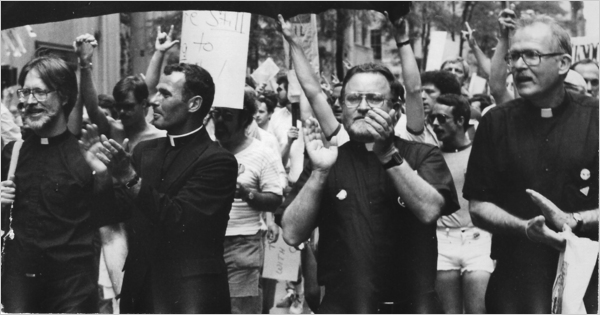
Robert Carter, right, with Dan McCarthy, left, Bernard Lynch and John McNeill at a gay pride march in the early 1980s
For St Valentine's day,we should remember the same sex lovers (a surprising number of them) who feature in Scripture and in the history of the Catholic Church. In the list below, I do not not claim that the relationships were necessarily sexual (although some of them most definitely were, but all are deserve attention by modern queer Christians. (For fuller assessments, follow the links).
The Roman soldiers, lovers and martyrs Sergius and Bacchus are well known examples of early queer saints. Polyeuct and Nearchos are not as familiar- but should be. John Boswell ("Same Sex Unions in Pre-Modern Europe") names the two as one of the three primary pairs of same sex lovers in the early church, their martyrdom coming about half a century after Felicity and Perpetua, and about another half century before Sergius & Bacchus .
Like the later pair, Polyeuct and Nearchos were friends in the Roman army in Armenia. Nearchos was a Christian, Polyeuct was not. Polyeuct was married, to a woman whose father was a Roman official. When the father-in-law undertook as part of his duties to enforce a general persecution of the local Christians, he realized that this would endanger Polyeuct, whose close friendship with Nearchos could tempt him to side with the Christians. The concern was fully justified: although Polyeuct was not himself a Christian, he refused to prove his loyalty to Rome by sacrificing to pagan gods. In terms of the regulations being enforced, this meant that he would sacrifice his chances of promotion, but (as a non-Christian) not his life. Christians who refused to sacrifice faced beheading. When Nearchos learned of this, he was distraught, not at the prospect of death in itself, but because in dying, he would enter Paradise without the company of his beloved Polyeuct. When Polyeuct learned the reasons for his friends anguish, he decided to become a Christian himself, so that he too could be killed, and enter eternity together with Nearchos.
St Aelred, whose feast we celebrate today, is recognised in all sources as an important English saint, who lived in the north of England in the 12 C. As a young man, he joined the Cistercian abbey of Rievaulx, later returning there as Abbott. He is remembered especially for his writings on friendship, some of which have led gay writers such as John Boswell to claim him as 'homosexual'. For instances, Integrity USA, an Anglican LGBT organisation, have designated him as their patron. From the website of Integrity, this Collect for the feast of Aelred:
Collect
Pour into our hearts, 0 God, the Holy Spirit's gift of love, that we, clasping each the other's hand, may share the joy of friendship, human and divine, and with your servant Aelred draw many into your community of love; through Jesus Christ the Righteous, who lives and reigns with you in the unity of the Holy Spirit, one God, now and for ever. Amen.
The Roman soldiers, lovers and martyrs Sergius and Bacchus are well known examples of early queer saints. Polyeuct and Nearchos are not as familiar - but should be. John Boswell ("Same Sex Unions in Pre-Modern Europe") names the two as one of the three primary pairs of same-sex lovers in the early church, their martyrdom coming about half a century after Felicity and Perpetua, and about another half century before Sergius & Bacchus .
Like the later pair, Polyeuct and Nearchos were friends in the Roman army in Armenia. Nearchos was a Christian, Polyeuct was not. Polyeuct was married, to a woman whose father was a Roman official. When the father-in-law undertook as part of his duties to enforce a general persecution of the local Christians, he realized that this would endanger Polyeuct, whose close friendship with Nearchos could tempt him to side with the Christians. The concern was fully justified: although Polyeuct was not himself a Christian, he refused to prove his loyalty to Rome by sacrificing to pagan gods. In terms of the regulations being enforced, this meant that he would sacrifice his chances of promotion, but (as a non-Christian) not his life. Christians who refused to sacrifice faced beheading. When Nearchos learned of this, he was distraught, not at the prospect of death in itself, but because in dying, he would enter Paradise without the company of his beloved Polyeuct. When Polyeuct learned the reasons for his friends anguish, he decided to become a Christian himself, so that he too could be killed, and enter eternity together with Nearchos.
Earlier in the week, I wrote that some Bible stories are so familiar, we do not stop to consider their significance. I could also add, that some others are so familiar, we do not stop to ask if they are accurate. A case in point is that of today's feast of the Epiphany, which we routinely celebrate as the visit of the three kings of the East to the infant Jesus - but the Gospel text does not specify that there were three, nor that they were kings.
After Jesus was born in Bethlehem in Judea, during the time of King Herod, Magi from the east came to Jerusalem and asked, “Where is the one who has been born king of the Jews? We saw his star when it rose and have come to worship him.”
It is the term "magi" that has been traditionally adapted to "wise men", or corrupted in popular imagination to "kings". Astrologer-magicians, in the Zoroastrian religion, would be a more accurate translation. (Note the obvious linguistic connection between "magus" and "magic"). Kittredge quotes Nancy Wilson and Virginia Mollenkott, to suggest that the Magi were probably either eunuchs, or trans.
In the catalogue of "gay saints", or pairs of supposedly "gay lovers" in Scripture, the coupling of John the Evangelist (the "beloved disciple") and Jesus himself is surely the most controversial. Many people, including some of my friends from the LGBT Soho Masses, find the whole idea that this may have been a "gay", sexually active relationship, highly offensive. Others argue the opposite case.
In an explosive book, "the man jesus loved, the reputable biblical scholar Theodore Jennings mounts an extended argument that Jesus himself was actually gay and that the beloved disciple of John's Gospel was Jesus' lover. To support this provocative conclusion, Jennings examines not only the texts that relate to the beloved disciple but also the story of the centurion's servant boy and the texts that show Jesus' rather negative attitude toward the traditional family: not mother and brothers, but those who do the will of God, are family to Jesus. Jennings suggests that Jesus relatives and disciples knew he was gay, and that, despite the efforts of the early Church to downplay this "dangerous memory" about Jesus, a lot of clues remains in the Gospels. Piecing the clues together, Jennings suggests not only that Jesus was very open to homosexuality, but that he himself was probably in an intimate, and probably sexual, relationship with the beloved disciple.
John Boswell was an esteemed historian who argued that homosexuality has always existed, that it has at times enjoyed wide social acceptance, and that the Church historically allowed same-sex unions.
"It is possible to change ecclesiastical attitudes toward gay people and their sexuality because the objections to homosexuality are not biblical, they are not consistent, they are not part of Jesus' teaching; and they are not even fundamentally Christian."
John Boswell was a gifted medieval philologist who read more than fifteen ancient and modern languages. After receiving his PhD from Harvard in 1975, he joined the history faculty at Yale University. Boswell was an authority on the history of Jews, Muslims, and Christians in medieval Spain. He helped to found the Lesbian and Gay Studies Center at Yale in 1987. In 1990 he was named the A. Whitney Griswold Professor of History.
In 1980 Boswell published the book for which he is best known: Christianity, Social Tolerance, and Homosexuality: Gay People in Western Europe from the Beginning of the Christian Era to the Fourteenth Century. In this groundbreaking study, Boswell argued against "the common idea that religious belief-Christian or other-has been the cause of intolerance in regard to gay people." The book was named one of the New York Times ten best books of 1980 and received both the American Book Award and the Stonewall Book Award in 1981.
Boswell's second book on homosexuality in history was The Marriage of Likeness: Same-Sex Unions in Premodern Europe, published in 1994. In it he argues that the Christian ritual of adelphopoiia ("brother-making") is evidence that prior to the Middle Ages, the Church recognized same-sex relationships. Boswell's thesis has been embraced by proponents of same-sex unions, although it remains controversial among scholars.
John Boswell converted to Roman Catholicism as an undergraduate at the College of William and Mary, and remained a devout Catholic for the rest of his life. He was an effective teacher and popular lecturer on several topics, including his life journey as an openly gay Christian man.
Boswell died of AIDS-related illness on Christmas Eve in 1994 at age 47.
Rev. James Lewis Stoll, M.Div. was a Unitarian Universalist minister who became the first ordained minister of any religion in the United States or Canada to come out as gay. He did so at the annual Continental Conference of Student Religious Liberals on September 5, 1969 in La Foret, Colorado. Later, he led the effort that convinced the Unitarian Universalist Association to pass the first-ever gay rights resolution in 1970.
After training at Starr King School for the Ministry, in Berkeley, followed by ordination, he served as pastor at a church in Kennewick, Wash., from 1962 until 1969. For reasons that are not clear, he was asked to resign, and then moved to San Francisco, where he shared an apartment with three others.
In September of 1969, he attended a convention of college-age Unitarians in Colorado Springs. One evening after dinner, he stood up and came out publicly as a gay man. He declared his orientation, stated that it was not a choice, that he was no longer ashamed of it, and that from then on, he would refuse to live a lie.
“On the second or third night of the conference,” according to Mr. Bond-Upson, “after dinner, Jim got up to speak. He told us that he’d been doing a lot of hard thinking that summer. Jim told us he could no longer live a lie. He’d been hiding his nature — his true self — from everyone except his closest friends. ‘If the revolution we’re in means anything,’ he said, ‘it means we have the right to be ourselves, without shame or fear.'
“Then he told us he was gay, and had always been gay, and it wasn’t a choice, and he wasn’t ashamed anymore and that he wasn’t going to hide it anymore, and from now on he was going to be himself in public. After he concluded, there was a dead silence, then a couple of the young women went up and hugged him, followed by general congratulations. The few who did not approve kept their peace.” ’
After the convention, Stoll wrote articles on gay rights, and preached sermons on the subject at several churches. The following year, the full annual meeting of the Unitarian Universalist Association passed a resolution condemning discrimination against homosexual persons, beginning a gradual but irresistible move towards full LGBT inclusion.
No action was ever taken by the church against Stoll, and so he remained a minister in good standing, but he was never again called to serve a congregation. It is not clear whether this had anything to do with lingering prejudice against his orientation. It could also be on the grounds of some suspicions of drug abuse, or of inappropriate sexual behaviour.
Later, he founded the first counseling center for gays and lesbians in San Francisco. In the 1970s he established the first hospice on Maui. He was president of the San Francisco chapter of the American Civil Liberties Union in 1990s. He died at the age of 58 from complications of heart and lung disease, exacerbated by obesity and a life-long smoking habit
Stoll's name is not well known today, but for this brave and honest public witness, he deserves to be better remembered.In declaring himself, he was not the first ordained clergyman to come out, but he was the first to do so voluntarily, and the first in an established denomination. His action undoubtedly made it easier for the others who followed him, and to the formal acceptance by the Unitarians of openly gay men and lesbians in the church, and to the now well-established process to full LGBT inclusion in so many denominations.
Today, the church celebrates the feast of three young men, Shadrack, Mesach and Abednego, the companions of Daniel the prophet. I missed the opportunity to comment on the due date, which was unfortunate: they are important for highlighting a much neglected group in the church - the transgendered.
We are probably all familiar with the stories of Daniel in the lion's den, and of his three companions in the burning fiery furnace. What they don't tell us in Sunday School, is that as slaves captured and taken to service in the king's court in Babylon they were almost certainly eunuchs - castrated males. This was the standard fate of slaves in the royal court, as Kathryn Ringrose has shown, and as anticipated by Isaiah:
And some of your descendants, your own flesh and blood who will be born to you, will be taken away, and they will become eunuchs in the palace of the king of Babylon.
Venantius Fortunatus was a poet, born c. 530 in Treviso, near Ravenna in Italy. He spent his time as court poet to the Merovingians. After visiting the tomb of St. Martin of Tours at St. Hilary at Poitiers, he decided to enter a monastery. He continued to write poetry, some of which have a permanent place in Catholic hymnody, for instance the Easter season hymns "Vexilla Regis" and the "Pange Lingua"(Sing, O my tongue, of the battle). Three or four years before he died he was made bishop of Poitiers. Although never canonized, he was venerated as a saint in the medieval church, and his feast day is still recognized on 14th December each year.
Like Paulinus of Nola, St Veantius’s poetry also includes some decidedly secular verse of the romantic sort. That this celebrates male love is clear from its inclusion in the Penguin Book of Homosexual Verse.
"Written on an Island off the Breton Coast"
You at God's altar stand, His minister
And Paris lies about you and the Seine: Around this Breton isle the Ocean swells, Deep water and one love between us twain. Wild is the wind, but still thy name is spoken; Rough is the sea: it sweeps not o'er they face. Still runs my lover for shelter to its dwelling, Hither, O heart, to thine abiding place. Swift as the waves beneath an east wind breaking Dark as beneath a winter sky the sea, So to my heart crowd memories awaking, So dark, O love, my spirit without thee.
[trans. Helen Waddell, in Penguin Book of Homosexual Verse]
Books:
Coote, Stephen, ed., The Penguin Book of Homosexual Verse Boswell, John: Christianity, Social Tolerance and Homosexuality.
At Enhanced Masculinity, I came across a post which reported on an address by Pope Benedict about the martyrdom and later canonization of St Joan of Arc. I was pleased to see this, as I have written before of the importance of Joan as a queer saint who was first martyred by the church, and later rehabilitated and honoured. Much the same will surely occur in time to those modern queer heroes who have been professionally martyred, by the Church which has deliberately destroyed their careers, for the great sin of attempting to speak the truth on sexual ethics or LGBT inclusion.
So, in addition to the significance of this address to my own arguments about the relevance of the queer saints and martyrs, it also relates to the current theological ferment on sexual ethics and widespread criticism of the institutional church. When I then crossed to the Vatican website and read the address in full, I found even more in Pope Benedict's words that can guide and inspire gay in lesbian Catholics in our struggles to withstand the hostility of the traditional, disordered teaching on homoerotic relationships.
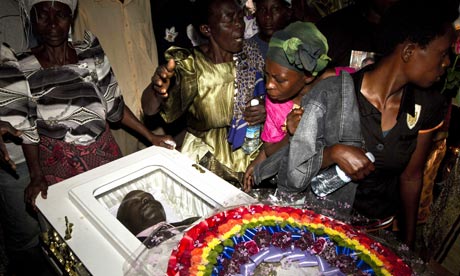
In June each year, the Church remembers a group of Ugandan martyrs, in the feast of Charles Lwangwa and companions. This week, we as queer Christians have new Ugandan martyr to remember, in David Kanto, an openly gay church worker who was brutally murdered in a clearly homophobic attack. While we mourn his death, we should at the same time pause to reflect on both sets of deaths, and on the role of the Christian churches in fomenting African homophobia, in colonial times and in the modern world.
Charles Lwangwa and companions were a group of young pages to the king of Buganda who converted to Christianity. Encouraged by the local missionaries, they resisted the sexual advances of their royal master. For this act of treason (in the eyes of the king and the Buganda court), they were executed. For this courageous martyrdom (as the missionaries saw it), they were later canonized as saints.
This week, David Kanto was murdered.
David Kato, Martyr
David was brutally beaten to death in his home today, 26 January 2011, around 2pm. Across the entire country, straight, lesbian, gay, bisexual, transgender, and intersex Ugandans mourn the loss of David, a dear friend, colleague, teacher, family member, and human rights defender.
David has been receiving death threats since his face was put on the front page of Rolling Stone Magazine, which called for his death and the death of all homosexuals. David's death comes directly after the Supreme Court of Uganda ruled that people must stop inciting violence against homosexuals and must respect the right to privacy and human dignity.
-extract from public statement bySexual Minorities Uganda
(For a proper understanding of the place of homeroticism in Jewish and Christian history, it is instructive to contrast it with its place in other religions. I have described previously how many religions not only accept a recognized and important place for same sex love, but even identifyspecific patrons of homosexual love. I now propose to consider the many other gods and goddesses who either took same sex lovers themselves, or were served by sexually or gender non-conforming priests and priestesses. I begin, as any account of the development of civilization must do, in the Middle East.)
Same sex love is a common theme in world religion and its literature, and is even present at the very beginning of literary history. The Epic of Gilgamesh is the world's oldest work of literature - and includes a central theme of love between two men. The hero Giligamesh was the king of Uruk, described as two thirds god and one third man, and a giant in size and strength, with a prodigious sexual appetite. He routinely used his strength and royal power to take advantage of both young men, taking them from their fathers, and young women, taking them from their husbands. To protect their sons and wives from the kings lust, the people turn to their gods, and in particular the creator goddess Aruru, pleading with her to send Gilgamesh a companion on whom he can expend his energies. Aruru responds, and sends to Gilgamesh a man, Enkidu, who is massive in size, inspiring in physique, hairy like an animal, and with luxuriant tresses of hair "like a woman".
Gilgamesh's Grief at Enkidu's Death
The subsequent relationship between the two, their adventures together, Gilgamesh's grief after Enkidu's death and their subsequent reunion in the afterworld with Enkidu's ghost form the meat of the epic. The content is not explicitly homoerotic, but there are clear erotic undertones. Enkidu was created to divert the king's sexual appetite from his subjects, and there is no indication that such a prodigious sexual energy suddenly evaporated. At one point, Gilgamesh even declines a direct sexual invitation from the goddess Ishtar - preferring his male companion Enkidu. Recalling the words of the biblical prophet David about Jonathan, it is said that Gilgamesh loved Enkidu "like a wife".
Discussing the erotic element in their relationship, the biblical scholar Marti Nissinen ("Homoeroticism in the Biblical World") makes an interesting point, one that will be familiar to many gay men in the modern West, and should give pause to those who insist that sex between men may be permitted in a committed, permanent relationship, but not before:
At first, the Epic of Gilgamesh can be described as a characterization of love between two men, with a homoerotic aspect that expresses their deep friendship......At the beginning, there is plenty of sex in the lives of Gilgamesh and Enkidu, but this lifestyle is presented as primitive and reckless. ....As the story proceeds, the relationship deepens and, simultaneously, the sexual passions seem to subside to the point that one can speak of a "spiritual" friendship between the two men. The erotic tension between Gilgamesh and Enkidu is not lost, but is transformed in the way that the same - sex interaction of the two men finally is characterized by love, with little if any sexual activity. Eroticism is important first and foremost as the impetus to the transformation which leads first from savage sexual behaviour to mutual love, and finally away from physical sex.
This process will be familiar to many modern gay men. In place of the romantic stereotype of a slowly blossoming chaste courtship, followed by a grand wedding and only then by sexual consummation, the pattern is more usually reversed. Possibly influenced by the absence in practice of opportunities for more conventional courtships between men to develop, possibly by the more frankly sexual interests in relationships of men compared with women, the majority of gay male relationships begin with sexual encounters on or soon after a first date. Some of these develop into lasting friendships, and then some into lasting, committed unions.
Elsewhere in the Middle East, it is not the gods who were queer, but their priests and priestesses. There is a wealth of material on this, but two extracts from de la Huerta make the point in summary:
In ancient Mesopotamia, the Goddess Innana (also known as Ishtar) was considered the patron of the sinnisat zikrum, a class of gender-variant and possibly lesbian princesses. Likewise, she was also honoured and served by the kulbu, gender-variant male priests, which included the assinu and the kurgarru. Both male and female functionaries wore androgynous attire combined with sacd vestments and were considered to hold special powers. It was believed, for example, that the simple act of touching an assinu’s head would lead to victory in battle, while the mere sighting of a kurgarru was thought to bring good luck.
The Canaanite Goddess Ashtar was also served by a class of gender-variant priests, called qedeshim (the "holy ones") who were responsible for the upkeep of the temple grounds and the creation of ritual objects. They were said to engage in sacred temple prostitution and may have used sexual practices as a way to induce enhanced states of consciousness.
-De la Huerta, p 32 (after Conner, Blossom of Bone)
In Egyptian mythology, there is an important reminder that sex (whether between men or between a man and woman) was not always an expression of love, but was frequently an expression of power and aggression. Seth, the murderer of his brother Osiris, summons Osiris' nephew Horus, ostensibly to achieve some reconciliation. Instead, he attempts to rape him while Horus is asleep, thus putting him into a sexually subordinate position, which would leave him unfit for kingship. Instead, the younger man turns the tables by getting some of Seth's sperm in his hand, which he later mixes with his (Seth's) food. By taking male sperm, into his body, it is Seth who becomes unfit for kingship.


 (1972)
 (1973)




 , the reputable biblical scholar Theodore Jennings mounts an extended argument that Jesus himself was actually gay and that the beloved disciple of John's Gospel was Jesus' lover. To support this provocative conclusion, Jennings examines not only the texts that relate to the beloved disciple but also the story of the centurion's servant boy and the texts that show Jesus' rather negative attitude toward the traditional family: not mother and brothers, but those who do the will of God, are family to Jesus. Jennings suggests that Jesus relatives and disciples knew he was gay, and that, despite the efforts of the early Church to downplay this "dangerous memory" about Jesus, a lot of clues remains in the Gospels. Piecing the clues together, Jennings suggests not only that Jesus was very open to homosexuality, but that he himself was probably in an intimate, and probably sexual, relationship with the beloved disciple.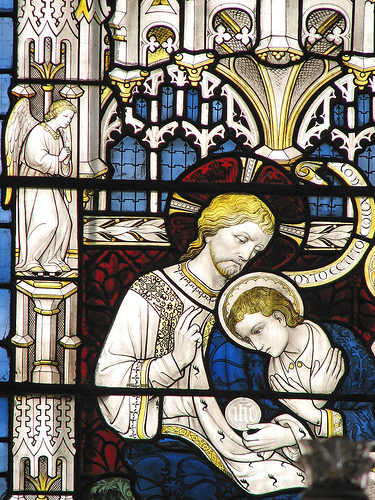


 .
.