Saturday, 22 May 2010

Peter Gomes, Out Theologian

b. May 22, 1942
There can be no light without the darkness out of which it shines.

Peter Gomes offers a look at religion from a distinctive perspective. Gomes, a Reverend and Professor at Harvard University, argues that the Bible is neither anti-Semitic, anti-feminist nor anti-gay.
In 1991, Peninsula, a conservative Harvard magazine, published a 56-page issue largely critical of homosexuality. Gomes denounced the magazine and came out publicly at Harvard's Memorial Church. A small group called Concerned Christians at Harvard immediately called for his resignation, but Gomes received support from the Harvard administration.
Renowned for both his teaching and his preaching, Reverend Gomes is the Plummer Professor of Christian Morals at Harvard and the Pusey Minister at Harvard's Memorial Church. A graduate of Bates College in 1965 and Harvard Divinity School in 1968, he also studied at the University of Cambridge, where he is an Honorary Fellow and where the Gomes Lectureship was established in his honor. Gomes holds thirty-three honorary degrees. Religion and American Life named him Clergy of the Year in 1998, and he won the Phi Beta Kappa Teaching Award from Harvard in 2001. Gomes offered prayers at the inaugurations of Ronald Reagan and George H.W. Bush.
Gomes is a widely published author. Of the ten volumes of sermons and numerous articles and papers he has written, two of his works - "The Good Book: Reading the Bible with Mind and Heart" (1996) and Sermons: "Biblical Wisdom for Daily Living" (1998) - were New York Times and national bestsellers.

Thursday, 20 May 2010

Alcuin of Tours


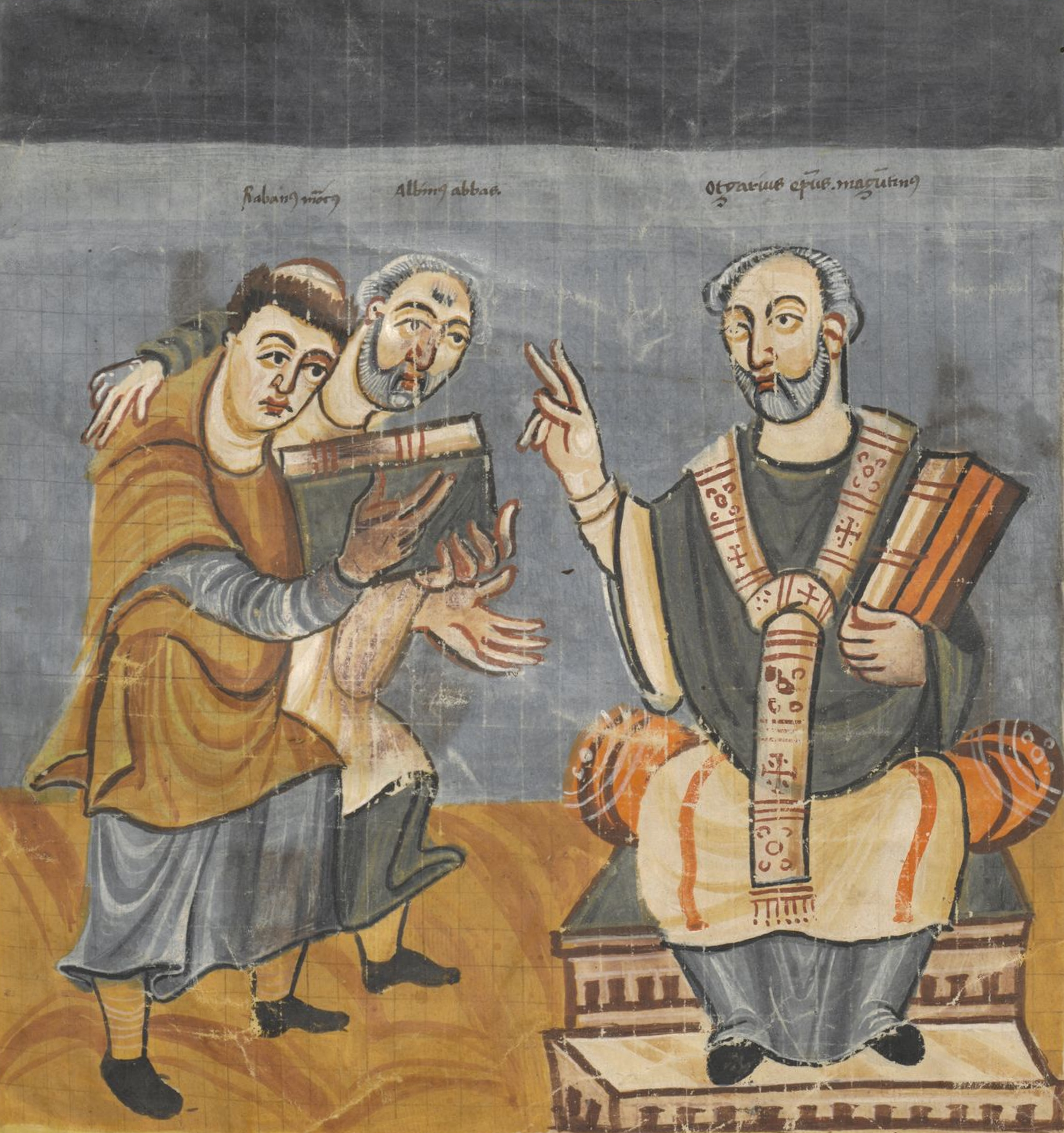
"Raban Maur (left), supported by Alcuin (middle), dedicates his work to Archbishop Otgar of Mainz (Right); Carolingian Manuscript"


Alcuin was an Englishman who, after a period as monk and teacher at the great cathedral of York, served at the court of Charlemagne, whom he had met while returning from a visit to Rome. The Emperor recruited him to his court specifically because he recognised in him the potential to achieve a renaissance of learning and church reform. Note that the widely reproduced picture of him above, as well as another extant painting, shows him presenting books of learning.

We usually think of the "renaissance", as a rediscovery of classical thought, as dating from several centuries later, but in many respects he was an early precursor.

Wednesday, 19 May 2010

Gay Bishops: How Many?

Bishop Mary Glasspool
Bishop Mary Glasspool has now been consecrated as a bishop in the diocese of Los Angeles, making her the second openly gay bishop in the Episcopal church. (There could soon be another Episcopal gay bishop. Rev Michael Barlowe is one of four candidates for a vacancy in Utah). Some sources are describing her as the second gay bishop  in history" - but that would be pushing it, and is breathtaking in its cultural myopia.  So, for context and a refresher once again of how deeply homoerotic relationships have been embedded in the Christian church, I offer some reminders.


Lesbian Bishop Eva Brunne GETTY


Mary Glasspool is the first openly lesbian bishop in the Episcopal church, but not the first globally: that would be Bishop  Eva Brunne, consecrated by the Swedish Lutherans last year.

Bishop Gene Robinson was the first modern bishop in the Anglican communion to be consecrated while openly gay, but there have been others before him who came out openly after being named bishop - for example, Otis Charles, also of Utah, Derek Rawcliffe of Glasgow and Galloway in the Scottish Episcopalian church, and Mervyn Castle of False Bay (part of the Archdiocese of Cape Town in the Anglican, "Church of the Province of South Africa").

Wednesday, 21 April 2010

On Top of the World: Marry on Mt Everest, Honeymoon With Elephants.

While the necessary legislation continues its slow progress through Nepal's parliament, the country's tourism minister is wasting no time using it to promote Nepal as a prime destination for gay and lesbian tourism. Marry on Everest, he says, and take a honeymoon safari through the Himalayas on elephant back.

From the Daily Mail:

Nepal to celebrate becoming first Asian nation to recognise gay marriages with same-sex unions on Mount Everest

Nepal is set to become the first Asian nation to allow same-sex marriages.
The country, which as recently as 2007 classified homosexuality as a crime, is even promoting gay weddings on Mount Everest in a bid to become the continent's premier gay tourism destination.
The government hopes its plans will help attract one million tourists next year, more than double the number that travelled to Nepal in 2009.

The Medieval Flowering of Homoerotic Christiantity

In the modern popular imagination, the middle ages have generally had a bad press, compared unfavourably with the classical civilizations which preceded it, the Renaissance flowering which followed it - or even the Islamic and Byzantine centres of scholarship and learning alongside medieval Europe.  However, the thousand or so years between  the fall of Rome and the high Renaissance cover a wide range of conditions. In the midst of this period, at the start of the second millenium, lies a period which deserves greater attention from anyone interested in the history of the church, or of homosexuality, or (most particularly) of the intersection of the two. This was a period of the most visible, most public "gay" sub-culture in Europe before the late twentieth century.  It was also a great age of church reform  - and despite strong pressure from vocal opponents, the church reformers generally ignored it.

Anselm of Canterbury: Gay Bishop, Gay Protector. 21/04

Anselm, Archbishop of Canterbury from 1093 - 1109, is important for the evidence he represents that the hostility of some Christians to homoerotic relationships has not always been typical of the institutional church. He has two claims in particular to attention from modern gay and lesbian Catholics. First, he is one of a band of notable medieval clerics who although personally celibate, exhibited a clear homoerotic sensibility, whose affectionate letters to his band of intimate male friends contribute to what John Boswell has described as a "medieval flowering" of a gay subculture, which was not again equalled until the latter part of the twentieth century.    He reminds us also, that just as there was then a homoerotic culture  deeply embedded in the catholic clergy, exactly the same applies today, as Mark Jordan has clearly shown ("The Silence of Sodom: Homosexuality in Modern Catholicism ").


St Anselm
Read some of these letters in Boswell, or read then on-line at Rictor Norton's Best Beloved brother, extracts from his book: My Dear Boy: Gay Love Letters Through the Centuries.  

However, he is also important as an early protector of gay men from the rising tide of intolerance that came to dominate the later medieval and renaissance periods, intolerance that persevered today, and is widely mistaken for something which is somehow inherent to the Christian faith.  

 
From the Calendar of LGBT Saints: (April 21):


The Council of London in 1102 wanted to enact ecclesiastical legislation which declared – for the first time in English history – that homosexual behaviour was a sin, and they recommended that offending laymen be imprisoned and clergymen be anathematized.
But Anselm as Archbishop of Canterbury prohibited the publication of their decree, advising the Council that homosexuality was widespread and few men were embarrassed by it or had even been aware it was a serious matter; he felt that although sodomites should not be admitted to the priesthood, confessors should take into account mitigating factors such as age and marital status before prescribing penance, and he advised counselling rather than punishment.


See Also:


The Medieval Flowering of Homoerotic Christianity
The Homoerotic Catholic Church


Books:


Boswell, John: Christianity, Social Tolerance, and Homosexuality: Gay People in Western Europe from the Beginning of the Christian Era to the Fourteenth Century


Jordan,Mark D: The Silence of Sodom: Homosexuality in Modern Catholicism
Norton, Rictor: My Dear Boy: Gay Love Letters Through the Centuries.  

Wednesday, 24 March 2010

In Memoriam: Fr Robert Carter, Priest and Gay Activist

“Since Jesus had table fellowship with social outcasts and sinners, those rejected by the religious establishment of his time, I consider myself to have been most fully a Jesuit, a ‘companion of Jesus,’ when I came out publicly as a gay man, one of the social rejects of my time. It was only by our coming out that society’s negative stereotypes would be overcome and we would gain social acceptance.”

-Fr Robert Carter

There is no contradiction between being Catholic and gay or lesbian. Indeed, just as Robert Carter says he was most fully a Jesuit when he cane out publicly, so for many of us, we are most fully   Catholic when we too come out in Church.  (I say deliberately "for many of us", as coming out is always a deeply personal decision, which may not always be appropriate for all.)

Robert Carter, Priest and Gay Activist, Dies at 82

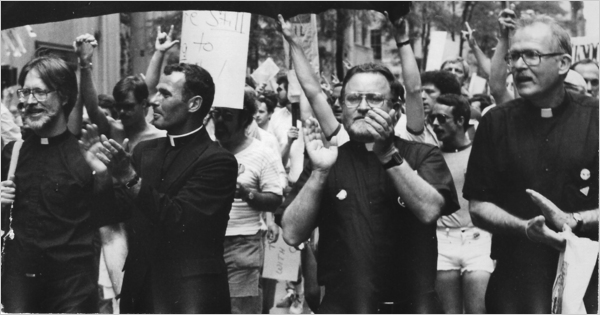
The Rev. Robert Carter, who in the early 1970s was one of the first Roman Catholic priests in the country to declare publicly that he was gay and who helped found the National Gay and Lesbian Task Force, died on Feb. 22 in the Bronx. He was 82.

[caption id="attachment_5493" align="aligncenter" width="600" caption="Robert Carter, right, with Dan McCarthy, left, Bernard Lynch and John McNeill at a gay pride march in the early 1980s"][/caption]