Friday, 6 January 2012

Three Queers from the East: Thoughts for the Epiphany

Earlier in the week, I wrote that some Bible stories are so familiar, we do not stop to consider their significance. I could also add, that some others are so familiar, we do not stop to ask if they are accurate. A case in point is that of today's feast of the Epiphany, which we routinely celebrate as the visit of the three kings of the East to the infant Jesus - but the Gospel text does not specify that there were three, nor that they were kings.
After Jesus was born in Bethlehem in Judea, during the time of King Herod, Magi from the east came to Jerusalem and asked, “Where is the one who has been born king of the Jews? We saw his star when it rose and have come to worship him.”

It is the term "magi" that has been traditionally adapted to "wise men", or corrupted in popular imagination to "kings". Astrologer-magicians, in the Zoroastrian religion, would be a more accurate translation. (Note the obvious linguistic connection between "magus" and "magic"). Kittredge quotes Nancy Wilson and Virginia Mollenkott, to suggest that the Magi were probably either eunuchs, or trans.


Thursday, 5 January 2012

Apollinaria/Dorotheos 5/01


According to the LGBT Catholic Handbook, this week sees the feast day of St.  Apollinaria /Dorotheos of Egypt (5th, 6th January). She is said to have been one of a group of transvestite saints - women who took on men's clothing  in order to live as monks.

For the specific story of Apollinaria, we turn to the Orthodox church, who take these female monks rather more serioulsy than the western church.


This is from the Orthodox website, "God is Wonderful in His Saints"
She was a maiden of high rank, the daughter of a magistrate named Anthimus in the city of Rome. Filled with love for Christ, she prevailed on her parents to allow her to travel on pilgrimage to the Holy Land. In Jerusalem she dismissed most of her attendants, gave her jewels, fine clothes and money to the poor, and went on to Egypt accompanied only by two trusted servants. Near Alexandria she slipped away from them and fled to a forest, where she lived in ascesis for many years. She then made her way to Sketis, the famous desert monastic colony, and presented herself as a eunuch named Dorotheos. In this guise she was accepted as a monk.
Anthimus, having lost his elder daughter, was visited with another grief: his younger daughter was afflicted by a demon. He sent this daughter to Sketis, asking the holy fathers there to aid her by their prayers. They put her under the care of "Dorotheos", who after days of constant prayer effected the complete cure of her (unknowing) sister. When the girl got back home it was discovered that she was pregnant, and Anthimus angrily ordered that the monk who had cared for her be sent to him. He was astonished to find that "Dorotheos" was his own daughter Apollinaria, whom he had abandoned hope of seeing again. After some days the holy woman returned to Sketis, still keeping her identity secret from her fellow-monks. Only at her death was her true story discovered.
The Handbook lists some scholarly references in support, while a look at some orthodox websites corroborates the story and confirms her feast on 5th January.  The Advent Catholic Encyclopedia. however,  dismisses the tale as 'hagiographic fiction.'

Apollinaria's story and motives are remote from our time, and 'transvestite' is not to be confused with 'transgendered'. (UPDATE: After I first described this group of women as "transvestite", I was taken to task by a reader, who pointed out that these days, "cross-dressing" is more appropriate terminology). Still, whatever the full historic truth of Apollinaria/ Dorotheos specifically, it seems to me this is a useful story to hold on to as a reminder of the important place of the transgendered, and differently gendered,  in our midst.

Many of us will remember how difficult and challenging was the process of recognising, and then confronting, our identities as lesbian or gay, particularly in the context of a hostile church. However difficult and challenging we may have found the process of honestly confronting  our sexual identities,  consider how much more challenging must  be the process of confronting and negotiating honestly a full gender identity crisis.

Let us acknowledge the courage of those who have done it, and pray for those who are preparing to do so.

Related articles


References:


Talbot, Alice-Mary: "Holy Women of Byzantium: Ten Saints' Lives in English Translation"

Anson, J., "", Viator 5 (1974), 1-32

Bennasser, Khalifa Abubakr, Gender and Sanctity in Early Byzantine Monasticism: A Study of the Phenomenon of Female Ascetics in Male Monastic Habit with a Translation of the Life of St. Matrona, [Rutgers Ph.D Dissertation 1984; UMI 8424085]
Enhanced by Zemanta

Thursday, 29 December 2011

David the Prophet & Jonathan, His Lover

The story of David and Jonathan is one of those most frequently quoted in any discussion of biblical same sex relationships. As with the stories of Ruth & Naomi, or of Jesus and John (the "beloved disciple"), it is similarly bedeviled by discussion over the degree of physical intimacy involved (was there or wasn't there?), and the impossibility of knowing for certain.
Personally, I see these questions as something of a distraction, just as I do with the other cases. Gay men are frequently accused of being "obsessed" with genital sex. If we only accept as "gay" those men for whom we know there was this genital activity, we are simply reinforcing the stereotype. I prefer simply to recognize that there was clearly a deeply intimate emotional relationship here, and to ignore the degree of physical expression. (Chris Glaser has pointed out that whatever the nature of the relationships, the stories of David & Jonathan, and of Ruth and Naomi, are the two longest love stories told in the Bible - longer than any obviously heterosexual love stories. Marriage in Biblical times was not about love. See "Coming Out as Sacrament")

However, for those who are determined to dig deeper, there is a reference by John McNeill (in Sex as God Intended) which is worth thinking about.

Tuesday, 27 December 2011

St John the Evangelist and Prochorus

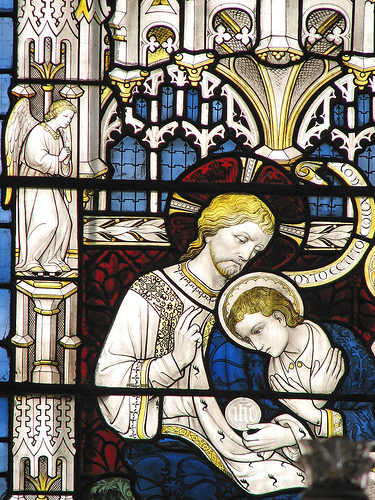
St John the Evangelist is often identified as the "Beloved Disciple" mentioned in his own Gospel, and it has been suggested that there may well have been an intimate relationship between him and Jesus. (In medieval Northern Europe, there was even a long-standing tradition that he and Christ were the bridal couple at the Cana Wedding Feast).

After Jesus had left the earth, John had a further notable and intimate (at least emotionally so) relationship with  another male disciple, this time younger than he - his disciple and scribe, Prochorus, bishop of Nicomedia. (Prochorus in turn, later formed a fresh relationship of his own with a younger man, Irenaeus,)


Dec 27th: John, the (Queer) Evangelist.

The Gospel of John is of particular interest to queer people of faith for its repeated references to the "beloved disciple", or to "the disciple that Jesus loved". These references make clear that whoever he was, this disciple had a relationship with Jesus of particular intimacy. There's the well-known scene from the Last Supper where he rests his head on Jesus' breast (or lap), and at the crucifixion, he is the only man standing among the women at the foot of the cross. He is the one to whom Christ entrusts the care of his mother - rather as a surviving spouse in marriage would assume some responsibility for the care of a mother-in-law. The existence of this special relationship  provides much of the argument for the proposition that Jesus' sexual orientation may have been what we call "gay".

St John the Evangelist, the "Beloved Disciple": December 27th

In the catalogue of "gay saints", or pairs of supposedly "gay lovers" in Scripture, the coupling of John the Evangelist (the "beloved disciple")  and Jesus himself is surely the most controversial. Many people, including some of my friends from the LGBT Soho Masses, find the whole idea that this may have been a "gay", sexually active relationship, highly offensive. Others argue the opposite case.

In an explosive book, "the man jesus loved,  the reputable biblical scholar Theodore Jennings mounts an extended argument that Jesus himself was actually gay and that the beloved disciple of John's Gospel was Jesus' lover.  To support this provocative conclusion, Jennings examines not only the texts that relate to the beloved disciple but also the story of the centurion's servant boy and the texts that show Jesus' rather negative attitude toward the traditional family: not mother and brothers, but those who do the will of God, are family to Jesus.  Jennings suggests that Jesus relatives and disciples knew he was gay, and that, despite the efforts of the early Church to downplay this "dangerous memory" about Jesus, a lot of clues remains in the Gospels.  Piecing the clues together, Jennings suggests not only that Jesus was very open to homosexuality, but that he himself was probably in an intimate, and probably sexual, relationship with the beloved disciple.
-Daniel Helminiak, Sex and the Sacred

Saturday, 24 December 2011

John Boswell

b. March 20, 1947
d. December 24, 1994

John Boswell was an esteemed historian who argued that homosexuality has always existed, that it has at times enjoyed wide social acceptance, and that the Church historically allowed same-sex unions.

"It is possible to change ecclesiastical attitudes toward gay people and their sexuality because the objections to homosexuality are not biblical, they are not consistent, they are not part of Jesus' teaching; and they are not even fundamentally Christian."


John Boswell was a gifted medieval philologist who read more than fifteen ancient and modern languages. After receiving his PhD from Harvard in 1975, he joined the history faculty at Yale University. Boswell was an authority on the history of Jews, Muslims, and Christians in medieval Spain. He helped to found the Lesbian and Gay Studies Center at Yale in 1987. In 1990 he was named the A. Whitney Griswold Professor of History.

In 1980 Boswell published the book for which he is best known: Christianity, Social Tolerance, and Homosexuality: Gay People in Western Europe from the Beginning of the Christian Era to the Fourteenth Century. In this groundbreaking study, Boswell argued against "the common idea that religious belief-Christian or other-has been the cause of intolerance in regard to gay people." The book was named one of the New York Times ten best books of 1980 and received both the American Book Award and the Stonewall Book Award in 1981.

Boswell's second book on homosexuality in history was The Marriage of Likeness: Same-Sex Unions in Premodern Europe, published in 1994. In it he argues that the Christian ritual of adelphopoiia ("brother-making") is evidence that prior to the Middle Ages, the Church recognized same-sex relationships. Boswell's thesis has been embraced by proponents of same-sex unions, although it remains controversial among scholars.

John Boswell converted to Roman Catholicism as an undergraduate at the College of William and Mary, and remained a devout Catholic for the rest of his life. He was an effective teacher and popular lecturer on several topics, including his life journey as an openly gay Christian man.

Boswell died of AIDS-related illness on Christmas Eve in 1994 at age 47.

Bibliography:
Selected works by John Boswell:
Enhanced by Zemanta