Wednesday, 9 February 2011

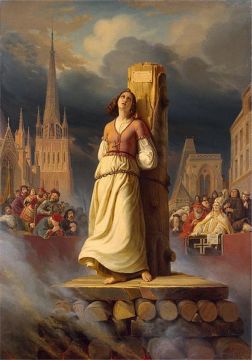
Pope Benedict, on the Queer Lessons in the Church's Martyrdom of St Joan.

At Enhanced Masculinity, I came across a post which reported on an address by Pope Benedict about the martyrdom and later canonization of St Joan of Arc. I was pleased to see this, as I have written before of the importance of Joan as a queer saint who was first martyred by the church, and later rehabilitated and honoured. Much the same will surely occur in time to those modern queer heroes who have been professionally martyred, by the Church which has deliberately destroyed their careers, for the great sin of attempting to speak the truth on sexual ethics or LGBT inclusion.


So, in addition to the significance of this address to my own arguments about the relevance of the queer saints and martyrs, it also relates to the current theological ferment on sexual ethics and widespread criticism of the institutional church. When I then crossed to the Vatican website and read the address in full, I found even more in Pope Benedict's words that can guide and inspire gay in lesbian Catholics in our struggles to withstand the hostility of the traditional, disordered teaching on homoerotic relationships.

Saturday, 29 January 2011

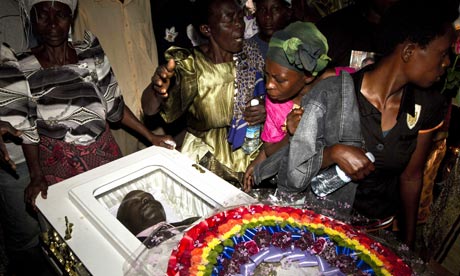
David Kato: A New Ugandan Martyr

In June each year, the Church remembers a group of Ugandan martyrs, in the feast of Charles Lwangwa and companions. This week, we as queer Christians have new Ugandan martyr to remember, in David Kanto, an openly gay church worker who was brutally murdered in a clearly homophobic attack. While we mourn his death, we should at the same time pause to reflect on both sets of deaths, and on the role of the Christian churches in fomenting African homophobia, in colonial times and in the modern world.
Charles Lwangwa and companions were a group of young pages to the king of Buganda who converted to Christianity. Encouraged by the local missionaries, they resisted the sexual advances of their royal master. For this act of treason (in the eyes of the king and the Buganda court), they were executed. For this courageous martyrdom (as the missionaries saw it), they were later canonized as saints.
This week, David Kanto was murdered.


David Kato, Martyr
David was brutally beaten to death in his home today, 26 January 2011, around 2pm.  Across the entire country, straight, lesbian, gay, bisexual, transgender, and intersex Ugandans mourn the loss of David, a dear friend, colleague, teacher, family member, and human rights defender.
David has been receiving death threats since his face was put on the front page of Rolling Stone Magazine, which called for his death and the death of all homosexuals.  David's death comes directly after the Supreme Court of Uganda ruled that people must stop inciting violence against homosexuals and must respect the right to privacy and human dignity.
-extract from public statement by Sexual Minorities Uganda


Thursday, 6 January 2011

Joseph and His Fabulous Queer Technicolour Dreamcoat.

Sometimes, stories and images are so familiar to us, that we completely fail to see their significance. The story of Joseph and his coat is familiar to us all from childhood Bible stories - and even more familiar as Lloyd-Webber's Joseph and His Amazing Technicolour Dreamcoat. Ignore the main story for now, and just focus on that coat of many colours.

In the modern world, colour is everywhere, so much so that we hardy notice it unless it is used particularly well, or until it is unexpectedly absent. It was not always so. In the Biblical world, clothing was mostly drab: dyes of all kinds were costly , brightly coloured cloth of any kind was an expensive luxury. It is not surprising that Joseph's brothers would have been jealous of the special favour shown by their father, and wished to sell him into slavery.

Joseph sold into slavery, Edward Knippers
;
But there could be more to the story than first appears: this was not just a coloured coat, but a very specific type - a coat of many colours, in stripes. Just such a coat was typically worn by a specific group of people - a distinctly queer group.

Tuesday, 4 January 2011

Queer Gods, Demigods and Their Priests: The Middle East

(For a proper understanding of the place of homeroticism in Jewish and Christian history, it is instructive to contrast it with its place in other religions. I have described previously how many religions not only accept a recognized and important place for same sex love, but even identifyspecific patrons of homosexual love. I now propose to consider the many other gods and goddesses who either took same sex lovers themselves, or were served by sexually or gender non-conforming priests  and priestesses. I begin, as any account of the development of civilization must do, in the Middle East.)
Same sex love is a common theme in world religion and its literature, and is even present at the very beginning of literary history. The Epic of Gilgamesh is the world's oldest work of literature - and includes a central theme of love between two men. The hero Giligamesh was the king of Uruk, described as two thirds god and one third man, and a giant in size and strength, with a prodigious sexual appetite. He routinely used his strength and royal power to take advantage of both young men, taking them from their fathers, and young women, taking them from their husbands. To protect their sons and wives from the kings lust, the people turn to their gods, and in particular the creator goddess Aruru, pleading with her to send Gilgamesh a companion on whom he can expend his energies. Aruru responds, and sends to Gilgamesh a man, Enkidu, who is massive in size, inspiring in physique, hairy like an animal, and with luxuriant tresses of hair "like a woman".

Gilgamesh's Grief at Enkidu's Death


The subsequent relationship between the two, their adventures together,  Gilgamesh's grief after Enkidu's death and their subsequent reunion in the afterworld with Enkidu's ghost form the meat of the epic. The content is not explicitly homoerotic, but there are clear erotic undertones. Enkidu was created to divert the king's sexual appetite from his subjects, and there is no indication that such a prodigious sexual energy suddenly evaporated. At one point, Gilgamesh even declines a direct sexual invitation from the goddess Ishtar - preferring his male companion Enkidu. Recalling the words of  the biblical prophet David about Jonathan, it is said that Gilgamesh loved Enkidu "like a wife".
Discussing the erotic element in their relationship, the biblical scholar Marti Nissinen ("Homoeroticism in the Biblical World") makes an interesting point, one that will be familiar to many gay men in the modern West, and should give pause to those who insist that sex between men may be permitted in a committed, permanent relationship, but not before:
At first, the Epic of Gilgamesh can be described as a characterization of love between two men, with a homoerotic aspect that expresses their deep friendship......At the beginning, there is plenty of sex in the lives of Gilgamesh and Enkidu, but this lifestyle is presented as primitive and reckless. ....As the story proceeds, the relationship deepens and, simultaneously, the sexual passions seem to subside to the point that one can speak of a "spiritual" friendship between the two men. The erotic tension between Gilgamesh and Enkidu is not lost, but is transformed in the way that the same - sex interaction of the two men finally is characterized by love, with little if any sexual activity. Eroticism is important first and foremost as the impetus to the transformation which leads first from savage sexual behaviour to mutual love, and finally away from physical sex.
This process will be familiar to many modern gay men. In place of the romantic stereotype of a slowly blossoming chaste courtship, followed by a grand wedding and only then by sexual consummation, the pattern is more usually reversed.  Possibly influenced by the absence in practice of opportunities for more conventional courtships between men to develop, possibly by the more frankly sexual interests in relationships of men compared with women, the majority of gay male relationships begin with sexual encounters on or soon after a first date. Some of these develop into lasting friendships, and then some into lasting, committed unions.


Elsewhere in the Middle East, it is not the gods who were queer, but their priests and priestesses. There is a wealth of material on this, but two extracts from de la Huerta make the point in summary:
In ancient Mesopotamia, the Goddess Innana (also known as Ishtar) was considered the patron of the sinnisat zikrum, a class of gender-variant and possibly lesbian princesses. Likewise, she was also honoured and served by the kulbu, gender-variant male priests, which included the assinu and the kurgarru. Both male and female functionaries wore androgynous attire combined with sacd vestments and were considered to hold special powers. It was believed, for example, that the simple act of touching an assinu’s head would lead to victory in battle, while the mere sighting of a kurgarru was thought to bring good luck.
The Canaanite Goddess Ashtar was also served by a class of gender-variant priests, called qedeshim (the "holy ones") who were responsible for the upkeep of the temple grounds and the creation of ritual objects. They were said to engage in sacred temple prostitution and may have used sexual practices as a way to induce enhanced states of consciousness.
-De la Huerta, p 32 (after Conner, Blossom of Bone)
In Egyptian mythology, there is an important reminder that sex (whether between men or between a man and woman) was not always an expression of love, but was frequently an expression of power and aggression. Seth, the murderer of his brother Osiris, summons Osiris' nephew Horus, ostensibly to achieve some reconciliation. Instead, he attempts to rape him while Horus is asleep, thus putting him into a sexually subordinate position, which would leave him unfit for kingship. Instead, the younger man turns the tables by getting some of Seth's sperm in his hand, which he later mixes with his (Seth's) food. By taking male sperm, into his body, it is Seth who becomes unfit for kingship.

Recommended Books
Connor, Randy P, and Sparks, David: Cassell's Encyclopedia of Queer Myth, Symbol and Spirit 
De la Huerta, Christian: Coming Out Spiritually: The Next Step

Related Posts:
Some Gods of Homosexual Love (Queer Saints and Martyrs) 
Chin, Mayan Gay God (It's a Queer World)
The Chinese Rabbit God (It's a Queer World)

Friday, 31 December 2010

The Story of the "Queer Saints and Martyrs": Taking Shape

Ever since I began writing for the Queer Church, one of the key themes I have been exploring has been that of the place of LGBT men and women in Christian history - recognized and unrecognised saints, martyrs for the church, some who have  been martyred by the church directly or indirectly, and those who have achieved remarkable high office in the church, as popes, bishops or abbots in spite of clear homoerotic interests and activities.

As I have explored individuals and notable groups, I have been seeing the outline of a narrative thread underlying them, which I have been using to draw them together into what I hope will become a book for publication. The outline for the book I have previously published, as a synopsis, and as a reflection of the feast of All (Gay) Saints. I have now expanded this synopsis one level, which I will be posting in instalments over the coming week, under six main divisions. For a preview of these posts and the work in progress, follow the links to my  "Queer Saints and Martyrs" pages here at Queering the Church, and from them to the detailed posts on individuals and groups at my satellite site, "Queer Saints and Martyrs - and others".

Prologue: Before Christianity

Same sex relationships in other religions, in the stories of the Hebrew Bible/Old Testament, and in the Gospels (before the disciples of Christ came to be known as "Christians")

The Early Christians: Saints and Martyrs for the Church

From both the Western and Eastern Roman Empire, a wide range of men (and fewer women). These include pairs of lovers, martyrs for the church, bishops who wrote homoerotic verse, and cross-dressing women.

Christian Homoeroticism in the Middle Ages: Saints and Others

Boswell has been criticized by more recent academics for his assertion that the Middle Ages represented a great flowering of a gay sub-culture. However, even if he overstated his case and the term "gay" for this period is subject to misinterpretation, there is no doubt that there were numerous recognized saints and other senior clergy who freely used homoerotic imagery in their spiritual writing, and  others who are notable for achieving high office as popes or bishops, in spite of well-known erotic relationships with men.

The prevalence of such relationships among the clergy prompted the most important of the calls for strong penalties against "sodomy", by Alain de Lille and St Peter Damian in particular. For a long time though, these calls were rejected by the leaders of the Church.

The Great Persecution: Martyred by the Church

The figure of Saint Joan is of central importance to queer Christians, as a cross-dressing queer saint who was first martyred by the church, and later canonized.  As the Middle  Ages passed into the Early Renaissance, many thousands more alleged sodomites were tried and condemned to death by the church, either directly by the Inquisition or by secular authorities at its instigation.

Ecclesiastical involvement in these trials later gave way to purely secular proceedings, but the initial pseudo-religious motivation for declaring same-sex love a capital offence remained an important factor in the retention of the death penalty in many European countries right up to the nineteenth and twentieth centuries, and for the export of state-sanctioned persecution by the colonial powers to societies which had previously tolerated or even celebrated sexual minorities.

As secular authorities relaxed or withdrew criminal sanctions though, religious authorities applied a form of figurative martyrdom to gay or lesbian identified people in the church, attempting to censor the writing of theologians who dissented from the orthodox prohibitions, or excluding from ministry those who were seen to be gay or lesbian.

Modern Saints, Modern Martyrs.

In the early church, it was said that the growth of the faith was fed by the blood of the martyrs. Much the same thing appeared to be happening at the close of the twentieth century and start of the twenty first. "Martyr" means one who gives witness, and the witness of the LGBT identified men and women who refused to be silenced by the Church authorities has inspired many more. Over the last few decades there has been a great flowering of writing on faith and spirituality from a queer perspective, and of explicitly queer ministry.

Epilogue: All Saints, and the Call to Witness

"Sainthood" in Christian theology is not simply a matter of those few who have been formally recognised and canonized by the Catholic Church, but is a state to which we are all called.
Tuesday, 21 December 2010

Modern Heroes: Bernard Lynch

I have serious reservations about any plan to out all gay Catholic priests, as described on the website of Church Outing I firmly support the principle of outing those who actively campaign against us, but particularly bishops, senior clergy, and individual priests who clearly ally themselves with the church’s public stance. However, for the rest, we should remember that we do not what individual priests are saying to people where it matters, in private. Silence need not mean consent: it can also indicated passive resistance. Recognising also the immense personal cost that can be involved for individual priests to come out, I prefer take the opposite route. Rather than naming and embarrassing those who would prefer to remain private, I would like to pay tribute to the great courage and honesty of those few who have indeed come out.


I would like to begin by introducing you to the London priest for Bernard Lynch, who was one of the founders of the Soho Masses 10 years ago, and who rather conveniently for me, unintentionally outed himself on national television on Saturday night. (Conveniently for me, because I can now write about this with full confidecne that I am not giving anything away. As he said to me after Mass last night, it can’t get him into any more trouble with the diocese than he is already in.) Now when I say he outed himself, I do not mean outed as a gay man, or even as a gay priest. No, he did that many years ago. Nor by “unintentionally” do I imply that he would prefer to remain private. No, he regularly introduces himself and his status fully and frankly. However, it was totally unintentional, as he had no idea the cameras and mic were running. This is how I chanced to see it.
My partner Raymond and I were at home on Saturday evening watching a BBC documentary on the English playwright Allan Bennett. (Raymond is a huge Bennett fan). One sequence showed Bennett as a guest of honour at the opening of new premises for a north London health centre. After the speechifying, there were background shots of the assembled crowds – and suddenly I saw Bernard in the centre of my screen. Briefly, he found himself introducing himself to the playwright, with the words, “I’m a gay man… and married”. Then, just before the camera moved on, he added, “and a Catholic priest.” Fr Bernard Lynch, introduced to the viewers as not just gay, not just a gay priest, but gay and legally married to his husband Billy.
Bernard’s honesty though has come at great personal cost. Years ago, while working in New York, he came under intense pressure as an openly gay priest, doing extensive pastoral work among people with AIDS, even facing prosecution for alleged improper behaviour with boys in the school where he was chaplain – allegations which were clearly shown to have been without foundation, and may well have been fabricated with malicious intent. (how ironic is that, when so many genuine abusers identified by the bishops have never faced criminal charges, and have simply been transferred or placed on “administrative leave”?)
Now based in London, Fr Bernard has a fraught and tense relationship with the local diocesan authorities, who refuse to grant him faculties to say Mass in a Catholic church. He does however, have the support of his order, and so is able to pursue a priestly ministry in private, especially as a spiritual director and psychotherapist.
Although I was living on the wrong side of London for it to be really viable, I did see Fr Bernard myself for a while for some direction, which I always found enriching and deeply thought-provoking. He had one key question which he asked on every occasion: “Where have you found joy? For joy is the unfailing sign of the Holy Spirit”. This observation I always found useful and enlightening then – and still do now.
Thank you, Fr Bernard Lynch.
Enhanced by Zemanta

Tuesday, 14 December 2010

St John of the Cross: 14th December

John of the Cross is important for queer Catholics, especially gay men, for two reasons. First, because he is a great teacher of spirituality, and the cultivation of spiritual practice, by enabling a more direct experience of the divine, is an excellent way to immunize ourselves from toxic and misguided teaching on human sexuality. Second, and more interestingly, because his language at times uses imagery which is plainly homoerotic, and so easily usable by gay men in their own prayer.


From the Calendar of LGBT Saints:

1542-1591

St. John of the Cross was one of the great Spanish mystics, whose outstanding Dark Night of the Soul is still read by all interested in Catholic mysticism. He also wrote a series of intense religious canticles. St. John, like other mystics such as St. Theresa of Avila, used the language of courtly love to describe his relationship with Christ. He also discussed, with rare candor, the sexual stimulation of prayer, the fact that mystics experience sexual arousal during prayer. With the male Christ of course, this amounts to a homoeroticism of prayer. It must be said that St. John was not entirely happy with this aspect of prayer. He was beatified by Clement X in 1675, canonized by Benedict XIII in 1726, and declared a Doctor of Church Universal by Pius XI in 1926


Quoted at The Wild Reed:
(from ) On a Dark Night

……..

……..
“Oh, night that guided me,
Oh, night more lovely than the dawn,
Oh, night that joined
Beloved with lover,
Lover transformed in the Beloved!

Upon my flowery breast,
Kept wholly for himself alone,
There he stayed sleeping,
and I caressed him,
And the fanning of the cedars made a breeze.

The breeze blew from the turret
As I parted his locks;
With his gentle hand
He caressed my neck
And caused all my senses to be suspended.

I remained, lost in oblivion;
My face I reclined on the Beloved.
All ceased and I abandoned myself,
Leaving my cares
forgotten among the lilies.”

See also:

Homoerotic Spirituality

The Intimate Dance of Sexuality and Spirituality

Enhanced by Zemanta