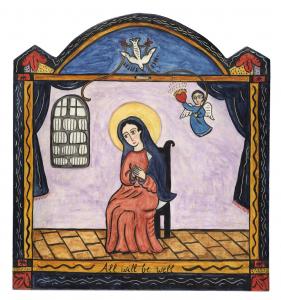
Friday, 20 July 2012

Uncumber [or Wilgefortis] 20/07

A wonderful example of a sainted bearded lady?

Wilgefortis

Friday, 29 June 2012

St Paul, Apostle to the Gentiles

There is much that is paradoxical in the figure of Paul. In his dual persona as Saul / Paul, he is renowned as both a one-time feared persecutor of Christians, and as the greatest of all the early missionaries, who spread the word far beyond it s original geographic compounds, and author of by far the most influential Christian texts outside the Gospels themselves. In the same way, as the author of the most infamous New Testament clobber texts, he is widely regarded as strongly condemning homoerotic relationships - and yet  Paul Halsall lists him in his Calendar of LGBT Saints:
There is considerable debate over those anti-gay "proof -texts", but whatever the conclusions, there is much, as Anglican Bishop of Newark John Spong has pointed out, which leads one to suspect Paul might have been "queer" in some way. The fact he was never married, unusual for a Jew of his time, his companionship with a series of younger men, especially St. Timothy, his mention of an unnamed "thorn in the flesh". and, possibly, his disdain for some types of exploitative homosexual relationship in his period, all raise questions, questions which cannot be answered it must be admitted, about his sexuality.
What are we to make of this?


First, let us dismiss the idea that Paul's writing is anti-gay: it isn't, and further, much of his message is precisely the opposite, arguing for full inclusion of all. For a counter to the standard view of Paul as anti-gay, anti-sex, see Reidulf Molvaer, Sex & St. Paul the Realist
St. Paul was, in many ways, an ascetic and happy to be so, but he refused to make asceticism a general model or ideal for Christians - most people cannot live by such principles, especially in the area of sex. In the seventh chapter of his first letter to Corinth, he rejects any appeal for his support of sexual abstinence as ethically superior to active sexual relations. He sets limits, but does not limit legitimate sexual relations to marriage. In his day, it was commonly believed that homosexual practice, more easily than heterosexual relations, could bring people into harmony with the unchangeable nature of God. This Paul strongly rejects in the first chapter of his letter to Rome. Otherwise he does not write about "natural" homosexuality. In fact, it is a logical inference from the principles he sets forth in his letter to Corinth that loving, lasting homosexual relations are ethically as valid as heterosexual relations. Dr. Molvaer maintains that insight into contemporary ideologies can be a help to understanding what the New Testament says about these matters. Today, as in the early Church, extraneous influences in these areas can easily distort genuine Christian moral concerns as they are stated by Christ and St. Paul.
Then, consider his person. Astonishingly little is known for certain of Paul the man, but Bishop Spong is not the only one to have suggested that Paul may have had some close same-sex relationships  of his own. Gay Catholic blogger Jeremiah Bartram (Gospel for Gays), who recently spent time on a pilgrimage "in the footsteps of St Paul" has reflected deeply on the life and writign of Paul, and concluded that on balance, the suggestion is sound ("Gay Paul").

In the absence of hard evidence, personally I am happy to leave this discussion to others with greater scholarship and expertise behind them. My interest in the queer saints is in the lessons they hold for us today, and here I think there is one clear message, which lies in the best known story of al about Paul, his conversion on the road to Damascus. This has entered language as a "Damascene Conversion", and therein lies hope. For if Saul, the renowned persecutor of Christians, could undergo such a complete change of heart and become instead active as the most famous proselytizer,  so too is there hope for the religion -based persecutors of sexual minorities today. Not only is there hope, but there is already abundant evidence from the very many Christians in the modern world who have experienced just such Damascene conversions, going from direct, outright condemnation of same sex relationships, to actively advocating full inclusion in church.   These changes of heart, usually coming after intensive study of Scripture and extensive discussions with gay and lesbian church members, have already been responsible for changes of policy in several denominations, and a more welcoming atmosphere in many local congregations. This process will continue.

For those Catholics who like to pray to the saints, you can freely include St Paul in you prayers. This is not because he was queer (although he may have been), but because his own conversion experience provides a useful model for all those modern day conversions that we need among the bigots who use religion as a cloak for prejudice and discrimination.

Friday, 22 June 2012

St. Paulinus of Nola, bishop 22/06

Although some would dispute the description of Paulinus as 'gay', the description seems to me entirely appropriate to his sensibility. Although history records no evidence of physical expression of his same sex attraction, nor is there any evidence against it.  Given the historical context he was living in (4th/5th century Roman empire) , when sex with either gender was commonplace for men at at all levels of society, inside and outside the Christian church, the absence of written records of private activities after 15 centuries is completely unremarkable.  Nor is the fact that he was married particularly significant - for Romans, marriage and sex with men were entirely compatible.  

Saturday, 2 June 2012

Rev. Phebe Ann Coffin Hannaford, Pioneering “Lesbian” Minister

b. May 6, 1829
d. June 2, 1921

Gay and lesbian clergy have been around for a long time - right from the start of ordained ministry (barring some quibbles over terminology: the words “gay” and “lesbian” do not apply directly to the earliest years). Even in modern times, there are numerous reports of openly gay or lesbian clergy going back a lot further than I had recognised. Among many who are described as the “first” in one or other specific field, the earliest clear example I have come across (so far) is Phebe Ann Coffin Hanaford, who was raised a Quaker,where she was accustomed to full participation by women,  was briefly a Baptist, and finally ordained in the Universalist church in 1968, claiming to have been the first woman of any denomination ordained in New England.  She was also plainly and openly “lesbian”, many years before the term or concept was widely recognized.


Phebe Ann Coffin was born into a Quaker family in Siasconset, on Nantucket Island, Massachusetts, the only child of the merchant and shipowner George W. Coffin and his wife Phebe Ann (Barnard) Coffin. Both were Quakers and direct descendants of the island's first white settlers, Tristram Coffin and Peter Folger.
Phebe lived amidst women who bore the responsibilities of daily life as the whaling men were at sea. These two influences made Phebe an extraordinarily independent woman. She was educated in public and private schools on the island, tutored in mathematics and Latin and her talents were encouraged at home. She was a formidable scholar and active reformer: she wrote the first biography of Lincoln to be published after his death, and was active in both the abolitionist and women’s movements.

She spoke openly of her desire to be a Quaker preacher. She took the pledge at the early age of 8 and at age 18 was chaplain and treasurer of the Daughters of Temperance and Deputy Grand Worthy Chief Templar in the Grand Lodge of Massachusetts.

She taught school on Cape Cod and in Nantucket until her marriage in 1849 to Dr. Joseph H. Hanaford, a homeopathic physician and school teacher. She joined her husband's Baptist church. Their son, Howard, was born in 1841 and their daughter, Florence, in 1854.

Living in Beverly during the Civil War, her commitment as an abolitionist led her to relinquish her Quaker pacifism. As her marriage was failing she supported and educated her children with her writing. Her contact with Universalist women opened up a world of activism for the rights of women. In 1868 she was ordained a minister in the Universalist church. From 1874, she was pastor to a congregation in New Jersey, but after her initial three year term, controversy arose over her reappointment which she did not get.

The controversy was nominally over her involvement in the “women’s issue” (ie, the suffragette movement), but in reality it was her relationship with coworker Ellen Miles, which had begun in 1870. Newspaper clippings preserved in Hanaford's scrapbook reported that the disgruntlement among congregation members was, in fact, over Hanaford's liaison with Miles, whom the papers called the 'minister's wife.' Hanaford, it seems, was not simply asked to cease her women's rights activities, but more specifically, to 'dismiss' Miss Miles... their letters testify to a deep and abiding affection. The two remained life-long companions, separated after forty-four years together only by Miles's death in 1914.

After her failure to be reappointed in New Jersey, she attempted to set up a new congregation of her own. However, when her dissident New Jersey congregation applied for formal recognition and was rejected by the General Universalist Convention in 1878, Hanaford had no settled pulpit, and for years she conducted lecturing and preaching tours across New England and the Middle Atlantic and Western states. Deprived of formal ministry, she created a successful independent ministry of her own – ultimately achieving high honour in the early twentieth century , when she was asked to officiate at the at the funeral services for two leading women's rights activists of the nineteenth century: the feminist philosopher Elizabeth Cady Stanton and the woman-suffrage organizer Susan B. Anthony. The two friends, who had shared a life of labor, died within four years of each other, and Hanaford had known them both well.

After Ellen's death Phebe lived with her granddaughter in Basom, New York where she was isolated from the activities she enjoyed. Both her children predeceased her. She voted in the New York election but not in the federal election of 1920. The family moved to Rochester, New York where she died alone in her bedroom. She was buried in an unmarked grave in Orleans, New York next to her daughter Florence Hanaford Warner.

There is a great deal in the story of this remarkable woman for us to reflect on and learn from. The story of her extraordinary achievement as a woman in defying and transcending gender boundaries as an impressive scholar and pioneer female ordained minister is remarkable in itself. Thereafter, after commencing a new life committed to a woman, she was confronted by a demand from her congregation to give up her partner and conform, or to face the loss of her ministry.  Courageously, she chose commitment and truth over expedience, and paid the price. She persevered independently for decades, forging an independent ministry where she was unable to work within the formal structures – and ultimately achieved honour and recognition for it.

Rev Hanaford deserves to be better remembered and celebrated.

Source:

A Paper Trail: Piecing Together the Life of Phebe Hanaford

Enhanced by Zemanta

Wednesday, 30 May 2012

St. Joan of Arc

Among all the multitude of queer saints,  Joan of Arc is one of the most important. In her notorious martyrdom for heresy (a charge which in historical context included reference to her cross-dressing and defiance of socially approved gender roles), she is a reminder of the great persecution of sexual and gender minorities by the Inquisition, directly or at their instigation. In LGBT Christian history, "martyrs" applies not only to those martyred by the church, but also to those martyred by the church. In her rehabilitation and canonization, she is a reminder that the leaders and theologians of the church, those who were responsible for her prosecution and conviction, can be wrong, can be pronounced to be wrong, and can in time have their judgements overturned.(This is not just a personal view. Pope Benedict has made some very pointed remarks of his own to this effect, while speaking about Joan of Arc).  In the same way, it is entirely possible (I believe likely) that the current dogmatic verdict of Vatican orthodoxy which condemns our relationships will also in time be rejected.  We may even come to see some of the pioneers of gay theology, who have in effect endured a kind of professional martyrdom for their honesty and courage, rehabilitated and honoured by the Church, just as St Joan has been.


Joan of Arc Iinterrogation by the Bishop  of Winchester (Paul Delaroche, 1797 -1856)
Joan of Arc:  Interrogation by the Bishop  of Winchester (Paul Delaroche, 1797 -1856)

Joan of Arc is the best known cross-dresser in history, defying gender expectations to lead an army, and lead it to victory in the service of her country.  This much is well known, and immediately qualifies her as a trans hero (or heroine.  Take  your pick.) What of the ret of us? Well, remember her story in the church as well as the battlefield:  she was burned as a heretic, before her later rehabilitation and eventual canonization. Now recall the association of heresy and “sodomy”.

John Boswell has clearly shown that the religious opposition to homoerotic relationships was not based in scripture, nor was it deeply entrenched in the early church. Instead, the opposition of the church followed, not led, popular intolerance that grew with the decline in urbanisation after the sack of Rome.  This growth in intolerance was not only directed at homosexuals, but also at other social outsiders – jews, gypsies and “heretics”. Writers such as Mark D Jordan and Allan Bray have since shown how the very word “sodomite”, now widely used  as a pejorative epithet against gay males, was a late medieval coinage which was originally used far more loosely and indiscriminately, often including ay other form of sexual non-conformism – or heresy.

So what was the crime of “heresy” of which she was accused? Well, nominally it was based on her claim to have seen “visions” which inspired her to follow her path of resistance to the foreign invaders.  But note the nationality of her accusers:  it was not the French Church which tried and judged her, but the English Bishops:  countrymen of the army she had opposed and defeated. Was her crime to have experienced visions, or was it to have opposed the English?


Joan of Arc
Joan of Arc at the Coronation of Charles VII: Ingres


Consider that which has made her most famous, iconic as an historic figure:  the cross-dressing.  This was a clear violation of her expected gender role, and may have been described by some as “sodomy” – which was closely related to heresy.  I have recently seen a claim (sadly, I have no link) that the real reason for her trial and execution was this cross-dressing.  If so, she is the first Christian martyr we know of who was executed not just executed and was gay, but executed because of her gender expression. However, there is of course a happy ending: she was later rehabilitated, and canonized. Now consider the obvious moral for us as GLBT Christians today.
Joan had a “vision”, an apparition of Mary. There are also other kinds of vision, some more mundane, more political, of the Martin Luther King “I have a dream”.  In this sense, many of us too have a vision, a dream, of proper inclusion and acceptance in the Christian churches, where we belong with everybody else, on the strength of the promises of Christ.
Joan was persecuted by the church authorities, condemned and executed.  We are not (directly) executed by the church today, but we are certainly condemned and persecuted, labelled as “fundamentally disordered”, and told that if we simply live truthfully in our god-given sexuality,we are committing “grave sin”.  Worse, by the clear failure to take a strong stand against civil laws and proscriptions, as for example the failure to sign the UN resolution on the decriminalisation of homosexuality early this year, the Church is indirectly giving support to some forces that do actively seek our death.
But in the end, she was vindicated.  We have not yet seen that development, but I am certain it will come. It is required by the Gospel of inclusion and social justice, it is also required by the internal logic of theology. James Alison has recently noted that theology will in time be forced to face up to the plain finings of science that  same sex relationships are not unnatural, just uncommon.  They have occurred throughout history, in many societies, and across the animal kingdom. Theologians will be slow to catch up, but they will, and we too will be vindicated.
St Joan of Arc and the queer community: we have a lot in common.


Further reading;

Related articles at QTC:
Related articles elsewhere:


Enhanced by Zemanta

Thursday, 10 May 2012

Catholic Queer Families: SS Bernard of Clairvaux and Malachy

The Queer Families of the Catholic Church

The book of Ruth reminds us of the diversity of families in the Bible, as I discussed yesterday.Immediately afterwards, I began preparing a post on the pair of saints Bernard of Clairvaux and Malachi. With queer families fresh in my mind, it occurred to me that one specific form of queer family has a long, established history in the Catholic Church - our religious houses, the monasteries, convents and other communities.

When I shared this thought with Bart, he pointed out some more:

The Catholic Church, of all institutions, should know better than to blurt such rubbish about the definition of family. It has been using the term family in the extended, spiritual sense for centuries now, with words like brother, sister, mother and father used within the context of religious societies for just as long a time. And the Church never seemed to worry that they were single-parent families either (only a Mother, or a Father, though female orders were always attached to a male order for reasons that we don't need to go into here). And, please note, they were ALWAYS single-sex families, veritable hothouses of homoerotic love if not sex.

Bart's distinction between homoerotic love and homoerotic sex is an important one. There are numerous examples of same sex monastic lovers in Church history, although we do not usually know if this had any physical expression. Sometimes there may have been physical love, frequently we may be sure, there was not.  I found this description of the relationship between Bernard of Clairvaux and Malachy in "Know My Name", by the gay liberation theologian Richard Cleaver.

Bernard of Clairvaux and Malachi
Bernard lived in community with other men and shared intense, loving relationships with them. This experience directly informed the theological work that brought Bernard the title Doctor of the Church.
It is no accident that a major vehicle of Bernard's teaching was a series of sermons on the Song of Songs, the erotic poem that is also sacred scripture. His reading reflects his experience - outer and inner - of emotional attachments to men. We are accustomed to considering his experiences "mystical", a term that in this context might as well be "magical". This is because we have fallen for the Platonic fallacy that flesh and spirit are completely at odds.
Bernard's life gives this notion the lie. Another of his many works, Life of St. Malachy, is based on his personal friendship with Archbishop Malachy of Armagh. It contains a description of their second meeting, shortly before Malachy died in Bernard's arms. Bernard's account makes deeply romantic reading for a modern gay man. "Oscula rui", Bernard says of their reunion: "I showered him with kisses". Geoffrey of Auxerre tells us what happened later. Bernard put on the habit taken from Malachy's body as it was being prepared for burial at Clairvaux, and we wore it to celebrate the funeral mass. He chose to sing not a requiem mass but the mass of a confessor bishop: a personal canonization and, incidentally, an example of using liturgy to do theology. Bernard himself was later buried next to Malachy, in Malachy's habit.
For Bernard, as for us today, this kind of passionate love for another human being was an indispensable channel for experiencing the God of love. Like the Cistercian commentator on the Song of Songs, we modern gay men know the transcendent meanings of erotic experience and the ways it can teach us. Many gay men have turned from Christianity to other spiritual traditions, especially nature religions, because the richness of Christian experience on just this point has been concealed from us. But, like the mystics, we have refused to sever our physical experience, including our erotic experience, from our interior lives. This body wisdom is one of the anchors of our lives, a pearl for which we have paid dearly in persecution. It is one of the gifts we have to offer to the people of God.
-Cleaver, Know My Name

The reference to the Song of Songs is important, as a reminder of how strongly erotic imagery (including homoerotic imagery) is associated with the Christian mystical tradition. Cleaver is right to point out that for those who are not tied by vows of celibacy, erotic experience is not antagonistic to spirituality, but may even enhance it. (The Presbyterian theologian Chris Glaser has written movingly of how spirituality and sexuality can complement each other).

Finally, Bernard's union with Malachy in death, buried alongside him, is a further reminder of how shared burials of same sex couples on Church ground was once commonplace, in 4th and 5th century Macedonia, across medieval Europe, and even in Victorian England (Blessed John Henry Newman and Ambrose St John).

Queer families: hidden in plain sight, right through Christian history.

Books:
Bray, AlanThe Friend

Related articles elsewhere


Tuesday, 8 May 2012

All Will be Well, and All Shall Be Well: Julian of Norwich, 8th May

There is no way that we should be thinking of Julian as gay or lesbian, but we should certainly think of her as queer (and as, she was undoubtedly female, in spite of her name). There are two reasons for including her here. The first is her pioneering unequivocal feminism. These are shown by her gender bending references in her book to God as mother - and even to Jesus as "mother Jesus", which are habits for us too to acquire in our prayer. In her own career, she was remarkable for producing the first book to be written in English by a woman. Can we think of her as the first feminist theologian?
"The Mother can lay her child tenderly to her breast, but our tender Mother Jesus can lead us easily into his blessed breast through his sweet open side, and show us there a part of the godhead and of the joys of heaven with inner certainty of endless bliss.

The second is the fundamental nature of her spirituality, which was centuries ahead of her time, and can be especially valuable to those who, like the LGBT community, feel threatened by an accusatory and hostile  institutional Church.  Here, it is important to note that her optimistic spirituality, as indicated in the well-known quotation in my headline, is not simply a Panglossian, mindless "always look on the bright side". There is a very sound theological basis for it, made clear in an expanded formulation of the idea:
"And so our good Lord answered to all questions and doubts which I could raise, saying most comfortably: I may make all things well, and I can make all things well, and I shall make all things well, and I will make all things well, and you will see yourself that every kind of thing will be well".
All will be well - because God has promised to make them well. Hope is a virtue - and optimisim a theological obligation.

Julian (not her birth name) was born in 1342. At the age of 30, she fell dangerously ill, coming close to death. At this time, she experienced a series of mystical visions on the Passion of Christ and on the love of God. After her recovery, she became an anchoress, and recorded her experiences which she described as "showings", in her book. She is renowned for her insistence in these on God's unbending love and care for Her people, which was unusual for a time when religion was seen in much stricter, more judgemental terms of avoiding eternal damnation.

Read "The Showing Of Love" on-line
The "Umilta" website has an astonishing collection of links to scholarly work on Juliana and her times ( including this useful one : Equally in God's Image  Women in the Middle Ages
Friends of Julian describes itself as the  "official" Julian website. I don't know on what authority they make the claim, but the site is at least attractive and informative.