Showing posts with label transvestite saints. Show all posts

Thursday, 1 November 2012

Nov Ist : All (Gay) Saints

Are there gay saints? Some sources say clearly yes, listing numerous examples. Others dispute the idea, saying either that the examples quoted are not officially recognised, or denying that they were gay because we do not know that they were sexually active. Before discussing specifically LGBT or queer saints, consider a more general question. Who are the “Saints”, and why do we recognise them
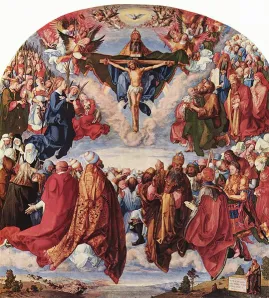
?All Saints Albrecht  Dürer
Richard McBrien gives one response, at NCR on-line:
There are many more saints in heaven than the relatively few who have been officially recognized by the church. “For every St. Francis of Assisi or St. Rose of Lima there are thousands of unknown and long forgotten mothers and fathers, sisters and brothers, grandmothers and grandfathers, aunts and uncles, cousins, friends, neighbors, co-workers, nurses, teachers, manual laborers, and other individuals in various kinds of occupations who lived holy lives that were consistent with the values of the Gospel of Jesus Christ. “Although each is in eternal glory, none of their names is attached to a liturgical feast, a parish church, a pious society, or any other ecclesiastical institution. The catch-all feast that we celebrate next week is all the recognition they're ever going to receive from the church.” “The church makes saints in order to provide a steady, ever renewable stream of exemplars, or sacraments, of Christ, lest our following of Christ be reduced to some kind of abstract, intellectual exercise.
Two things are important here: the category of saints is far larger than just those who have been recognised by a formal process; and the reason for giving them honour is to provide role models. It is not inherent to the tradition of honouring the saints that they should be miracle workers, or that we should be praying to them for special favours – although three officially attested miracles will help the formal canonization process. This formal process did not even exist in the early church: it was only in the 11th or 12 the century that saint making became the exclusive preserve of the Pope. It now becomes easier to make sense of the gay, lesbian and transvestite saints in Church history, and their importance.
For some, their official recognition is not important – all that counts is their value as role models. If they are widely seen as such, we are entitled to call them so, even without clear canonized status.

Their sexual conduct (celibate or non-celibate) is equally irrelevant to the label “gay.” There are some notable monks and priests who had deep, emotionally intimate love affairs with men but were known to remain celibate. This does not change their orientation, making them gay, any more than a celibate heterosexual is somehow not straight. With that out of the way, it becomes possible to recognise (and welcome)a wide range of lesbigaytrans saints in Christian and Jewish history, from Biblical times to the 21st century. It is important that we do so, to remind ourselves that we have always been a part of the church, that we have not always been rejected by the religious bigots, and that we can live lives of honour and holiness within the truth of who we are.

Some examples to think about:
David and Jonathan: A well-known story of biblical same-sex love. The possible sexual nature of this love is disputed : but this story, and that of Ruth & Naomi, remain the longest love stories told in Scripture
Ruth & Naomi: See above SS Sergius & Bacchus Roman soldiers, lovers and martyrs. These are the best known of the gay saints , and are often regarded as patronal saints by gay Christians.
Felicity & Perpetua. Two Roman women martyred together, they are often named as counterparts to Sergius & Bacchus
St Paulinus of Nola, gay Bishop. Paulinus is well accepted as a recognised Catholic saint, with entries in all the standard Catholic reference books recording his ministry and hsi highly regarded poetry. What these don't tell you, is that some of this was erotic love poetry addressed to his boyfriend.


Some Modern Saints (discussed at "Jesus in Love " blog)

Fr Mychal Judge (NY fire service Catholic chaplain, died in twin towers.)
Matthew Shepard: Modern Gay Martyr (Murdered in hate crime. Now remembered in Mathew Shephard Crimes Bill)

Previous posts (at Queering the Church):

Other Sites:

Wednesday, 30 May 2012

St. Joan of Arc

Among all the multitude of queer saints,  Joan of Arc is one of the most important. In her notorious martyrdom for heresy (a charge which in historical context included reference to her cross-dressing and defiance of socially approved gender roles), she is a reminder of the great persecution of sexual and gender minorities by the Inquisition, directly or at their instigation. In LGBT Christian history, "martyrs" applies not only to those martyred by the church, but also to those martyred by the church. In her rehabilitation and canonization, she is a reminder that the leaders and theologians of the church, those who were responsible for her prosecution and conviction, can be wrong, can be pronounced to be wrong, and can in time have their judgements overturned.(This is not just a personal view. Pope Benedict has made some very pointed remarks of his own to this effect, while speaking about Joan of Arc).  In the same way, it is entirely possible (I believe likely) that the current dogmatic verdict of Vatican orthodoxy which condemns our relationships will also in time be rejected.  We may even come to see some of the pioneers of gay theology, who have in effect endured a kind of professional martyrdom for their honesty and courage, rehabilitated and honoured by the Church, just as St Joan has been.


Joan of Arc Iinterrogation by the Bishop  of Winchester (Paul Delaroche, 1797 -1856)
Joan of Arc:  Interrogation by the Bishop  of Winchester (Paul Delaroche, 1797 -1856)

Joan of Arc is the best known cross-dresser in history, defying gender expectations to lead an army, and lead it to victory in the service of her country.  This much is well known, and immediately qualifies her as a trans hero (or heroine.  Take  your pick.) What of the ret of us? Well, remember her story in the church as well as the battlefield:  she was burned as a heretic, before her later rehabilitation and eventual canonization. Now recall the association of heresy and “sodomy”.

John Boswell has clearly shown that the religious opposition to homoerotic relationships was not based in scripture, nor was it deeply entrenched in the early church. Instead, the opposition of the church followed, not led, popular intolerance that grew with the decline in urbanisation after the sack of Rome.  This growth in intolerance was not only directed at homosexuals, but also at other social outsiders – jews, gypsies and “heretics”. Writers such as Mark D Jordan and Allan Bray have since shown how the very word “sodomite”, now widely used  as a pejorative epithet against gay males, was a late medieval coinage which was originally used far more loosely and indiscriminately, often including ay other form of sexual non-conformism – or heresy.

So what was the crime of “heresy” of which she was accused? Well, nominally it was based on her claim to have seen “visions” which inspired her to follow her path of resistance to the foreign invaders.  But note the nationality of her accusers:  it was not the French Church which tried and judged her, but the English Bishops:  countrymen of the army she had opposed and defeated. Was her crime to have experienced visions, or was it to have opposed the English?


Joan of Arc
Joan of Arc at the Coronation of Charles VII: Ingres


Consider that which has made her most famous, iconic as an historic figure:  the cross-dressing.  This was a clear violation of her expected gender role, and may have been described by some as “sodomy” – which was closely related to heresy.  I have recently seen a claim (sadly, I have no link) that the real reason for her trial and execution was this cross-dressing.  If so, she is the first Christian martyr we know of who was executed not just executed and was gay, but executed because of her gender expression. However, there is of course a happy ending: she was later rehabilitated, and canonized. Now consider the obvious moral for us as GLBT Christians today.
Joan had a “vision”, an apparition of Mary. There are also other kinds of vision, some more mundane, more political, of the Martin Luther King “I have a dream”.  In this sense, many of us too have a vision, a dream, of proper inclusion and acceptance in the Christian churches, where we belong with everybody else, on the strength of the promises of Christ.
Joan was persecuted by the church authorities, condemned and executed.  We are not (directly) executed by the church today, but we are certainly condemned and persecuted, labelled as “fundamentally disordered”, and told that if we simply live truthfully in our god-given sexuality,we are committing “grave sin”.  Worse, by the clear failure to take a strong stand against civil laws and proscriptions, as for example the failure to sign the UN resolution on the decriminalisation of homosexuality early this year, the Church is indirectly giving support to some forces that do actively seek our death.
But in the end, she was vindicated.  We have not yet seen that development, but I am certain it will come. It is required by the Gospel of inclusion and social justice, it is also required by the internal logic of theology. James Alison has recently noted that theology will in time be forced to face up to the plain finings of science that  same sex relationships are not unnatural, just uncommon.  They have occurred throughout history, in many societies, and across the animal kingdom. Theologians will be slow to catch up, but they will, and we too will be vindicated.
St Joan of Arc and the queer community: we have a lot in common.


Further reading;

Related articles at QTC:
Related articles elsewhere:


Enhanced by Zemanta

Sunday, 12 February 2012

Marina/Marinos of Alexandria 12/02

Marinos was one of a group of saints we might describe as transmen, biologically female but who lived as male monks in men's monasteries. Some of these are known only by name, some of the stories may be variations of the same person's story under different names, but that of Mary / Marinos, also known as Pelagia, is one of the most completely  known.

The story as we have it, is that Mary was an only child from the north of Lebanon, raised after her father's death by her widowed father, Eugene. Once Mary had grown up, Eugene told her that he would pass over to her all his possessions, as he wished to enter a monastery, for the sake of his soul. Mary was not happy with this, as she too was concerned for her own soul. So they agreed that Mary would cut her hair and adopt male clothing, so that she could pass as male, and enter the monastery together with her father. This they did, joining a monastery in Alexandria, Egypt, from which she takes her name. Inside the monastery, where the two shared a cell, the other monks noticed the higher pitched voice and smooth skin of their new brother (now known as Marinos), but assumed that either he was a eunuch, or that this was a special mark of the holiness they all saw in him.
Marina (in red) being brought to a monastery by her father Eugenius.
(14th century French manuscript).

In time, Marinos' father died, and he responded by increasing still further his ascetic manner of life. The abbot called him one day, and referring to his great holiness, sent him out in the company of a few others on monastic business, where they needed to spend one night in a public inn. The innkeeper had a daughter who set her sights on seducing the attractive Marinos, without success. She had however already been made pregnant by another (either one of the monks, or by a passing soldier – the sources diverge). When she realized she was with child, to protect herself she accused the innocent Marinos.

Monday, 1 November 2010

Nov 1st: All (Gay) Saints

Today is the feast of All Saints.  For us as gay men, lesbians in the church, this begs the obvious questions: are there gay saints?  Does it matter?
Some sources say clearly yes, listing numerous examples. Others dispute the idea, saying either that the examples quoted are not officially recognised, or denying that they wer gay because we do not know that they were sexually active.  Before discussing specifically LGBT or queer saints, consider a more general question.
Who are the “Saints”, and why do we recognise them?
All Saints Albrecht  Dürer
All Saints : Albrecht Dürer
Richard McBrien gives one response, at NCR on-line:
There are many more saints in heaven than the relatively few who have been officially recognized by the church.
“For every St. Francis of Assisi or St. Rose of Lima there are thousands of unknown and long forgotten mothers and fathers, sisters and brothers, grandmothers and grandfathers, aunts and uncles, cousins, friends, neighbors, co-workers, nurses, teachers, manual laborers, and other individuals in various kinds of occupations who lived holy lives that were consistent with the values of the Gospel of Jesus Christ.
“Although each is in eternal glory, none of their names is attached to a liturgical feast, a parish church, a pious society, or any other ecclesiastical institution. The catch-all feast that we celebrate next week is all the recognition they're ever going to receive from the church.”
“The church makes saints in order to provide a steady, ever renewable stream of exemplars, or sacraments, of Christ, lest our following of Christ be reduced to some kind of abstract, intellectual exercise.
Two things are important here, especially at this feast of "all" saints: the category of saints is far larger than just those who have been recognised by a formal process; and the reason for giving them honour is to provide role models. It is not inherent to the tradition of honouring the saints that they should be miracle workers, or that we should be praying to them for special favours – although officially attested miracles are part of the canonization process. This formal process did not even exist in the early church:  it was only in the 11th or 12 the century that saint making became the exclusive preserve of the Pope.
It now becomes easier to make sense of the gay, lesbian and transvestite saints in Church history, and their importance for the feast of All Saints.