Wednesday, 24 March 2010

In Memoriam: Fr Robert Carter, Priest and Gay Activist

“Since Jesus had table fellowship with social outcasts and sinners, those rejected by the religious establishment of his time, I consider myself to have been most fully a Jesuit, a ‘companion of Jesus,’ when I came out publicly as a gay man, one of the social rejects of my time. It was only by our coming out that society’s negative stereotypes would be overcome and we would gain social acceptance.”

-Fr Robert Carter

There is no contradiction between being Catholic and gay or lesbian. Indeed, just as Robert Carter says he was most fully a Jesuit when he cane out publicly, so for many of us, we are most fully   Catholic when we too come out in Church.  (I say deliberately "for many of us", as coming out is always a deeply personal decision, which may not always be appropriate for all.)

Robert Carter, Priest and Gay Activist, Dies at 82

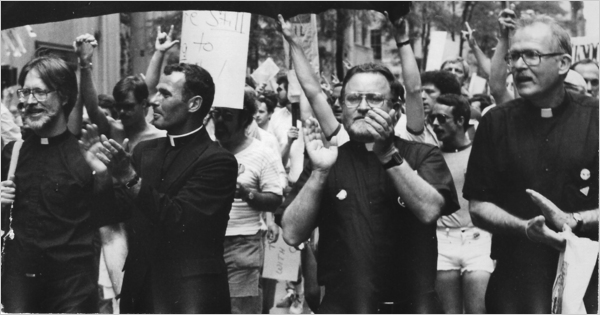
The Rev. Robert Carter, who in the early 1970s was one of the first Roman Catholic priests in the country to declare publicly that he was gay and who helped found the National Gay and Lesbian Task Force, died on Feb. 22 in the Bronx. He was 82.

[caption id="attachment_5493" align="aligncenter" width="600" caption="Robert Carter, right, with Dan McCarthy, left, Bernard Lynch and John McNeill at a gay pride march in the early 1980s"][/caption]

Monday, 15 March 2010

St Paulinus of Nola, Gay Bishop, Poet

Although some would dispute the description of Paulinus as 'gay', the description seems to me entirely appropriate to his sensibility. Although history records no evidence of physical expression of his same sex attraction, nor is there any evidence against it.  Given the historical context he was living in (4th/5th century Roman empire) , when sex with either gender was commonplace for men at at all levels of society, inside and outside the Christian church, the absence of written records of private activities after 15 centuries is completely unremarkable.  Nor is the fact that he was married particularly significant - for Romans, marriage and sex with men were entirely compatible. 


What is known is that he was passionately in love with a man, Ausonius, to whom he addressed exquisitely tender love poetry.   This is of sufficient quality and gay sensibility to be included in the Penguin book of homosexual verse:

"To Ausonius"

I, through all chances that are given to mortals,
And through all fates that be,
So long as this close prison shall contain me,
Yea, though a world shall sunder me and thee,

Thee shall I hold, in every fibre woven,
Not with dumb lips, nor with averted face
Shall I behold thee, in my mind embrace thee,
Instant and present, thou, in every place.

Yea, when the prison of this flesh is broken,
And from the earth I shall have gone my way,
Wheresoe'er in the wide universe I stay me,
There shall I bear thee, as I do today.

Think not the end, that from my body frees me,
Breaks and unshackles from my love to thee;
Triumphs the soul above its house in ruin,
Deathless, begot of immortality.

Still must she keep her senses and affections,
Hold them as dear as life itself to be,
Could she choose death, then might she choose forgetting:

Living, remembering, to eternity.

[trans. Helen Waddell, in Penguin Book of Homosexual Verse]

It is surely clear from the above that whatever his physical erotic activities, his sensibility was entirely what we would today call "Gay".  Paulinus'  feast day is on June 22nd.  It is fitting that we remember him, and the multitude of other LGBT saints in the long history of the church.

Further reading:

For more  online, see Paul Hansall's invaluable LGBT Catholic handbook, or the Catholic Encyclopedia. (Note though that the latter's entry on Paulinus is an excellent case study on how official Church history scrupulously edits out our LGBT history.  In a reasonably lengthy entry, Ausonius and the verses addressed to him are noted - but the essential facts that the relationship was passionate, or that the verses were clearly love poetry, are carefully filtered out.)

In print, see  John Boswell's "Christianity, Social Tolerance and Homosexuality", pp133 - 134.

Sunday, 27 December 2009

John the Evangelist. the "Beloved Disciple"

In the catalogue of "gay saints", or pairs of supposedly "gay lovers" in Scripture, the coupling of John the Evangelist (the "beloved disciple") and Jesus himself is surely the most controversial. Many people, including some of my friends from the LGBT Soho Masses, find the whole idea that this may have been a "gay", sexually active relationship, highly offensive. Others argue the opposite case.

In an explosive book, "The Man Jesus Loved", the reputable biblical scholar Theodore Jennings mounts an extended argument that Jesus himself was actually gay and that the beloved disciple of John's Gospel was Jesus' lover. To support this provocative conclusion, Jennings examines not only the texts that relate to the beloved disciple but also the story of the centurion's servant boy and the texts that show Jesus' rather negative attitude toward the traditional family: not mother and brothers, but those who do the will of God, are family to Jesus. Jennings suggests that Jesus relatives and disciples knew he was gay, and that, despite the efforts of the early Church to downplay this "dangerous memory" about Jesus, a lot of clues remains in the Gospels. Piecing the clues together, Jennings suggests not only that Jesus was very open to homosexuality, but that he himself was probably in an intimate, and probably sexual, relationship with the beloved disciple.

-Daniel Helminiak, Sex and the Sacred


I find Jennings' argument (as summarised by Helminiak) fascinating, and look forward to reading the full exposition, and other views. Personally, I agree that Jesus was certainly "queer", in the sense that he was plainly a sexual non-conformist who did not conform to the social expectations of the time. It must be true that, as "fully human", he must have experienced sexual feelings. Even in Jewish society, if he had indeed given expression to these with another man, this would not have been exceptional: as long as he did not contravene that Leviticus prohibition on lying with a man "as with a woman" - i.e. with anal penetration. I also take it is true that he was clearly gay - friendly, as is clear from the story of the centurion, his words abut Eunuchs, and (possibly) his friendship with Martha Mary and Lazarus. So, to say Jesus and John were possibly sexually intimate lovers is to me not shocking, indeed possible - but also irrelevant.

The significance for us of John as "the disciple Jesus loved", goes way beyond the possibility of genital activity. Love is primarily an emotional relationship, not a physical one. The English language does us a disservice in using "lovemaking" as a euphemism for the physical act, even without any deep emotional significance. "Loving", in its full sense is more important than mere "lovemaking" as a physical act. In this sense, we know without any possible doubt that the words "whom Jesus loved" are true. How do we know it? Because they are true for all the disciples, as they are for each of us, and for all others.

One of the reasons I believe it is helpful to reflect on the saints is to see them as role models, that is, to try to imagine ourselves in their place, to try to follow their example. If we do this, actively imagining ourselves in the place of John, the beloved disciple, we may more easily see ourselves as we really are - beloved ourselves.

This is important fo all followers of Christ, but is even more important for us as lesbigaytrans Catholics and other Christians, who so often find ourselves under attack by those in the churches who really should know better. When we find ourselves under attack, on the receiving end of hate it is important to remember that this comes from human institutions, not from Christ himself - for whom we are all "the disciple(s) whom he loved."

There is one more reason to look to John as a role model. In addition to the beloved disciple, he is more widely recognized as an evangelist: and a very special evangelist. Now, evangelism is not just a task that ended with the writing of the Gospels, nor is it a task that we can leave to the missionaries and professional clergymen (or women). We all have a responsibility to assist in the evangelization process, spreading and interpreting God's word as proper to our circumstances. We should use the example of St John as inspiration to us to do just that. Now note more important feature. As an evangelist, John is the outsider. The other three wrote the synoptic Gospels, largely in narrative format, and largely agreeing with each other. John wrote something different, something more reflective and interpretative, not the "same old story" as the others. As gay men and lesbians, we too are outsiders. As outsiders, we necessarily see things a little differently, and it is not surprising that so many of us have made names as artists: in literature, music or visual arts. Artists are widely recognized as interpreters of society, so it is not far-fetched to see John in this sense as the "artist" among the evangelists. We do not need to see Jesus and John as being "gay lovers" to find value thinking of John, at least, as "gay", as the artist, the outsider.

If also, we find the idea of their (possible) physical lovemaking helpful to our own personal prayer life, that is good too. But if it does not lead to richer prayer, discard it as irrelevant.


Thursday, 3 December 2009

Not Dead Yet: St Sebastian as Role Model

Writing about St Joan of Arc recently I observed that she carries a particular importance for us as gay men, lesbians and transsexuals in the church, as her martyrdom at the hands of church authorities can be seen as a powerful metaphor for the persecution we receive from parts of the church, just for being honest about ourselves, for refusing to renounce our God-given identity. I've been thinking further along these lines, and in fact all the Christian martyrs can similarly seen as role models - although the others were not typically executed by the church itself. One martyr in particular has been closely identified as a gay (male) icon - St Sebastian.
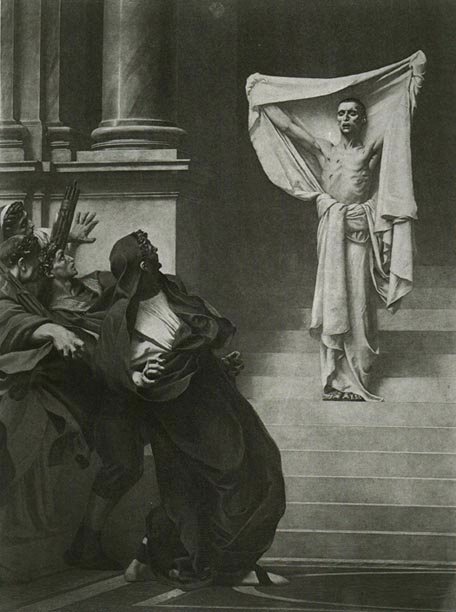
This is strictly speaking inappropriate, because there is not anything about Sebastian or his martyrdom that is particularly gay . The main reason quite frankly, that he has acquired this cult status is that painters for centuries have made striking images of his martyrdom, featuring half naked, desirable young men pierced with arrows: soft porn masquerading as inspirational religious art. ( The Independent newspaper has an excellent analysis, still available on-line, on just how this association developed through the art works.) Now, I have no problem with gay men enjoying pictures of St Sebastian, but have had some trouble seeing him as a specifically gay saint. However, I have come across one particular painting, quite different from the original, which immediately put me in mind of a concept I have written about before as a possible model for us in negotiating a proper relationship with the church. Here's the picture:


Gustave Rodolphe Boulanger, 1877

This is how I wrote about his death earlier this year:

Ordered to be executed, he was tied naked to a column and shot with arrows. Widely represented in art, it was not this, however, that killed him. He was left for dead, but was nursed back to life. After recovering, he intercepted the Emperor and denounced him for his cruelty to Christians. Enraged, the Emperor once again ordered his execution. This time, he was beaten to death, on 20th January 288. How many others have achieved martyrdom twice in one lifetime?

The image shows Sebastian pierced by arrows but "not dead yet", confronting the Emperor Maximilian after the first attempted execution.


So, what's the connection? Recall Michael B Kelly's concept of the walk back from Emmaus , the idea that as lesbigaytrans people in the Catholic church, we have a need, even an obligation, to walk away from the church - and hen to return , to confront the institutional leaders of the church with the reality of the risen Lord, and of his real message to the world. When I saw this image, I suddenly saw it as representing all queer people confronting the emperors of the church with the evidence of their attempted martyrdom. In spite of all the efforts of the ecclesiastical mechanism, through the misrepresentation of Scripture, the characterisation of us as "gravely "disordered, the active opposition in the political sphere to equal civic rights, and the failure to oppose criminalization, and hence the tacit support given to active bullying, violence and murder -- not to mention actual execution by burning at the stake, in earlier years- we too, are not dead yet.

Following the example of Sebastian, the challenge facing us to do more than simply mope about our pain, satisfied with mere survival. We too, must return to the church, showing them with the evidence of our pain-then negotiate with them a process of reconciliation.
For a look at some of the extraordinary range of representations os Sebastian in art, just look at the results of a Google Image search, or go to "Iconography of Saint Sebastian (painting)", which has an immense collection of links to art images, usefully arranged chronologically and by artist. I particularly like some of the images by 20th century artists, which seemed to me to go beyond the soppy sentimentality to something real and relevant. This one is startling - Sebastian as a self-portrait by a female artist. And why not?

Self-portrait As St Sebastian: Gaela Erwin


Tuesday, 24 November 2009

Epaminondas: Military Hero, Democrat, Cultiured Statesman. Gay.


Epaminondas lived before the Christian era, outside the Jewish tradition, and has no claim whatsoever to be treated as a “saints in any literal sense. However, taking the term much more loosely, including those we might consider as role models, he clearly fits the bill. If that doesn’t suit you, think of him as included in the “others” of my title.

Together with his lover Pelopidas, Epaminondas was one of the celebrated “Sacred Band of Thebes”, a military company of 150 pairs of lovers. That’s right, an army band where it was compulsory to be gay – and partnered. We usually think of the Spartans as the most military of the Greek cities, and with good reason. While Athens (and some other cities following them) valued democracy, philosophy and intellectual life generally, young Spartans were educated for one thing only – war. After Sparta had convincingly beaten Athens and her allies in the Peloponnesian War, the victors extinguished democracy in the vanquished cities, and placed their allies in command as local despots.
In the case of Thebes, they met strong resistance from the defenders of democracy, in the form of the band of male lovers. Founded initially by Georgidas, on the principle that men never fight more bravely than when fighting to protect and support their loved ones alongside them, the founding proposition was soon confirmed. In their first engagement with the Spartan enemy, victors in the recent Peloponnesian war, the new company of Theban lovers overcame a Spartan army of two to three times their number, and were able to reinstate democracy in their city.
Epaminondaswas initially somewhat hidden in the shadow of his friend Pelopidas, who succeeded Georgidas as leader just a year after the band was founded. Together, they won many famous victories. Later, overshadowing his friend, he found the more enduring fame, and for many notable qualities beyond his illustrious military career.
After assisting in the re-establishment of democracy in Thebes, he developed a career as an orator and statesman as well as a soldier. Although he was instrumental in defeating Sparta in establishing Thebes as the dominant geek power, he refused to use this power to to subject other cities to Theban domination and pillage, so that he was known as a military liberator, not a conqueror. Many scholars have described him as Greece’s greatest warrior-statesman. Diodorus Siculus wrote that he excelled all the others in valour and military shrewdness – but also in “eloquence of speech, elevation of mind, contempt of lucre, and fairness…”.
The Romans also admired him, although less enthusiastic about his cultural achievements. Cornelius Nepos included him in his Book o Great Commanders, but found it necessary to excuse his reputation as a musician and dancer on the grounds that the Greeks had a fondness for these pursuits. He “praises without reservation Epaminondas’ intellectual and athletic prowess, and finds he meets roman standards of temperance, prudence and seriousness….. and was such a lover of truth that he never lied, even in jest.” .
He died in 362, in a battle which once again defeated the Spartans, but also ended Epaminondas’ own life.
This could be my kind of guy – accomplished, virtuous, a democrat and liberator – and good-looking. Except that he lived about two millennia too soon, he could easily be seen as a great Renaissance man. My only objection? Surely he’s just too good to be true. Yet this is the picture that comes down to us from the ancients.
And to think that men of this calibre are not permitted to serve openly in the US army.
(Source: The material above condenses a passage from “Homosexuality & Civilization” by Louis Crompton, which makes an excellent and stimulating introduction to the history of homosexuality.)

Friday, 20 November 2009

Trans Martyrs

Today, November 20th, is the 9th annual day of Remembrance, a day set aside in memory of trans people who have been murdered for their honest expression of their gender identity. (Thanks, here, to Kittredge Cheery, who alerted me to this at Jesus in Love blog). I am certain that there will be other bloggers out there in the wider queer community who will be writing about the well-known examples, most of whom are modern Americans. I will leave these to the other writers, who for many reasons are closer to the subject than I. Instead, I want to look at the memory of trans saints in Catholic and Orthodox tradition. By definition, those who die for their faith are known as “martyrs”, from the Greek for “to bear witness”. In this extended sense, one can give witness, and thus be a “martyr” without undergoing actual death – but given the courage it must take to live publicly a trans identity, I suggest that all openly trans people, of whatever form, are constantly giving witness, and are in a sense living martyrs, so we should also recognise and honour the living, courageous trans people around us, and in he wider world.
I start with Joan of Arc, visionary, cross-dressing military hero, burned as a heretic, and now a recognized martyr and canonized saint, who is remembered annually on My 30th. (note that although burned as a “heretic”, the words for heresy and sodomy were often used interchangeably at that time. Some scholars believe that the specific heresy for which she was accused and sentenced was precisely her cross-dressing.

Then there are a lengthy list of cross-dressing women .saints, who passed as men in order to be admitted to male monasteries. Their stories are eclectic not always agreed. Some are accepted by the Eastern Orthodox church, but no the Western Romans, some are frankly fanciful, with little relation tot eh historical record. I have no desire here to encourage any kind of cult of the saints, with invocations to saints as some kind of pseudo-magical ritual to guarantee the granting of wishes. Some of them too, have become cross-dressers not out of some deep-seated gender conflict that needed to be resolved, but simply to gain access to institutions that would otherwise have rejected them. Why then, do I suggest we pay them any attention at all? Simply because, in the very presence in church records, they show that in times past the church was willing to recognise and pay honour to a group of people who set aside standard gender expectations to live a life of their own choosing. There is also a lesson here for the rest of us: when these people recognised that as women they were seen as second class-citizens in the eyes of the chruch, they indulged in a little trickery to claim a place that they saw as rightfully theirs. For us today, as queer Catholics or other Christians, we too are often seen as second class, not to be properly accepted in the main body of the Church. Perhaps, as Virginia Mollenkott recommends, we also need to becomes God’s Tricksters.
Here are some of the monastic transvestites:

St Apollinaria / Dorotheos, Jan 5th /6th (4th?)
icon-of-appolinaria
St Mary /Marinos the monk.
“She was the daughter of a wealthy Christian, Paphnutius, who with his wife brought up Euphrosyne in piety. Not wishing to marry, she secretly fled her home and its wealth, dressed herself in men's clothing and entered a monastery using the name of Smaragdus. There she lived in asceticism for thirty-eight years. She only revealed her identity on her death bed. Her father Paphnutius became a monk in the same monastery, and entered into repose ten years after his daughter. “
St Theodora / Theodorus of Alexandria Sep 11th
“While a young married woman, she committed adultery with another man. Seized by remorse, she fled her husband's house, dressed herself as a man, renamed herself Theodore, and entered a men's monastery, pretending to be a eunuch. "Theodore"'s fasts, prayers, vigils and tears amazed "his" brethren. Her secret was only discovered after her death. She had spent nine full years devoting her life to repentance for one sin. During her life she showed herself to be a wonderworker, taming wild beasts and healing sicknesses. Her husband came to her funeral, then lived until his death in the cell of his former wife.”
St Eugenia / Eugenios of Alexandria Dec 24th
“This Martyr was the daughter of most distinguished and noble parents named Philip and Claudia. Philip, a Prefect of Rome, moved to Alexandria with his family. In Alexandria, Eugenia had the occasion to learn the Christian Faith, in particular when she encountered the Epistles of Saint Paul, the reading of which filled her with compunction and showed her clearly the vanity of the world. Secretly taking two of her servants, Protas and Hyacinth, she departed from Alexandria by night. Disguised as a man, she called herself Eugene [Eugenios -ed.] while pretending to be a eunuch, and departed with her servants and took up the monastic life in a monastery of men. Her parents mourned for her, but could not find her. After Saint Eugenia had laboured for some time in the monastic life, a certain woman named Melanthia, thinking Eugene to be a monk, conceived lust and constrained Eugenia to comply with her desire; when Eugenia refused, Melanthia slandered Eugenia to the Prefect as having done insult to her honour. Eugenia was brought before the Prefect, her own father Philip, and revealed to him both that she was innocent of the accusations, and that she was his own daughter. Through this, Philip became a Christian; he was afterwards beheaded at Alexandria. Eugenia was taken back to Rome with Protas and Hyacinth. All three of them ended their life in martyrdom in the years of Commodus, who reigned from 180 to 192.”
( Remember also Protus & Hyacinthus, eunuch slaves of Eugenia, who were martyred alongside her.)
“She was from Perga in Pamphylia, and married very young, to a youth named Domitian, to whom she bore a daughter. The couple settled in Constantinople. Matrona became so constant in attending all-night vigils in the city's many churches that her husband suspected her of infidelity and forbade her to go out. This was unbearable to Matrona, who fled the house with her daughter. Determined to embrace monastic life, she gave her daughter into the care of a nun named Susanna, disguised herself as a eunuch, and entered the monastery of St Bassian (October 10) under the name of Babylas.”
(Later, she was found to be female, and was forced to leave the monastery – but instead was helped to form a women’s counterpart, and founded a strong community of monastic women
A bearded woman saint, also known as St. Liverade (France), Liberata (Italy), Liberada (Spain), Debarras (Beauvais), Ohnkummer (Germany), and Ontcommere (Flanders)
She was represented as a bearded women on a cross
This one, to be fair, has limited historical validity, but is fun to remember all the same. The legend ahs it that she was a woman, sworn to holy virginity, who grew a beard to avoid being forced into the marriage her father had arranged for her. Furious, he had her killed, so that she is remembered as the crucified bearded lady. History suggests, however, that the legend is based on some very simple errors of interpretation.
And Others:
  • St Mary / Marinos of Alexandria Feb 12th
  • St Hildegonde of Neuss near Cologne April 20th, A nun who lived under the name "Brother Joseph" in the Cistercian monastery of Schoenau near Heidelberg
  • St. Anastasia the Patrician (or "of Constantinople") , May 10th
  • St Pelagia / Pelagios June 9
  • St Marina /Marinos of Antioch, July 17th
  • St Marina of Sicily July 20th
  • St Thekla of Iconium Sept 23rd
  • St Athanasia of Antioch Oct 9th
  • St. Anna/Euphemianos of Constantinople, , Oct 29th

Wednesday, 18 November 2009

St. Aelred of Rievaulx, Abbot 12/01

St Aelred, is recognised in all sources as an important English saint, who lived in the north of England in the 12 C. As a young man, he joined the Cistercian abbey of Rievaulx, later returning there as Abbott. He is remembered especially for his writings on friendship, some of which have led gay writers such as John Boswell to claim him as ‘homosexual’. For instances, Integrity USA, an Anglican LGBT organisation, have designated him as their patron.

St Aelred, is recognised in all sources as an important English saint, who lived in the north of England in the 12 C. As a young man, he joined the Cistercian abbey of Rievaulx, later returning there as Abbott. He is remembered especially for his writings on friendship, some of which have led gay writers such as John Boswell to claim him as ‘homosexual’. For instances, Integrity USA, an Anglican LGBT organisation, have designated him as their patron.

Others point to his work as insisting on chastity, and believe that his well-recognised male friendships were entirely non-sexual. Whatever the genital truth, we should remember and honour Aelred as a reminder of the important place of intimate (emotionally, if not sexually) relationships between same-sex couples in the history of the church.

From the Calendar of LGBT Saints:

How Aelred Made it to the American Book of Common Prayer
by Louie Crew, founder of Integrity, [email: lcrew@ANDROMEDA.RUTGERS.EDU]

Aelred was not in ECUSA's calendar until a Roman Catholic head of history at Yale, John Boswell, wrote about him powerfully in his book Christianity, Social Tolerance and Homosexuality Boswell dwelt at length with the lesbigay positive evidence. That spurred Integrity member, the late Howard Galley, one of the major architects of the 1976 Prayer Book, to initiate the actions which finally led to Aelred's inclusion: using Aelred's own texts, Galley shaped the readings which appear in THE LESSER FEASTS AND FASTS, including this collect:

Pour into our hearts, O God, the Holy Spirit's gift of love, that we, clasping each the other's hand, may share the joy of friendship, human and divine, and with your servant Aelred, draw many to your community of love; through Jesus Christ the Righteous, who livers and reigns with you, in the unity of the Holy Spirit, one God, now and forever. AMEN

Select bibliography (From the Calendar of LGBT Saints)

Catholic Encyclopedia - entry on Aelred (available online)

Aelred of Rievaulx, Spiritual Friendship, trans. Mary Eugenia Laker, (Kalamazoo MI: Cistercian Publications 1977), see esp. p. 21 on Aelred's homosexual attractions.

Boswell, John, CSTH, 221-20

McGuire, Brian P, "Monastic Friendship and Toleration ", in Monks, Hermits and the Ascetic Traditions, Studies in Church History 22, ed. W.J. Shiels, (Oxford: Basil Blackwell, 1985) pp. 147-160

McGuire, Brian P, "Looking Back on Friendship: Medieval Experience and Modern Context", Cistercian Studies 21:2 (1986), pp. 123-142

McGuire, Brian P., Brother and Lover: Aelred of Rievaulx, (New York: Crossroad, 1994)
In his earlier articles, McGuire, the foremost expert on early Cistercian bonding, professed to find explanations of Aelred as homosexual as "one-dimensional", but in this book he more forthrightly identifies Aelred as homosexual.

McGuire, Brian Patrick, "Sexual Awareness and Identity in Aelred of Rievulx (1110-67)", American Benedictine Review 45(1994): 184-226
This probably the best work of its kind out on Aelred. It is the most comprehensive, and actually covers more ground than
Brother & Lover.

Russell, Kenneth C., "Aelred, the Gay Abbot of Rievaulx", Studia Mystica 5:4 (Winter 1982), 51-64